On eBird ↗
Eastern Red-rumped Swallow
Live sightings near you, the range map, bar charts of when it is seen, and Macaulay Library photos and recordings.
Eastern Red-rumped Swallow
Cecropis daurica
The eastern red-rumped swallow (Cecropis daurica) is a small passerine bird in the swallow family Hirundinidae. It is found in open, often hilly, areas with clearings and cultivation across eastern and southeastern Asia to north-eastern India and Taiwan.
The European red-rumped swallow and the African red-rumped swallow were formerly considered as subspecies of the eastern red-rumped swallow.
From the article Eastern red-rumped swallow on Wikipedia (CC BY-SA), quoted section by section
Description
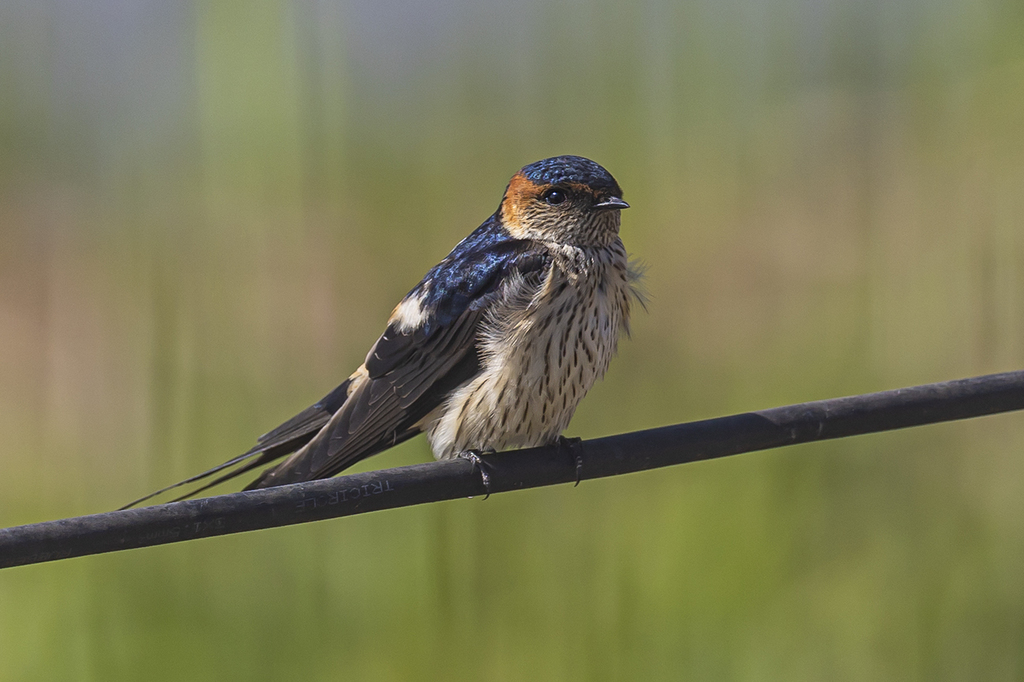
The eastern red-rumped swallow is 19 cm long with a deeply forked tail. It has blue upperparts other than a reddish collar (sometimes absent) and streaked chestnut rump. The face and underparts are white with heavy dark streaking. The wings are brown. The sexes are alike but juveniles are duller and browner, with a paler rump and shorter outer tail feathers. The population in mainland India, C. d. erythropygia, has the rump patch uniform dark chestnut without any dark shaft-streaks. The tail fork is shallow and the white patch on the inner web of the outer-tail feathers is indistinct. C. d. japonica breeds in eastern Asia and winters in Thailand, Burma, India and northern Australia. They are heavily streaked on the underside and have faint streaks on the rump. The population along the Himalayas, C. d. nipalensis, migrates to peninsular India in winter and breeds from Kulu in the west to Bhutan and Arunachal Pradesh in the east. This population has the rump paler with dark shaft streaks.
What it does
The contact call is pin, the alarm is chi-chi-chi, and the song is a soft twittering.
Migration. The nominate subspecies C. d. daurica and the northeast Asian C. d. japonica are long-distance migrants, wintering in Indonesia and Malaysia, and even northern Australia in small numbers. The southern and island subspecies are essentially resident, while the continental races C. d. mayri and C. d. stanfordi are partial migrants which move south in the winter.
Breeding. The eastern red-rumped swallow breeds from April to July alone or semi-colonially with scattered nests. The nest is a retort or bottle-shaped structure, made from mud pellets and lined with dried grasses and feathers. The clutch is usually four, sometimes five, white eggs. Both sexes build the nest, and share incubation and the care of the young. Nests are constructed in natural caves, but very often in artificial sites on bridges, in culverts and on buildings.
Feeding. The eastern red-rumped swallow feeds low over the ground or at cliff faces on flying insects. It has a slow buoyant flight compared to the barn swallow. It will feed with other swallow species.
Wikipedia: “Behaviour”
Listen
Looking for field recordings…
Where it lives
Recorded sightings
—
geo-referenced records in GBIF, from museums, herbaria and field observers.
Drag the globe to turn it. Dots are where records exist, not a range map; darker means more records.
In the stacks
Searching the stacks…
Every page naming Cecropis daurica in the Biodiversity Heritage Library →
This page is assembled live from iNaturalist, GBIF, Wikipedia, the Source Library and the Internet Archive. It is not yet part of the hand-edited codex. iNaturalist taxon 144792.