On eBird ↗
Mexican Jay
Live sightings near you, the range map, bar charts of when it is seen, and Macaulay Library photos and recordings.
Mexican Jay
Aphelocoma wollweberi
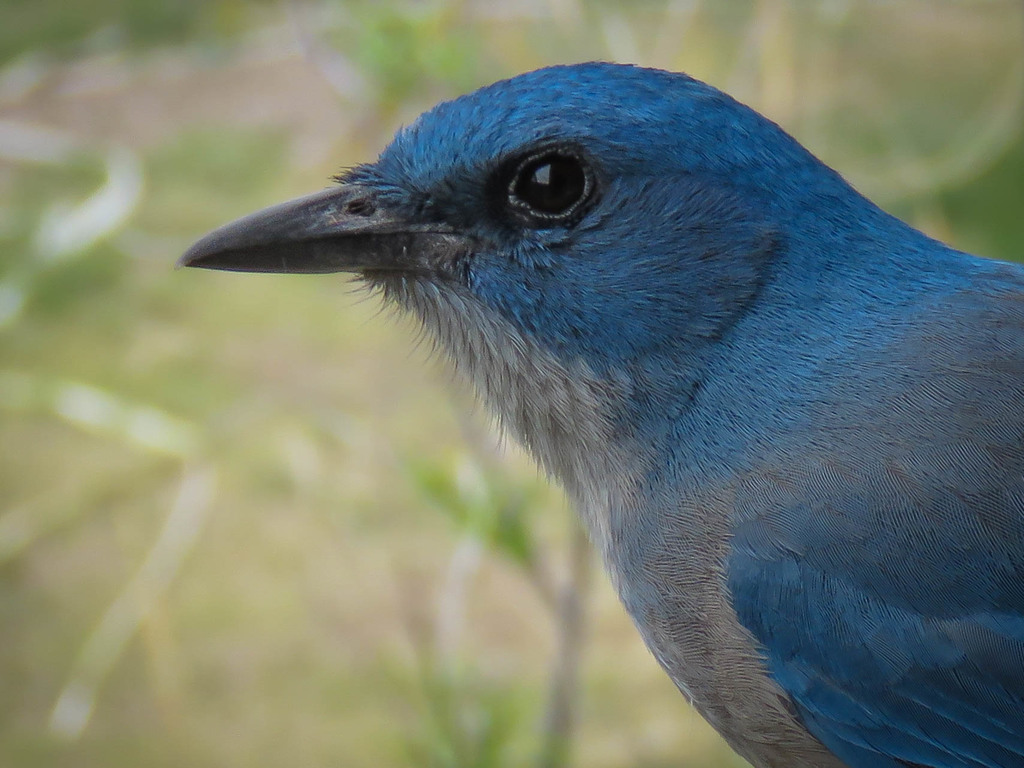
The Mexican jay (Aphelocoma wollweberi) formerly known as the gray-breasted jay, is a New World jay native to the Sierra Madre Oriental, Sierra Madre Occidental, and Central Plateau of Mexico and parts of the southwestern United States. In May 2011, the American Ornithologists' Union voted to split the Mexican jay into two species, one retaining the common name Mexican jay and one called the Transvolcanic jay. The Mexican jay is a medium-sized jay with blue upper parts and pale gray underparts. It resembles the Woodhouse's scrub-jay, but has an unstreaked throat and breast. It feeds largely on acorns and pine nuts, but includes many other plant and animal foods in its diet. It has a cooperative breeding system where the parents are assisted by other birds to raise their young. This is a common species with a wide range and the International Union for Conservation of Nature has rated its conservation status as being of "least concern".
From the article Mexican jay on Wikipedia (CC BY-SA), quoted section by section
Description
The Mexican jay is a medium-large (~120 g) passerine similar in size to most other jays, with a blue head, blue-gray mantle, blue wings and tail, and pale gray breast and underparts. The sexes are morphologically similar, and juveniles differ only in having less blue coloration and, in some populations, a pink/pale (instead of black) bill that progressively becomes more black with age (Brown and Horvath 1989). Some field guides misreport this color as yellow because the pale bill becomes yellow in museum study skins. The iris is brown and legs are black. It is most readily distinguished from the similar Woodhouse's scrub-jay by the plain (unstreaked) throat and breast, and the mantle contrasting less with the head and wings. Its range somewhat overlaps with the Woodhouse's scrub-jay, but, where they co-occur, the two species seem to show ecological and morphological character displacement (Curry et al. 2002).
Range & habitat
It is native to the Sierra Madre Oriental, Sierra Madre Occidental, and Central Plateau of Mexico as well as eastern Arizona, western New Mexico and western Texas in the United States. Its preferred habitat is montane pine-oak forest.
Wikipedia: “Distribution and habitat”
What it does
In the winter, the Mexican jay's diet consists mainly of acorns and pine nuts, which are stored in the autumn. However, they are omnivorous in all seasons and their diet includes a wide variety of plant and animal matter, including invertebrates, small amphibians and reptiles, and birds' eggs and nestlings (McCormack and Brown 2008). It has a cooperative breeding system similar to that of the related Florida scrub-jay, with several birds helping at a nest; these "helpers" are usually immature offspring of the dominant pair from the previous 1–2 years, but also include apparently unrelated flock members.
Wikipedia: “Ecology”
Listen
Looking for field recordings…
Where it lives
Recorded sightings
—
geo-referenced records in GBIF, from museums, herbaria and field observers.
Drag the globe to turn it. Dots are where records exist, not a range map; darker means more records.
In the stacks
Searching the stacks…
Every page naming Aphelocoma wollweberi in the Biodiversity Heritage Library →
This page is assembled live from iNaturalist, GBIF, Wikipedia, the Source Library and the Internet Archive. It is not yet part of the hand-edited codex. iNaturalist taxon 144207.