- Plants
- ›Vascular Plants
- ›flowering plants
- ›Dicots
- ›Heathers, Balsams, Primroses, and Allies
- ›diapensia family
- ›Diapensia
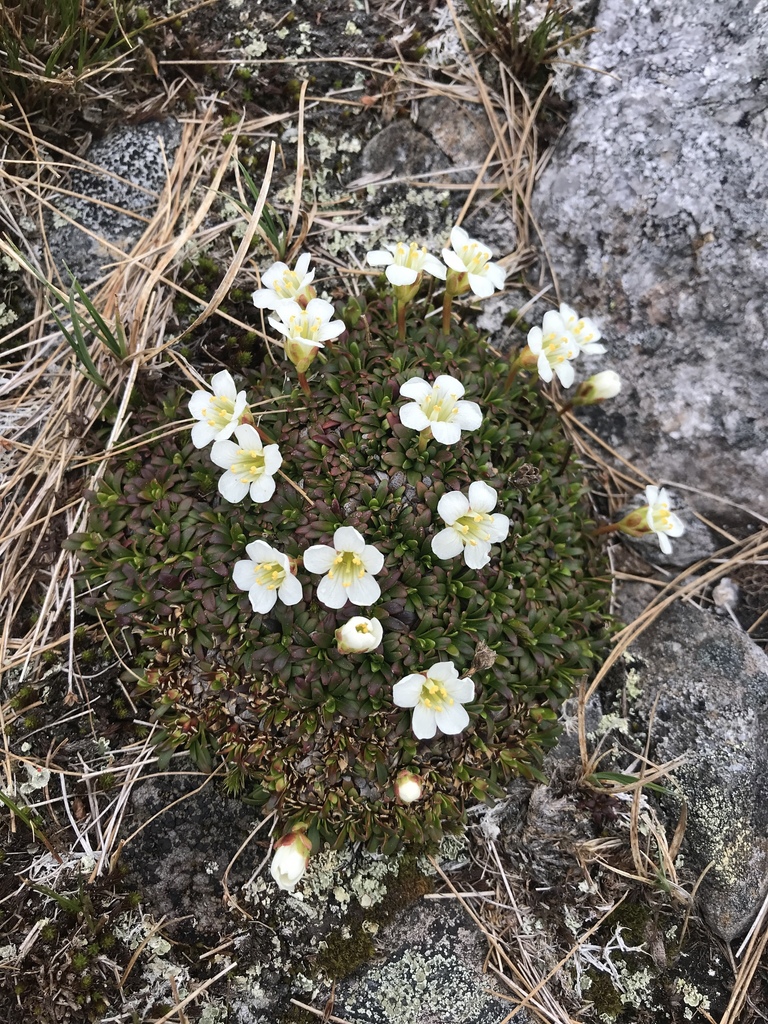
Diapensia
Diapensia lapponica
Diapensia lapponica, the pincushion plant, is a plant in the family Diapensiaceae, the only circumboreal species in the genus Diapensia, the others being mainly in the Himalaya and on mountains in southwestern China. This species likely became circumboreal-circumpolar [Arctic–alpine] after it jumped to arctic habitat from North China and Russia. The most likely candidate for ancestor is a white-flowered D. purpurea The plants grow on exposed rocky ridges that are kept free from snow by high winds.
Diapensia lapponica is extremely slow and low-growing and cannot compete with plants that overtop it. The plant is very sensitive to higher temperatures and so is often in misty foggy habitat. It usually dies when transplanted to lowland gardens and so this is not recommended. Cold-treated or wild and winter-collected seed will germinate indoors. The seed and leaves are high in lipids.
From the article Diapensia lapponica on Wikipedia (CC BY-SA), quoted section by section
In human culture
The name Diapensia lapponica was given by Linnaeus to designate a flower found in Lapland (Lapponia > adj. lapponicus), where he traveled early in his career. Linnaeus's book about the flora of Lapland has been called "the first proto-modern flora". However, sources disagree on how Linnaeus might have derived the genus name, Diapensia. Gray states that the term was derived from the ancient Greek name of the sanicle, a very different looking flower, and opined that the term was "of obscure meaning [and] strangely applied . . . to this boreal plant." Webster's also reflects uncertainty stating the term is "New Latin, perhaps irregular from Greek dia pente by fives + New Latin -ia; from the five-leaved calyx", a description that would apply to thousands of flowering plants. The Encyclopaedia Londinensis of John Wilkes suggested that term is from Greek,"deeply grieving or mourning; probably from its situation".
Wikipedia: “Etymology”
Where it lives
Recorded sightings
—
geo-referenced records in GBIF, from museums, herbaria and field observers.
Drag the globe to turn it. Dots are where records exist, not a range map; darker means more records.
In the old herbals & bestiaries

The Great Herbary with all the figures of the herbs
1532 · p.134

Commentaries on the Six Books of Dioscorides
Pietro Andrea Mattioli · 1560 · p.670

Commentaries on the Six Books of Dioscorides on Medical Matter
Pietro Andrea Mattioli · 1563 · p.615

Discourses on the Six Books of Dioscorides
Dioscorides; Pietro Andrea Mattioli (comm.) · 1568 · p.1255
In the stacks
Searching the stacks…
Every page naming Diapensia lapponica in the Biodiversity Heritage Library →
This page is assembled live from iNaturalist, GBIF, Wikipedia, the Source Library and the Internet Archive. It is not yet part of the hand-edited codex. iNaturalist taxon 144183.