- Plants
- ›Vascular Plants
- ›flowering plants
- ›Dicots
- ›Gentians, Dogbanes, Madders, and Allies
- ›madder family
- ›Ixoroideae
- ›Gardenieae
- ›Adenorandia
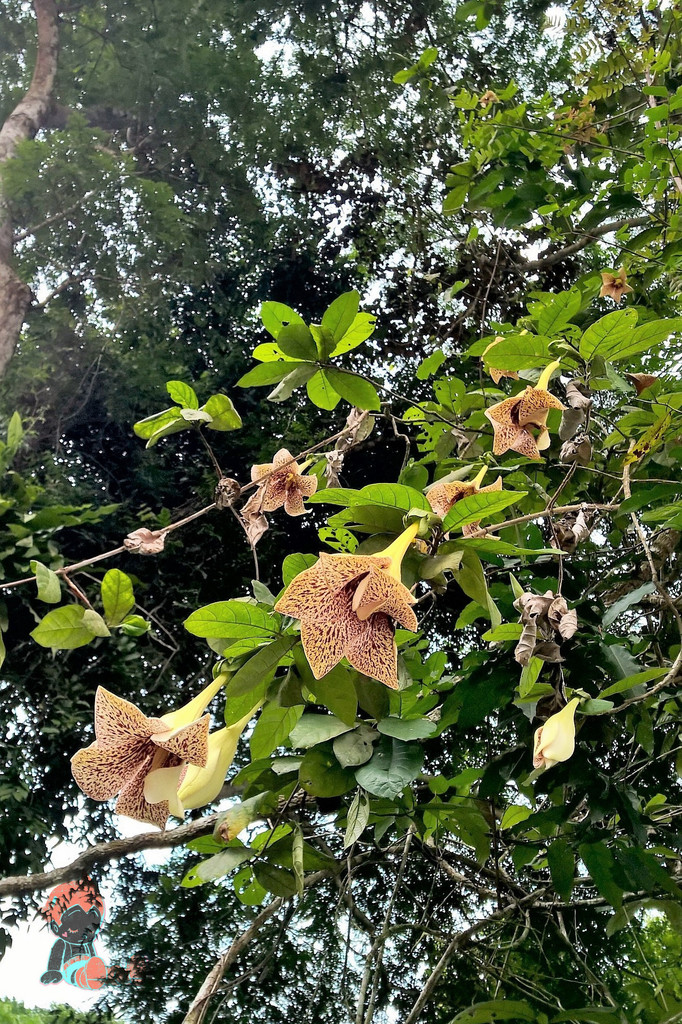
Adenorandia kalbreyeri
Adenorandia is a monotypic genus of flowering plants in the family Rubiaceae. It was described by Vermoesen in 1922. The genus contains only one species, viz. Adenorandia kalbreyeri, which is found from west-central tropical Africa.
From the article Adenorandia on Wikipedia (CC BY-SA), quoted section by section
Description
Scandent shrub or liana with stems over 6 m long. Leaves opposite, simple and entire; stipules 4–10 mm long, usually falling off; petiole 3–12 mm long; blade obovate, 7–24 cm × 4–10 cm, base cuneate to truncate, apex acuminate, pubescent below, pinnately veined with lateral veins in 8–15 pairs. Flowers solitary, terminal on lateral branches, bisexual, regular, 5-merous, very fragrant; pedicel up to 1 cm long; calyx tubular, 2–4 cm long, widening at apex with ovate-lanceolate lobes up to 2.5 cm × 1.5 cm, densely pubescent; corolla tubular, tube 10–16 cm long, lobes ovate to lanceolate, 4–8 cm × 2–4.5 cm, white, yellowish or greenish with red-purple streaks inside, pubescent; stamens inserted in the upper part of the corolla tube, sessile, anthers up to 3 cm × 3 mm; ovary inferior, 1-celled, style with glabrous columnar basal part and pubescent ellipsoid upper part up to 3 cm × 1 cm, shortly 2-lobed at apex. Fruit a leathery, almost globose berry up to 8 cm × 6 cm, with 10–12 longitudinal grooves and more or less persistent calyx tube, many-seeded. Seeds discoid.
Range & habitat
Adenorandia kalbreyeri is known from Ivory Coast, Nigeria, Cameroon, Gabon, Republic of the Congo, Democratic Republic of the Congo, and the Cabinda Province of Angola. It occurs in primary as well as secondary rain forest, often in forest edges, also in secondary regrowth in abandoned cultivation areas.
Wikipedia: “Distribution and habitat”
How it is grown
A blue fluid is extracted from the fruit of Adenorandia kalbreyeri, which acts as a black cosmetic and as a tattoo dye. The plant has a high ornamental value as a climber with fragrant lily-like flowers.
Wikipedia: “Cultivation and use”
Where it lives
Recorded sightings
—
geo-referenced records in GBIF, from museums, herbaria and field observers.
Drag the globe to turn it. Dots are where records exist, not a range map; darker means more records.
In the stacks
Searching the stacks…
Every page naming Adenorandia kalbreyeri in the Biodiversity Heritage Library →
This page is assembled live from iNaturalist, GBIF, Wikipedia, the Source Library and the Internet Archive. It is not yet part of the hand-edited codex. iNaturalist taxon 1441776.