 NL·0632
Herbarium of the Nature Library
- Name
- Pitta brachyura
- Family
- Pittidae
- Native to
- Breeds in the Himalayan foothills (from NE Pakistan to Nepal), central and western India; winters in peninsular India and Sri Lanka
- Habitat
- Deciduous forest, Scrub forest, Gardens
On eBird ↗
Indian Pitta
Live sightings near you, the range map, bar charts of when it is seen, and Macaulay Library photos and recordings.
Indian pitta
Pitta brachyura
Also calledNavrang / Naurang (Hindi/Urdu; 'nine colours') · Yìndù bāsè dōng 印度八色鸫 (Chinese)
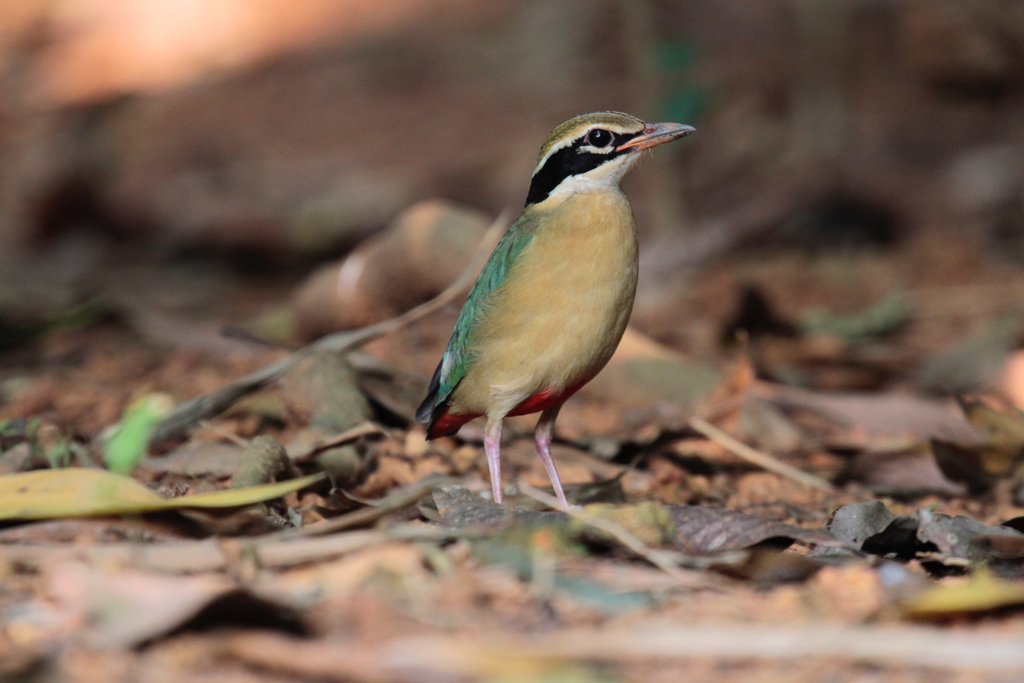
A plump, short-tailed ground bird painted green, sky-blue, buff, black and scarlet, which hops on the forest floor turning over leaves. It migrates within the subcontinent, arriving in northern forests with the monsoon to breed.
The Indian pitta also known as Navrang, is a passerine bird native to the Indian subcontinent. It inhabits scrub jungle, deciduous and dense evergreen forest. It breeds in the forests of the Himalayas, hills of central and western India, and migrates to other parts of the peninsula in winter. Although very colourful, it is usually shy and hidden in the undergrowth where it picks insects on the forest floor. It has a distinctive two note whistling call which is heard at dawn and dusk. It is listed as least concern on the IUCN Red List as the population is considered large. Wikipedia
What it can do
- iMigrates at night within South Asia and is sometimes found exhausted in towns
- iiFlicks dead leaves aside with its bill to expose insects and worms
- iiiBuilds a large domed nest of twigs and leaves on or near the ground
In the field
Field marks
- aStocky, almost tailless bird with long legs
- bBright green back, shining blue patch on the wing and rump
- cBuff underparts with a scarlet-crimson belly and vent
- dBold black eye-stripe with white above, and a buff crown stripe
- Voice
- A loud, clear, two-note whistle 'wheet-tew', given mostly at dawn and dusk
- Not to be confused with
- Hooded pitta (NE India, Southeast Asia) has a black head with a chestnut crown and no white supercilium; Blue-winged pitta has a darker head and more blue in the wing.
- Where to see it
- Breeding forests of Uttarakhand, Madhya Pradesh and Maharashtra; wintering in Sri Lanka's dry zone and the Western Ghats; occasionally Margalla Hills, Pakistan
- When
- Summer (monsoon) breeder in the north (May–Sep); winter visitor in the south and Sri Lanka (Oct–Apr)
Listen
Looking for field recordings…
Life & habits
- Diet
- Insects, earthworms, snails and other ground invertebrates
- Habitat
- Deciduous and evergreen forest undergrowth, scrub jungle, well-vegetated gardens
- Size
- About 15–19 cm long
Mostly silent and secretive, but calls loudly at dawn and dusk, often from a tree perch in the breeding season.
Where it lives
Recorded sightings
—
geo-referenced records in GBIF, from museums, herbaria and field observers.
Native range
Breeds in the Himalayan foothills (from NE Pakistan to Nepal), central and western India; winters in peninsular India and Sri Lanka
Drag the globe to turn it. Dots are where records exist, not a range map; darker means more records.
In the stacks
Searching the stacks…
Every page naming Pitta brachyura in the Biodiversity Heritage Library →
Marginalia
Its folk name navrang, 'nine colours', is used across north India for a bird whose plumage seems to hold every colour of the forest.
Curiosity
Migrating Indian pittas regularly turn up in cities in southern India and Sri Lanka after striking buildings during their night flights.
Kinship



Photographs: iNaturalist contributors under the licences shown. Records: GBIF.org. Historical plates: Source Library (CC BY-SA 4.0; originals public domain). Summary text: Nature Library editors and Wikipedia (CC BY-SA). Medicinal and edibility notes are historical and educational, not advice. iNaturalist taxon 14388.