On eBird ↗
Eastern Shrike-tit
Live sightings near you, the range map, bar charts of when it is seen, and Macaulay Library photos and recordings.
Eastern Shriketit
Falcunculus frontatus
The eastern shriketit (Falcunculus frontatus) is a species of passerine bird in the family Falcunculidae. It is also known as bark tit, crested tit or yellow-bellied tit.
It is found in south-eastern Australia from the southeast of South Australia, throughout Victoria, eastern New South Wales to southeastern Queensland, with some scattered occurrences further north and west in Queensland.
From the article Eastern shriketit on Wikipedia (CC BY-SA), quoted section by section
Description
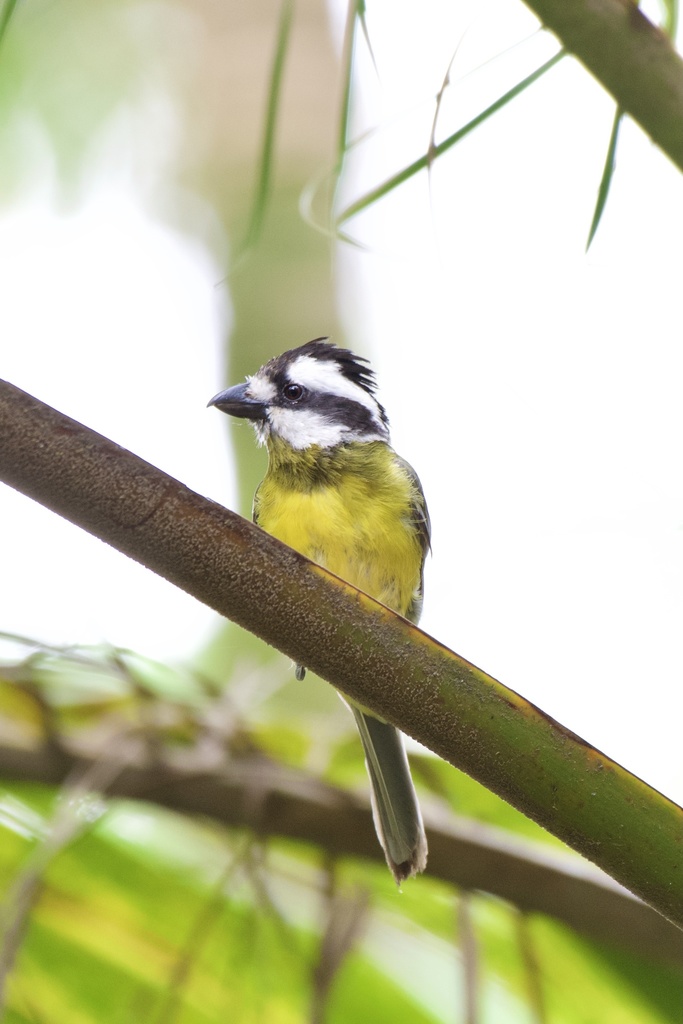
The eastern shriketit is 15–19 cm (5.9–7.5 in) in overall length, with a wingspan of 24–29 cm (9.4–11.4 in). The males weigh 26.5–40 g (0.9–1.4 oz) and the females 23–33 g (0.8–1.2 oz). The eastern shriketit has a mantle, back and rump that are olive-brown to olive-green. The underparts are yellow. The head features broad white patches separated by a thick black eyeline with another black band running over the crown from the bill to the nape. The male has an erectable crest. It has a large bill with which to lever and strip bark. The throat of the male is black, whereas that of the female is olive-brown. Juveniles have a similar head pattern to adults but the throat, breast and belly are buffy-white, and the wings are browner.
Vocalisation. The call of the eastern shriketit is a weak, mellow and mournful whistle, sounding like whiert, whit-whit, wheeir. It also makes repeated stuttering or chuckling calls described as "knock-at-the-door", and can perfectly mimic many species within its habitat.
Similar species. The golden whistler (Pachycephala pectoralis) occupies a similar range and habitat to the eastern shriketit from which it is distinguished by a mostly black head, white throat with black breast-band, narrow bill and yellow plumage extending across the nape.
Range & habitat
The eastern shriketit is endemic to Australia. It is found in the Atherton Tablelands of tropical Queensland, southward through New South Wales and Victoria, including the Murray-Darling basin, to the Mount Lofty Ranges and Fleurieu Peninsula of South Australia. It is commonest in north-central and coastal Victoria and east of the Great Dividing Range in New South Wales; its presence in Queensland is more scattered. Its preferred habitat is the canopy of eucalypt forests and open woodlands, and to a lesser extent stands of mallee, cypress-pine, coastal tea-tree and banksia. It is also found in trees along rivers and occasionally in rainforests. It is sedentary or locally nomadic.
Wikipedia: “Distribution and habitat”
What it does
The eastern shriketit forages unobtrusively, either in pairs or small groups in the canopy of trees, levering up and tearing bark with its strong bill to reveal prey of spiders, beetles and insect larvae. As an avian example of tool-use, it has been observed holding a twig in its bill and poking it into a crevice to obtain concealed insects.
Wikipedia: “Feeding”
Listen
Looking for field recordings…
Where it lives
Recorded sightings
—
geo-referenced records in GBIF, from museums, herbaria and field observers.
Drag the globe to turn it. Dots are where records exist, not a range map; darker means more records.
In the stacks
Searching the stacks…
Every page naming Falcunculus frontatus in the Biodiversity Heritage Library →
This page is assembled live from iNaturalist, GBIF, Wikipedia, the Source Library and the Internet Archive. It is not yet part of the hand-edited codex. iNaturalist taxon 1435879.