- Plants
- ›Vascular Plants
- ›flowering plants
- ›Dicots
- ›Mints, Plantains, Olives, and Allies
- ›Mint Family
- ›Nepetoideae
- ›Mentheae
- ›Melissas and sages
- ›Salvia
- ›Glutinaria
- ›Glutinaria
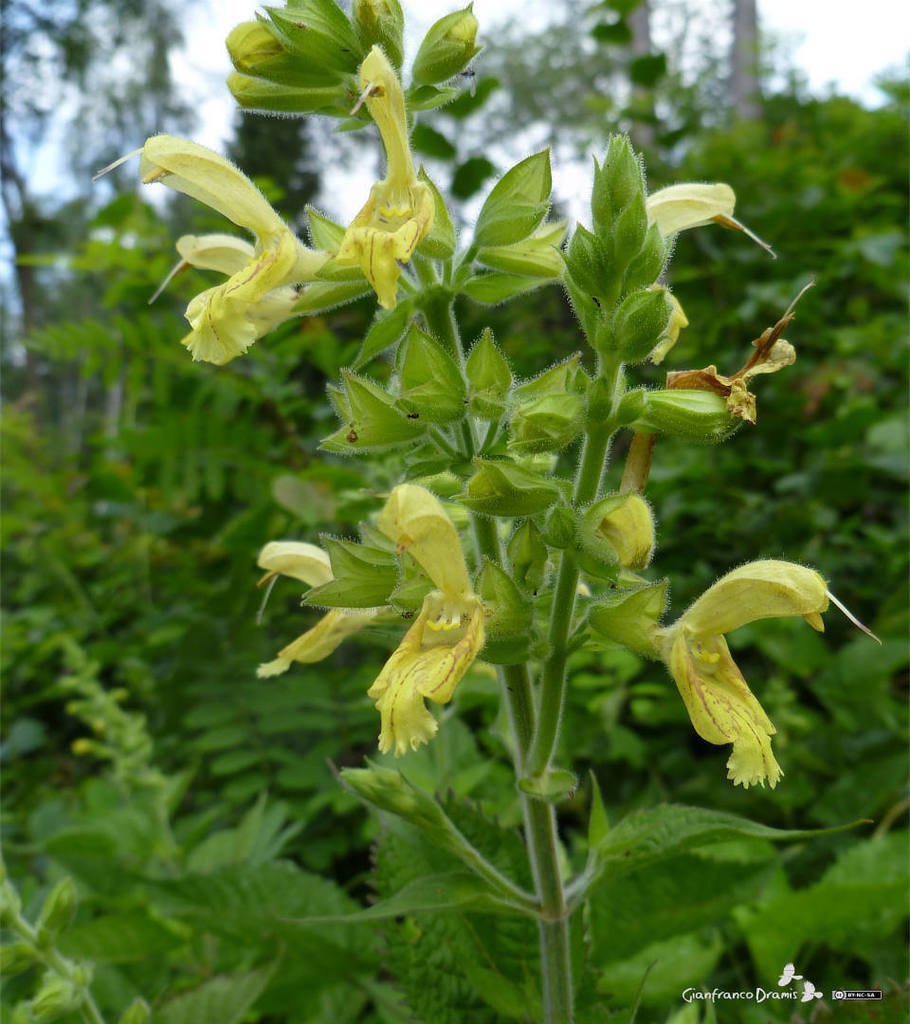
Sticky Sage
Salvia glutinosa
Salvia glutinosa, the glutinous sage, sticky sage, Jupiter's sage, or Jupiter's distaff, is a herbaceous perennial plant belonging to the family Lamiaceae.
From the article Salvia glutinosa on Wikipedia (CC BY-SA), quoted section by section
Description
Salvia glutinosa grows to approximately 40–60 centimetres (16–24 in) tall. The stems are erect, with bright green hairy leaves that are about 13 cm (5.1 in) long, with petioles of about 8–10 centimetres (3.1–3.9 in). The leaves are deciduous, toothed, pointed, tomentose and glandular. With the first frosts, foliage disappears and the plant is ready to overwinter in dormant buds. All parts of the plant are covered with sticky glandular hairs, especially the lime-green calyces and the flowers, resulting in the name "glutinosa". These sticky hairs probably have a protective function against predators. Salvia glutinosa is the main host plant of the plant bug Macrotylus quadrilineatus, that feeds on the juices of the plant and on small insects entrapped on this sticky sage. Flowers grow in whorls of two to six, with pale yellow flowers speckled with maroon. The flowers are supported by tiny persistent bracts and have a length of 3–5 centimetres (1.2–2.0 in), which is quite big for a sage. The flowers have two stamens and a bell-shaped calyx. The flowering period extends from June to September. This species has been reported to contain salvinorin A. However, this report has not been replicated, and a previous study of 441 Salvia species from many regions found salvinorin A only in Salvia divinorum, from Mexico.
Range & habitat
This plant is native to Central and East Europe, and West Asia. It is grown in gardens.
Wikipedia: “Distribution”
Where it lives
Recorded sightings
—
geo-referenced records in GBIF, from museums, herbaria and field observers.
Drag the globe to turn it. Dots are where records exist, not a range map; darker means more records.
In the stacks
Searching the stacks…
Every page naming Salvia glutinosa in the Biodiversity Heritage Library →
This page is assembled live from iNaturalist, GBIF, Wikipedia, the Source Library and the Internet Archive. It is not yet part of the hand-edited codex. iNaturalist taxon 143418.