On eBird ↗
White-necked Rockfowl
Live sightings near you, the range map, bar charts of when it is seen, and Macaulay Library photos and recordings.
White-necked Rockfowl
Picathartes gymnocephalus
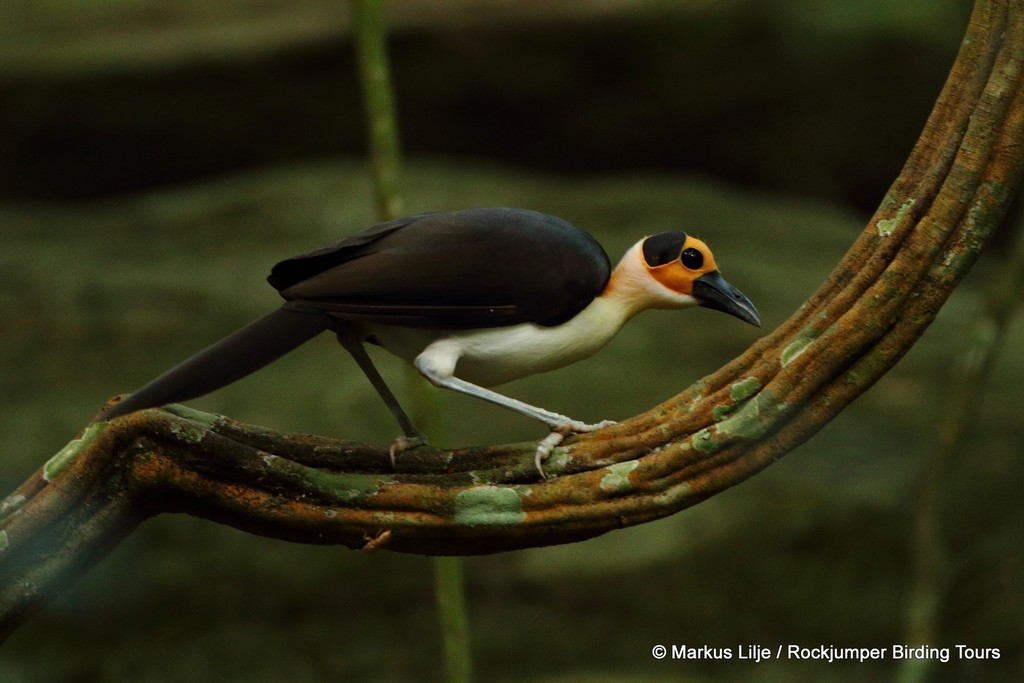
The white-necked rockfowl (Picathartes gymnocephalus) is a medium-sized bird in the family Picathartidae, with a long neck and tail. Also known as the white-necked picathartes, this passerine is mainly found in rocky forested areas at higher altitudes in West Africa from Guinea to Ghana. Its distribution is patchy, with populations often being isolated from each other. The rockfowl typically chooses to live near streams and inselbergs. It has no recognized subspecies, though some believe that it forms a superspecies with the grey-necked rockfowl. The white-necked rockfowl has greyish-black upperparts and white underparts. Its unusually long, dark brown tail is used for balance, and its thighs are muscular. The head is nearly featherless, with the exposed skin being bright yellow except for two large, circular black patches located just behind the eyes. Though the bird is usually silent, some calls are known.
These rockfowl feed primarily on insects, though parents feed small frogs to their young. One feeding strategy involves following Dorylus army ant swarms, feeding on insects flushed by the ants. Rockfowl move through the forest primarily through a series of hops and bounds or short flights in low vegetation. This species rarely flies for long distances. The white-necked rockfowl is monogamous and pairs nest either alone or in the vicinity of other pairs, sometimes in colonies with as many as eight nests. These nests are constructed out of mud formed into a deep cup and are built on rock surfaces, typically in caves. Two eggs are laid twice a year.
From the article White-necked rockfowl on Wikipedia (CC BY-SA), quoted section by section
Description
This rockfowl measures around 38 to 41 cm (15 to 16 in) in length, with its notably long tail contributing about 18 cm (7.1 in). Adult rockfowl show little sexual dimorphism in plumage and the sexes cannot be told apart by appearance. On the adult, the head, excluding the chin and throat, is completely bare of feathers except for a thin layer of fuzz on the forehead. The head's skin is bright yellow except for two large, circular patches of black skin located just behind the eye and containing the ear; only a thin, 2 mm (0.079 in) wide patch of yellow skin on the crown prevents the two black patches from connecting. The black patch has a raised edge and appears to be a distinct part of the face. The eyelid and eyering are a thin line of black surrounding the bird's large, dark brown eyes. The beak is robust, disproportionately large, and black. This beak can be considered crow-like, is noticeably decurved in the upper mandible, and is about 30 mm (1.2 in) long. The bird's chin and throat are covered in a thin layer of white feathers, and the neck is long and slender. The nape is also covered in white feathers, while the hindneck is nearly bare, revealing the orange-yellow skin. The upper mantle is a solid black, merging into a greyish-black lower mantle. The rockfowl's thighs are very muscular and aid its partially terrestrial lifestyle. …
Range & habitat
This species is found only in West Africa from Guinea to Ghana. It is locally common in southeastern Guinea, and is widespread in Sierra Leone except for the north and northwest, and in Liberia except for the north and northeast. In Côte d'Ivoire, the species is currently [when?] restricted to areas near the Guinean and Liberian border. The bird also lives in Ghana, where it is both local and uncommon in the south central parts of the nation. The white-necked rockfowl's total range covers approximately 391,000 km2 (151,000 sq mi). However, the species occurs in low population densities in patches across this large range. The species does not migrate, though it does disperse widely after the breeding season. This rockfowl lives on steep slopes in both primary and mature secondary forests. These forests are typically covered in rocks and are found in hilly lowland areas up to 800 m (2,600 ft). The white-necked rockfowl often lives near flowing streams and rivers so that it has access to wet mud for nest construction. Colonies are typically found within 100 m (330 ft) of a stream. The species also seems to show a preference for living near inselbergs. Rockfowl are occasionally seen in partly cleared forests and near cities, but this appears to be abnormal. Recent surveys have shown that abandoned rockfowl nests are more likely to be in or near secondary forest.
Wikipedia: “Distribution and habitat”
What it does
This picathartes typically keeps low in the vegetation or on the ground near its nesting grounds. It moves quickly through its forested habitat primarily through a series of hops and bounds, followed by a pause before resuming its movements. It uses its tail for balance while traversing the forest. The rockfowl also flies at a low altitude for short distances between vines and trees, and it rarely flies for long distances. This species can disappear from sight into a mass of creepers or rocks. It is capable of high jumps, sometimes jumping 6 m (20 ft) off the cave floor to its nest while only partly using its wings. It was once thought that the rockfowl rarely ventures far from its breeding grounds; however, new data suggests that the species has a much broader range than previously thought. Rockfowl have been known to continue roosting on their nests for a period following the breeding season. These birds are normally solitary or in pairs, though sometimes they live in groups of three to five birds. Typically, they silently evade any unusual movements in their forest. However, if these birds know that they have been sighted, they can become quite inquisitive and occasionally approach observers. One of the rockfowl's displays entails several of the birds in a colony forming a loose circle. …
Wikipedia: “Ecology and behavior”
Listen
Looking for field recordings…
Where it lives
Recorded sightings
—
geo-referenced records in GBIF, from museums, herbaria and field observers.
Drag the globe to turn it. Dots are where records exist, not a range map; darker means more records.
In the stacks
Searching the stacks…
Every page naming Picathartes gymnocephalus in the Biodiversity Heritage Library →
This page is assembled live from iNaturalist, GBIF, Wikipedia, the Source Library and the Internet Archive. It is not yet part of the hand-edited codex. iNaturalist taxon 14220.