On eBird ↗
Rose Robin
Live sightings near you, the range map, bar charts of when it is seen, and Macaulay Library photos and recordings.
Rose Robin
Petroica rosea
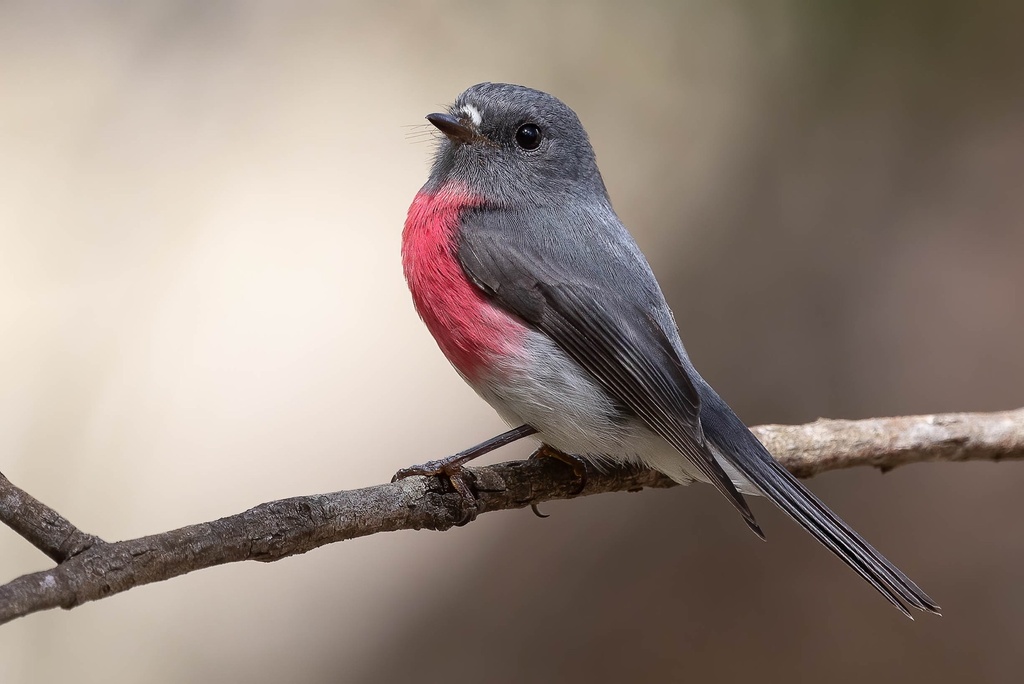
The rose robin (Petroica rosea) is a small passerine bird native to Australia. Like many brightly coloured robins of the Petroicidae, it is sexually dimorphic. The male has a distinctive pink breast. Its upperparts are dark grey with white frons, and its tail black with white tips. The underparts and shoulder are white. The female is an undistinguished grey-brown. The robin has a small black bill and eyes.
It is endemic to Australia east or south of the Great Dividing Range, from Queensland through to southeastern South Australia. Its natural habitats are the gullies and valleys of temperate forests and subtropical or tropical moist lowland forests.
From the article Rose robin on Wikipedia (CC BY-SA), quoted section by section
Description
Adult birds are around 11 cm (4.3 in) in length. The male rose robin has a pink breast and abdomen, with dark grey head, throat, back and tail. The frons and outer tail shafts are white. There is no white wing bar. The female is plain-coloured; pale grey-brown above, and grey-white underneath, with small white marks on the wings and over the bill. The bill, legs and eyes are black. Both the male and female make a tick call.
Range & habitat
The rose robin occurs in eastern and southeastern Australia, from Rockhampton east of the Great Dividing Range through eastern New South Wales and Victoria into southeastern South Australia. It does not occur in Tasmania. It is found in wet sclerophyll forest and rainforest, where it inhabits gullies and valleys, dispersing to drier forest in cooler months. The rose robin is vulnerable to development and clearing of forested areas, which has led to it disappearing in these areas. Populations have been recorded in conservation areas, namely the Dandenong Creek, Scotchmans Creek and Gardiners Creek Corridors, in Melbourne's eastern suburbs.
Wikipedia: “Distribution and habitat”
What it does
Found in ones or twos, rose robins tend to feed in the tops of trees. Insects and spiders form the bulk of the diet, with most being caught while the robin is flying. Unlike other robins, the rose robin does not return to the same branch while foraging. Prey consists of a variety of spiders and insects, including caterpillars, wasps, bugs such as cicadas and chinch bugs, beetles such as jewel beetles, leaf beetles, leaf-eating beetles and weevils, flies and ants.
Wikipedia: “Behaviour”
Listen
Looking for field recordings…
Where it lives
Recorded sightings
—
geo-referenced records in GBIF, from museums, herbaria and field observers.
Drag the globe to turn it. Dots are where records exist, not a range map; darker means more records.
In the stacks
Searching the stacks…
Every page naming Petroica rosea in the Biodiversity Heritage Library →
This page is assembled live from iNaturalist, GBIF, Wikipedia, the Source Library and the Internet Archive. It is not yet part of the hand-edited codex. iNaturalist taxon 14167.