- Plants
- ›Vascular Plants
- ›flowering plants
- ›monocots
- ›lilies, supplejacks, and allies
- ›Bellworts and allies
- ›Gloriosa
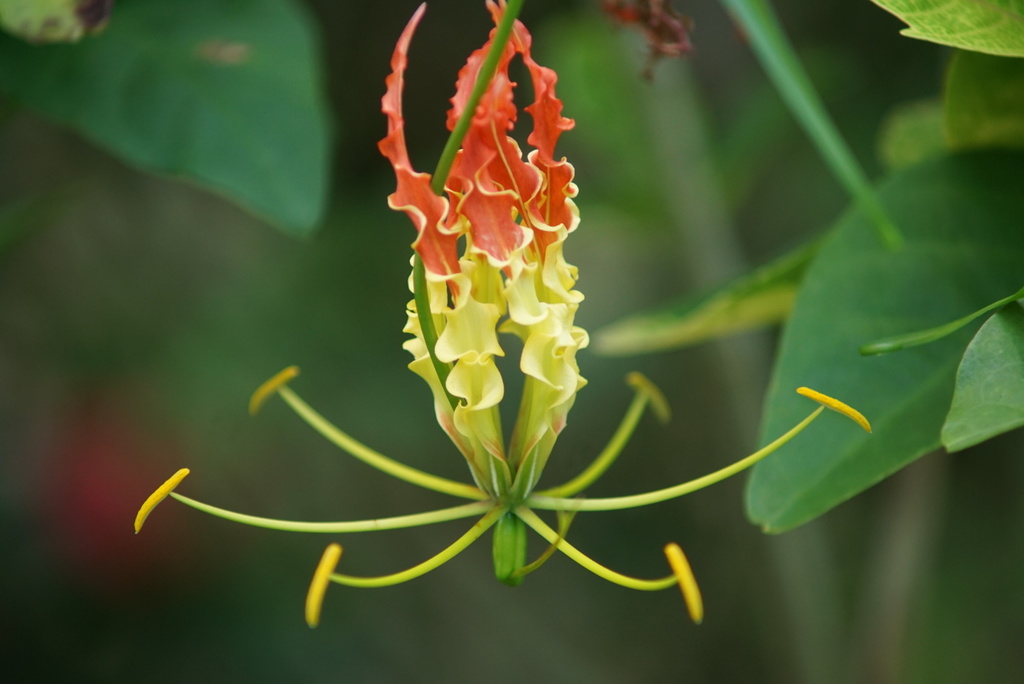
flame lily
Gloriosa superba
Gloriosa superba is a species of flowering plant in the family Colchicaceae. It is native to and common across most of Africa except North Africa, South Asia, Southeast Asia, and south-central China. It has been introduced to parts of Americas, Australia, and the Pacific Islands.
The plant produces several solitary bright red and yellow coloured flowers on long stalks. Though most parts of the plant are highly poisonous, it is used extensively in traditional medicine.
From the article Gloriosa superba on Wikipedia (CC BY-SA), quoted section by section
Description
Gloriosa superba is a herbaceous perennial plant that grows from a fleshy, horizontal, and white rhizome. It has a thin stem measuring up to 3 to 4 m (9.8 to 13.1 ft) in length in climbing plants, while being shorter in erect plants. Unlike other plants from the lily family, the plant produces green colored leaf-tip tendrils which are 2 to 3 in (51 to 76 mm) long, which is used for holding on to surfaces. The leaves are either arranged alternately or oppositely. The leaves are lance-shaped or elongated oval shaped with coiled lip tips with tendrils. The leaves are attached to the stem by a short petiole. The leaves are 10.2 to 12.7 cm (4.0 to 5.0 in) long, and 1.3 to 2.5 cm (0.51 to 0.98 in) wide, with smooth margins, and has several prominent veins running along the surface. The plant produces large solitary flowers measuring 7.6 to 12 cm (3.0 to 4.7 in) in length and 4.5 to 7 cm (1.8 to 2.8 in) in diameter. Each flower may weigh over 2.5 g (0.09 oz). They are borne on slender and long pedicels measuring up to 20 cm (7.9 in) in length. The flowers are actinomorphic and bisexual. The perianth consists of six 5 to 8.3 cm (2.0 to 3.3 in) long tepals, which are elongated and spoon shaped with wavy margins. The tepals are largely free and attached only at the base. When the small, green colored buds blossom, the tepals elongate and bend backwards while changing color. …
Range & habitat
The plant is native to Africa, tropical regions of South Asia and Southeast Asia, and south-central China. In Africa, except North Africa, it is found in most of the mainland, from Senegal in the east to Ethiopia in the west, and all the way down to South Africa. It has been introduced to Alabama and Hawaii in the United States, parts of the Caribbean, Suriname in South America, the Australian territories of New South Wales, Queensland, and Northern Territory, and various Pacific Islands. Though it is distributed widely across South Asia and Africa, the species has been rarer in Southern Africa, Bangladesh, Sri Lanka, and certain territories of India. The decline is attributed to the harvesting of wild plants for its parts for usage in traditional medicine. On the other hand, outside its native range, it has been classified as an invasive species in Australia and the Pacific Islands such as Cook Islands, French Polynesia, Kiribati, and Singapore. The plant is found across a variety of habitats including dense tropical forests, savannah, grasslands, dunes, edges of agricultural fields, barren lands, and on roadsides. It is generally found in the wild at altitudes ranging from 900 to 1,300 m (3,000 to 4,300 ft), though it has been found at altitudes up to 2,500 m (8,200 ft). In natural habitats, the plant is likely pollinated by butterflies and sunbirds.
Wikipedia: “Distribution and ecology”
At the table
It is grown as an ornamental plant for its varied colored flowers. As it contains colchicine, it is widely used in pharmaceuticals. Colchicine is used in the treatment of gout, and other inflammatory disorders. Colchicine has also used in experimental research to slow cell division, finding application in oncology. The plant derivatives are used in arrow poison in Africa, and snake repellent in India. The plant is extensively used in traditional medicine such as ayurveda. It has been used to as a laxative, and to treat ulcers, arthritis, haemorrhoids, cholera, infertility, intestinal worms, colic, renal ailments, snake bite, typhus, leprosy, and other dermatological conditions. In Africa, the parts of the plant are used to treat various ailments. The leaves are used for treating asthma in Democractic Republic of Congo, and rheumatism in Burundi. The extract from the leaves are used to treat cough, and pain in Ivory Coast and Burkina Faso, and as a disinfectant and anti-malaria drug in Tanzania. The tuber extract is used as a sleep inducer in Sudan, and to treat abdominal disorders in Kenya and Congo. It is also ued to treat ear ache in Tanzania and tooth ache in Zimbabwe. Apart from traditional uses, the plant and its derivatives has been used to commit murder, suicide, to induce abortions and to poison animals such as dogs.
Wikipedia: “Uses”
Toxicity
The plant contains high levels of colchicine, an alkaloid, derived from the amino acids phenylalanine and tyrosine as precursors. Apart from colchicine and colchicoside, it contains several other alkaloids including gloriosine, and other chemicals such as chelidonic acid, and salicylic acid. The young leaves and seeds contain a higher concentration of colchicine, with the seeds containing a colchicine content that is two to five times higher than in the tuber. β-Sitosterol, a fatty acid, and glucosides are found in the flowers. Due to the presence of colchicine, most parts of the plant are toxic, especially the seeds and the tubers. The plant parts or derived compounds are poisonous and ingestion can be fatal to humans, fish, cattle, and other domesticated animals. Poisonings also occur as the tubers are mistaken for sweet potato or yam and consumed. About 60 mg (0.93 gr) of colchicine is considered lethal to humans, while deaths have occurred at lower doses, and people have survived after ingesting doses of up to 350 mg (5.4 gr). Research has indicated that the median lethal dose was 5 mg per kg in rats. Colchicine is absorbed in the gastrointestinal tract. It affects the cell membrane and disrupts cell division. The symptoms of poisoning can show up two to six hours after ingestion. …
Wikipedia: “Chemical composition and toxicity”
How it is grown
The plant is widely cultivated in South Asia, and in parts of Southeast Asia and Africa. The domestic cultivars may vary in characteristics from the wild plants. There are dwarf varieties and plants producing flowers with broader and smoother tepals. Several color variations are cultivated including plants producing all white, orange, plum, or yellow flowers. The plant can be propagated by seed or vegetatively by dividing the rhizome. The sprouting of the seeds can take anywhere between a few weeks to three months. The seeds can sprout even after remaining dormant for up to nine months. The tubers are divided every two years, and two-thirds of the tubers generally sprout within a month. However, an existing tuber can be used to propagate a maximum of two plants in a year. As plants grown from seeds can take long to germinate, and three years to mature, various methodologies, such as soaking the seeds in water, maintaining a warm and stable temperature while germinating, augmenting with chemicals such as hypochlorite, and addition of growth hormones such as auxins, are used to speed up the germination and growth of the plant. The plant grows well on moist and well drained soils with good sun light. Mature plants flower for about seven weeks during the rainy season, and the flower buds take about two weeks to bloom. …
Wikipedia: “Cultivation”
In human culture
Gloriosa superba is the national flower of Zimbabwe. In 1947, Elizabeth II received a diamond brooch in the shape of the flower for her twenty-first birthday while traveling to Rhodesia. The flower is known by various names in Tamil including Chenkaanthal and Karthigai Poo (flower blooming in the Tamil calendar month of Karthigai) in Tamil. It is the state flower of the Indian state of Tamil Nadu. As per the Government of Tamil Nadu, it was designated so because of its association with Tamil culture and its medicinal usage. The flower was designated as the national flower of the de facto state of Tamil Eelam by the Liberation Tigers of Tamil Eelam in 2003, as it contained the colours of the Tamil Eelam flag and because it bloomed during November, coinciding with Maaveerar Naal.
Wikipedia: “Culture and symbolism”
Where it lives
Recorded sightings
—
geo-referenced records in GBIF, from museums, herbaria and field observers.
Drag the globe to turn it. Dots are where records exist, not a range map; darker means more records.
In the old herbals & bestiaries

In the stacks
Searching the stacks…
Every page naming Gloriosa superba in the Biodiversity Heritage Library →
This page is assembled live from iNaturalist, GBIF, Wikipedia, the Source Library and the Internet Archive. It is not yet part of the hand-edited codex. iNaturalist taxon 141177.