On eBird ↗
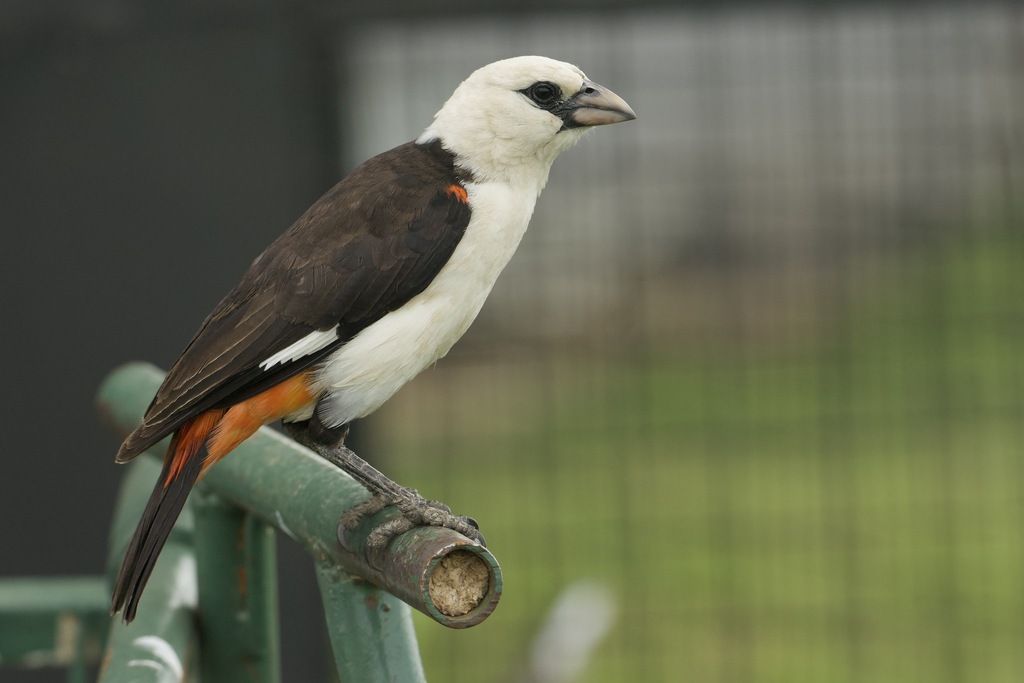
White-headed Buffalo-Weaver
Live sightings near you, the range map, bar charts of when it is seen, and Macaulay Library photos and recordings.
White-headed Buffalo-Weaver
Dinemellia dinemelli
The white-headed buffalo weaver or white-faced buffalo-weaver (Dinemellia dinemelli) is a species of passerine bird in the family Ploceidae native to East Africa. The buffalo part of its name derives from its habit of following the African buffalo, feeding on disturbed insects. Two subspecies are recognized.
From the article White-headed buffalo weaver on Wikipedia (CC BY-SA), quoted section by section
Description
The white-headed buffalo weaver is 170 to 190 mm (6.7–7.5 in) in length and 57 to 85 g (2.0–3.0 oz) in weight. In addition to its white head and underparts, the white-headed buffalo weaver has a vividly orange-red rump and undertail coverts. Its thighs are dark brown. Narrow white bands can be found on the wings especially when stretch his wings sideways. Both sexes are similar in plumage and hard to differentiate. The bill is conical and black. D. d. dinemelli has a brown tail, whereas D. d. boehmi has a black tail.
Range & habitat
The white-headed buffalo weaver is native to the African countries of Ethiopia, Kenya, Somalia, Sudan, Tanzania, and Uganda. It prefers habitats such as savanna, and shrublands, but especially dry brush and acacia thickets.
Wikipedia: “Distribution and habitat”
What it does
Like most weavers, it is a gregarious bird which forages on the ground for insects, especially beetles and butterflies, fruits, and seeds, often in company with starlings. Foraging is often done in groups of 3–6 birds. It has various calls and the sound is sometimes parrot-like: "skwieeer", "kiiyerr", a ringing and repetitious "tew". In addition, variable sounds such as chuckles and whistles can be heard at breeding and roosting sites. The sounds are slow and drawn out. They also make trills: "tsu-weely-weely-wair". They often perch in trees and hang upside-down and can be very noisy. Breeding and roosting is done in groups and they can be defensive against intruders, usually by making noise. Altercations are rarely fatal and usually vocal. Males display to females by spreading their wings to show their white wing-patches and red-orange tail-coverts. Breeding pairs are monogamous and nests are built together. The breeding season is related to rainfall and varies according to local conditions. Nest materials are pushed together, not interwoven, to form an oval 570 millimetres (22 in) wide. A short entrance tube opens downwards and is about 2 to 4 metres (6.6–13.1 ft) above the ground. Soft materials line the inner portions of the nest, which usually has several rooms, with defensive thorny branches on the outside. …
Wikipedia: “Behaviour”
Listen
Looking for field recordings…
Where it lives
Recorded sightings
—
geo-referenced records in GBIF, from museums, herbaria and field observers.
Drag the globe to turn it. Dots are where records exist, not a range map; darker means more records.
In the stacks
Searching the stacks…
Every page naming Dinemellia dinemelli in the Biodiversity Heritage Library →
This page is assembled live from iNaturalist, GBIF, Wikipedia, the Source Library and the Internet Archive. It is not yet part of the hand-edited codex. iNaturalist taxon 14087.