On eBird ↗
Rock Sparrow
Live sightings near you, the range map, bar charts of when it is seen, and Macaulay Library photos and recordings.
Rock Sparrow
Petronia petronia
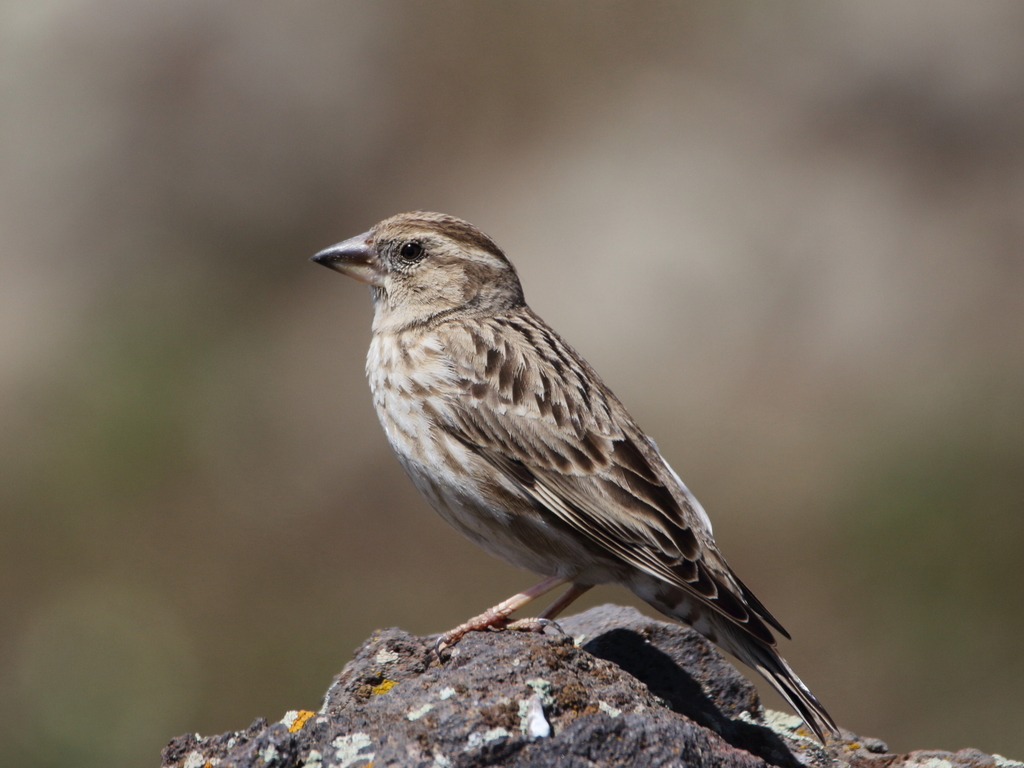
The rock sparrow or rock petronia (Petronia petronia) is a small passerine bird in the sparrow family Passeridae. It is the only species in the genus Petronia. It breeds on barren rocky hills from Madeira and the Canary Islands east through the Iberian Peninsula and western north Africa, across southern Europe and through southwestern and central Asia to Mongolia and the north and west of China. It is resident in the west of its range, but some Asian birds may migrate to more southerly areas, or move to lower altitudes in mountains, in winter.
From the article Rock sparrow on Wikipedia (CC BY-SA), quoted section by section
Description
The rock sparrow is 15–17 cm (5.9–6.7 in) in length, on average slightly larger a house sparrow, and with a conspicuously larger, more conical bill. It has a strong whitish supercilium and weaker crown stripe. It has a patterned brown back and wings, streaked underparts, and a diagnostic, but hard-to-see, yellow throat spot. It is largely monochromatic, with a distinctive yellow patch on their upper breast that starkly contrasts the earth tones of their plumage. This carotenoid-based trait is present in both sexes, and plays an important role during the breeding season, signalling both attractiveness and social status. This bird has a loud wheezy song.
Range & habitat
It is a very rare vagrant north of its breeding range. There is just a single record from Great Britain, at Cley, Norfolk on 14 June 1981. This gregarious bird is also found in human settlements in suitable country.
Wikipedia: “Distribution and habitat”
What it does
The rock sparrow mainly forages on the ground. It eats seeds throughout the year and berries in autumn. In the spring its diet includes invertebrates, particularly caterpillars and grasshoppers. These are also fed to the young.
Wikipedia: “Food and feeding”
Listen
Looking for field recordings…
Where it lives
Recorded sightings
—
geo-referenced records in GBIF, from museums, herbaria and field observers.
Drag the globe to turn it. Dots are where records exist, not a range map; darker means more records.
In the stacks
Searching the stacks…
Every page naming Petronia petronia in the Biodiversity Heritage Library →
This page is assembled live from iNaturalist, GBIF, Wikipedia, the Source Library and the Internet Archive. It is not yet part of the hand-edited codex. iNaturalist taxon 14076.