On eBird ↗
Siberian Accentor
Live sightings near you, the range map, bar charts of when it is seen, and Macaulay Library photos and recordings.
Siberian Accentor
Prunella montanella
The Siberian accentor (Prunella montanella) is a small passerine bird that breeds in northern Russia from the Ural Mountains eastwards across Siberia. It is migratory, wintering in Korea and eastern China, with rare occurrences in western Europe and northwestern North America. Its typical breeding habitat is subarctic deciduous forests and open coniferous woodland, often close to water, although it also occurs in mountains and spruce taiga. It inhabits bushes and shrubs in winter, frequently near streams, but may also be found in dry grassland and woods.
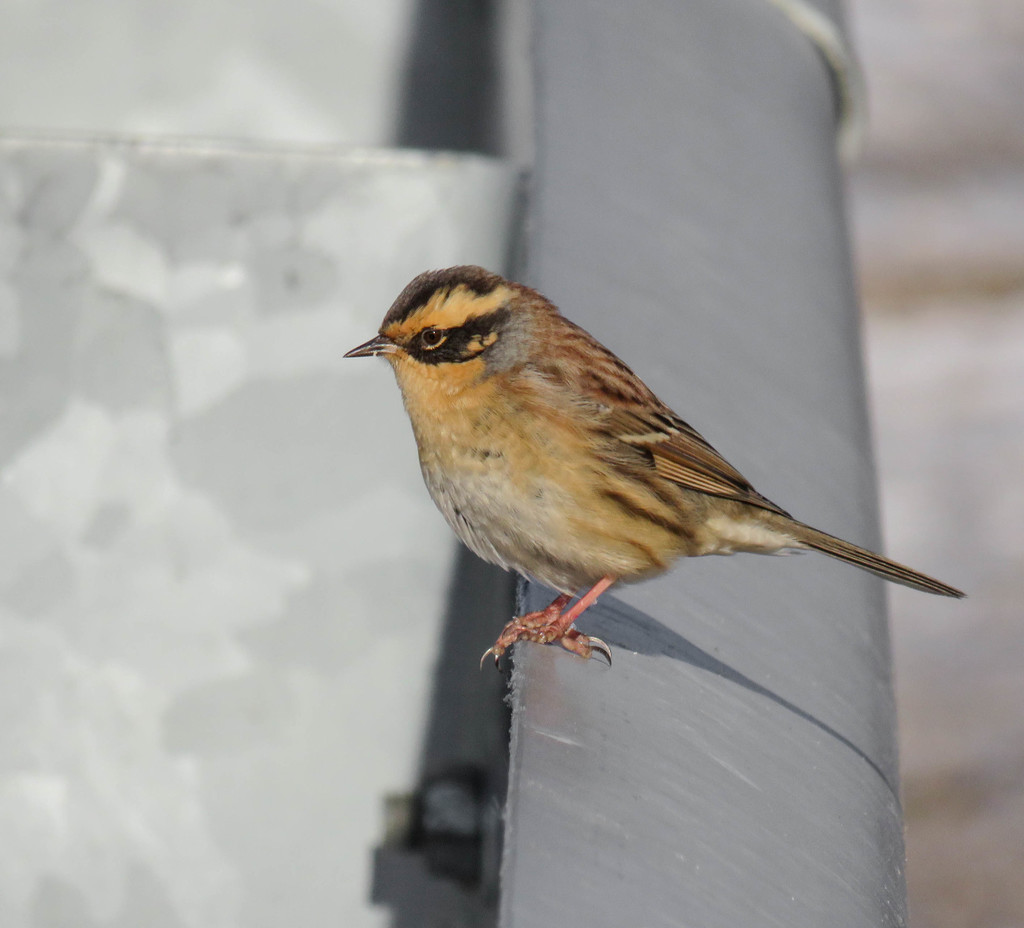
The Siberian accentor has brown upperparts and wings, with bright chestnut streaking on its back and a greyish-brown rump and tail. The head has a dark brown crown and a long, wide pale yellow supercilium ("eyebrow"). All plumages are quite similar. The nest is an open cup in dense shrub or a tree into which the female lays four to six glossy deep blue-green eggs that hatch in about ten days. Adults and chicks feed mainly on insects, typically picked off the ground, but sometimes taken from vegetation. In winter, the accentors may also consume seeds or feed near human habitation.
From the article Siberian accentor on Wikipedia (CC BY-SA), quoted section by section
Description
The Siberian accentor is on average 14.5 centimetres (5.7 in) long and weighs 17.5 grams (0.62 oz). The adult of the nominate race has brown upperparts and wings, with bright chestnut streaking on its back and a greyish-brown rump and tail. There are two narrow whitish bars on the folded wings. The head has a dark brown crown, a long, wide pale yellow supercilium, a blackish patch behind the eye and grey sides to the neck. The underparts are ochre yellow, becoming strongly buff on the flanks and greyish on the lower belly. There are rich chestnut streaks on the sides of the breast and the flanks. The iris is a warm red-brown, the sharply pointed bill is dark and the legs are reddish. All plumages are similar. The female has slightly duller underparts with weaker streaking, and the juvenile is overall duller with brown spots on the breast and chest. Juvenile birds in autumn also show more wear to the tail feathers and the tertials that cover the folded wing, and they often have a duller iris colour than the adults. The subspecies P. m. badia is somewhat smaller and darker than the nominate form, with richer brown upperparts, deeper buff underparts, and rustier flank streaks. Adults undergo a complete moult between July and September after breeding has finished. …
Range & habitat
The Siberian accentor breeds in a belt across northern Russia east from just west of the Ural Mountains to the Pacific coast, with a second, more fragmented, band across southern Siberia. It is migratory, wintering in east China and Korea. This species winters in small numbers in Mongolia, but only rarely in Japan. The breeding habitat is subarctic willow and birch forests, and open coniferous woodland, often close to rivers or bogs, although pairs are also found in mountains and spruce taiga. In winter, the Siberian accentor occupies bushes and shrubs, often near streams, but may also be found in dry grassland and woods.
Movements. Siberian accentors leave the north of their breeding range from mid-September onwards but may stay for a further month or two in the south. In spring, returning birds pass through Mongolia from the end of March and southeasternmost Russia in April and May, reaching their breeding grounds in May, perhaps as late as June in the far north. Vagrant birds have been recorded in Belarus, Kazakhstan, Lebanon and several European countries, as well as in North America. …
Wikipedia: “Distribution and habitat”
What it does
Siberian accentors are typically skulking birds, readily disappearing into cover. They have an above average ability to maintain their body temperature in cold conditions, an adaptation to their sometimes cold environment.
Breeding. The breeding season of the Siberian accentor is from June to August. Little is known about territorial or breeding behaviour, but birds of the nominate subspecies tend to occur in small groups of two to six closely spaced nests. This clumping does not appear to be shown by the southern subspecies, P. m. badia. The nest is an open cup built 0.4–8 metres (1 ft 4 in – 26 ft 3 in) above the ground in a dense shrub, or where branches fork in a tree. The nest is constructed from coarse vegetation such as twigs and leaves and lined with hair or fine grasses. The eggs are a glossy deep blue-green and measure 18.6 by 13.7 millimetres (0.73 in × 0.54 in); they weigh about 1.9 grams (0.067 oz). The clutch of four to six eggs is incubated by the female for about ten days to hatching and the downy brown-black chicks are then fed by both parents. They can breed in the following year. Two broods may be produced annually in the south of the range, just one further north.
Feeding. The Siberian accentor feeds mainly on insects, typically picked off the ground, but sometimes taken from vegetation including bushes and trees, and frequently from near snow fields. …
Wikipedia: “Behaviour”
Listen
Looking for field recordings…
Where it lives
Recorded sightings
—
geo-referenced records in GBIF, from museums, herbaria and field observers.
Drag the globe to turn it. Dots are where records exist, not a range map; darker means more records.
In the stacks
Searching the stacks…
Every page naming Prunella montanella in the Biodiversity Heritage Library →
This page is assembled live from iNaturalist, GBIF, Wikipedia, the Source Library and the Internet Archive. It is not yet part of the hand-edited codex. iNaturalist taxon 13983.