On eBird ↗
Black Bishop
Live sightings near you, the range map, bar charts of when it is seen, and Macaulay Library photos and recordings.
Black Bishop
Euplectes gierowii
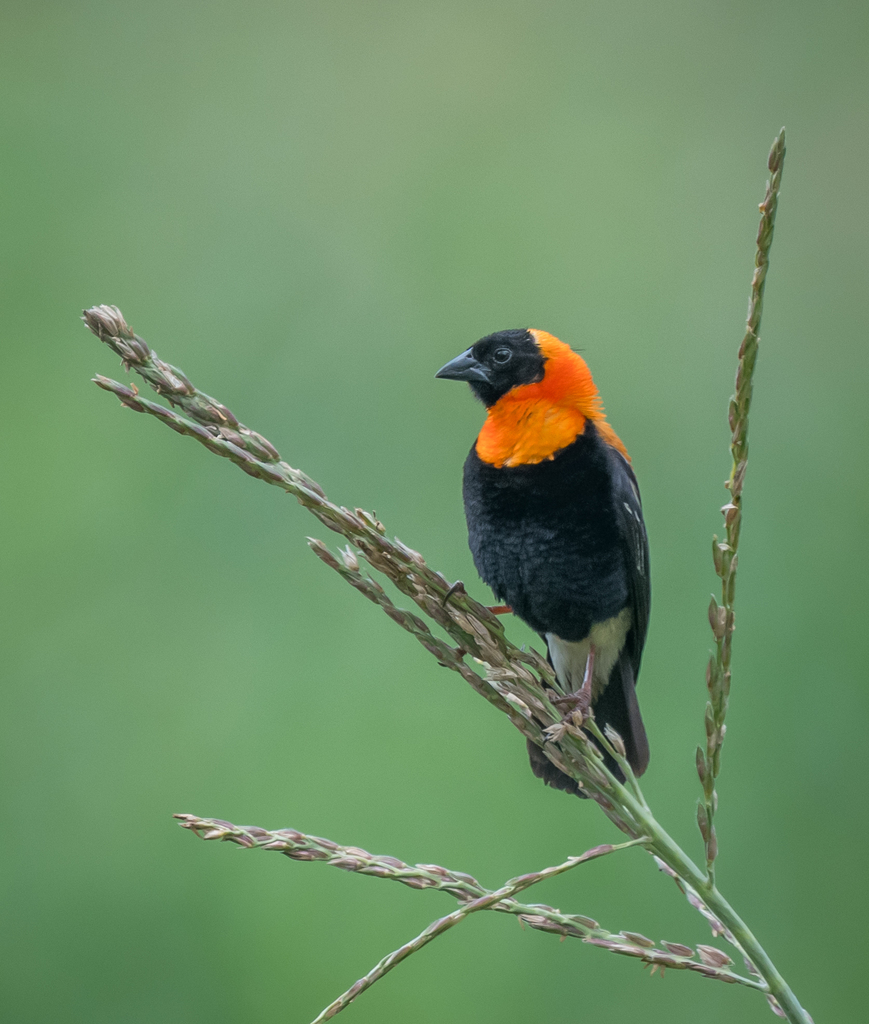
The black bishop (Euplectes gierowii) is a species of passerine bird in the family Ploceidae native to Africa south of the Sahara. Three subspecies are recognised.
From the article Black bishop on Wikipedia (CC BY-SA), quoted section by section
Description
At 14 to 16 cm (5.5–6.3 in), the black bishop is large for its genus. The breeding male is black on the wings, tail, chest, cheeks and forehead. The neck, back of the head and breast band) are orange or orange-red. The under tail-coverts are pale buff with black streaks, and the upper back is yellow or orange-yellow in subspecies ansorgei, and orange in friederichseni. The throat is scarlet in the nominate subspecies and black in ansorgei. The subspecies friederichseni has the undertail coverts isabelline. The upper back is golden yellow and the rump is brown. The conical bill, characteristic of finches, is black and the tarsus is brown. Females are dark, including the sides of the face, have boldly spotted under tail-coverts, and dark spots on a buff breast. The female's wing linings are black. The non-breeding male is black on the back, wings and rump, with yellowish supercilia and chin; the sides of face and breast are tawny buff. The juvenile resembles the female but has smaller breast spots. The calls comprise various subdued twittering sounds, including see-zee see-zee see-zhe see-zhe SEE-ZHEE, zee-zee-zeezee-zee, and hishaah, hishaah, SHAAAAAAH, tsee-tseet-tseet-tseet.
Range & habitat
The black bishop is native to Angola, Cameroon, Central African Republic, Republic of the Congo, Democratic Republic of the Congo, Ethiopia, Kenya, South Sudan, Tanzania, and Uganda. Its preferred habitats are grasslands, shrublands, and wetlands.
Wikipedia: “Distribution and habitat”
What it does
The black bishop can sometimes be found in small flocks, but is not a highly gregarious species, especially when nesting. It is probably polygynous. The male defends the territory during breeding season.
Wikipedia: “Behaviour”
Listen
Looking for field recordings…
Where it lives
Recorded sightings
—
geo-referenced records in GBIF, from museums, herbaria and field observers.
Drag the globe to turn it. Dots are where records exist, not a range map; darker means more records.
In the stacks
Searching the stacks…
Every page naming Euplectes gierowii in the Biodiversity Heritage Library →
This page is assembled live from iNaturalist, GBIF, Wikipedia, the Source Library and the Internet Archive. It is not yet part of the hand-edited codex. iNaturalist taxon 13971.