On eBird ↗
Northern Red Bishop
Live sightings near you, the range map, bar charts of when it is seen, and Macaulay Library photos and recordings.
Northern Red Bishop
Euplectes franciscanus
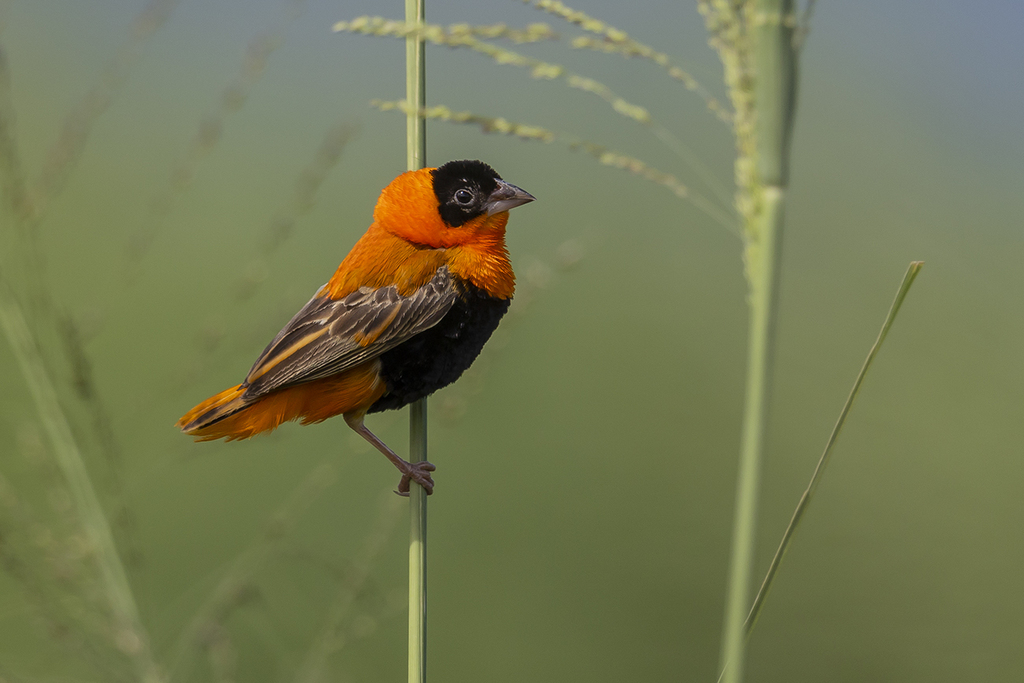
The northern red bishop or orange bishop (Euplectes franciscanus) is a small passerine bird in the family Ploceidae. It is part of the largest genus in the family with over 60 different species. Its sister species is the Southern red bishop (Euplectes orix). This species is most recognizable by the bright reddish orange with contrasting black plumage displayed by the breeding male. It is most common throughout the northern African continent but has also been introduced to areas in the western hemisphere.
From the article Northern red bishop on Wikipedia (CC BY-SA), quoted section by section
Description
This short-tailed bishop is small in size, about 11 cm and weighing about 12-22 grams. The striking red-orange feathers are produced by pigments derived from compounds in their diet. Specifically, the yellow, orange, and red pigments originate from compounds called carotenoids, which are very diet-dependent. Lutein and two red fractions (R1 and R2) derived from lutein are the two dominating carotenoids that contribute to the bird's pigment in the wild. Northern red bishops held in captivity lack the R2 red fraction carotenoid from their diet. This plumage is present on the backside of the male and wraps around the chin to back of the head, throat, and breast, with a dark black crown, forehead, flank, and belly. The tail and upper wings are brown, with pale legs and a black bill. This plumage, the identifier of the northern red bishops, is only present in the breeding males. Females and non-breeding males have a dilute brown and white feather pattern, similar to that of a song sparrow. Males entering breeding season transition into this bright and brilliant plumage, and eventually they molt these display feathers at the end of the breeding season to acquire the plumage close to that of the females.
Range & habitat
The northern red bishop has a wide distribution across northern Africa. This species inhabits northern Liberia, southern Mauritania, Senegambia, Guinea, north Sierra Leone, east Eritrea, Ethiopia, northwest and southern Somalia, northeast Democratic Republic of the Congo, North Uganda, Burkina Faso, northern Ivory Coast, South Chad, North Cameroon, Sudan, Tanzania, and Kenya. Northern red bishops generally reside in tall grasslands or cultivated areas near water and marshes. This species has been observed in lowlands to elevations as high as 1000 meters. This species was introduced to Puerto Rico in the 1960s, and has since been reported throughout the West Indies. The northern red bishop has been reported in Martinique, Guadeloupe, Barbados, Jamaica, and St. Croix, U.S. Virgin Islands, along with recorded occurrences in Cuba. In recent decades, the northern red bishop were introduced to areas of the United States, including southern California, Texas, and Hawaii. In 1997, the estimated population size of northern red bishops in Los Angeles and Orange counties reached 400, although this number has likely declined in recent years due to a loss of marshland habitat. A small population also resides in Harris County, TX.
Wikipedia: “Distribution and habitat”
What it does
This species tends to feed mostly on grass seeds, but they are also known to eat insects. Notable grasses the northern red bishop feeds on include Echinochloa, Cortaderia, and Paspalum dilatatum. Millet seeds are said to be favored. They have also been known to feed on aquatic vegetation (Polygonum) and cocklebur (Xanthium). In the late winter and springtime, these birds have been seen visiting seed feeders. They usually forage on the ground or within grass and weed stems, and they can hunt insects both in flight and on the ground. Northern red bishops tend to form large flocks in the nonbreeding season and may be seen with other canaries or waxbills.
Wikipedia: “Food and feeding”
Listen
Looking for field recordings…
Where it lives
Recorded sightings
—
geo-referenced records in GBIF, from museums, herbaria and field observers.
Drag the globe to turn it. Dots are where records exist, not a range map; darker means more records.
In the stacks
Searching the stacks…
Every page naming Euplectes franciscanus in the Biodiversity Heritage Library →
This page is assembled live from iNaturalist, GBIF, Wikipedia, the Source Library and the Internet Archive. It is not yet part of the hand-edited codex. iNaturalist taxon 13966.