- Plants
- ›Vascular Plants
- ›flowering plants
- ›Dicots
- ›saxifrages, stonecrops, and allies
- ›stonecrop family
- ›Sempervivoideae
- ›Sedeae
- ›Dudleya
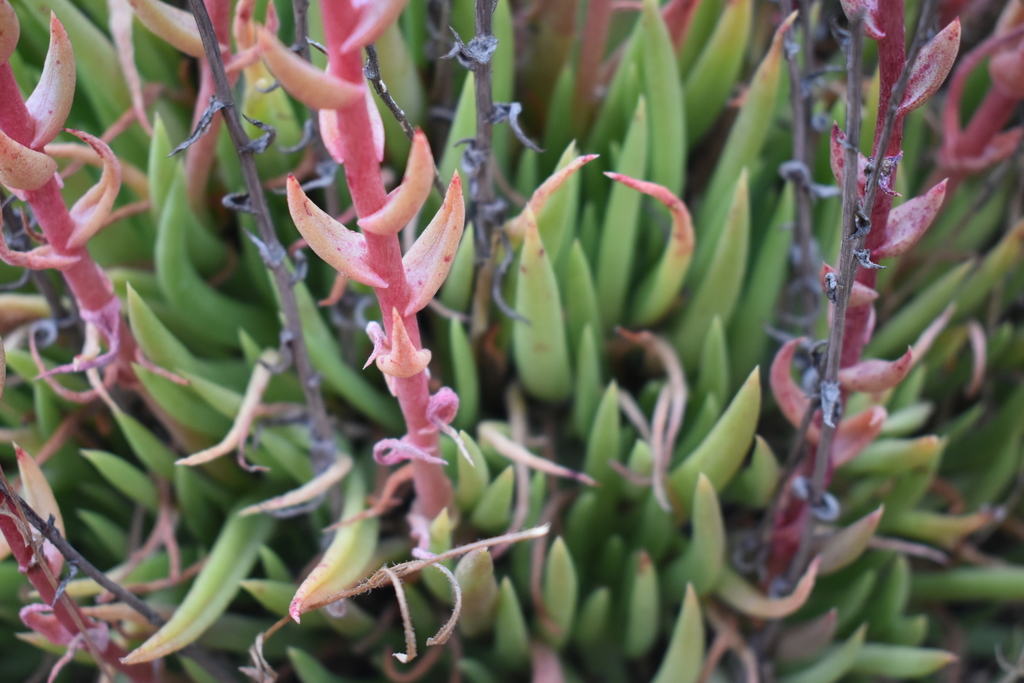
Baja California Hybrid Liveforever
Dudleya × semiteres
Dudleya attenuata is a species of perennial succulent plant known by the common name taper-tip liveforever, native to Baja California and a small portion of California. It is a rosette-forming leaf succulent which has narrow pencil-shaped leaves that can often be found covered in a white epicuticular wax. The thin, sprawling stems branch to form the clusters of rosettes, with plants creating a "clump" up to 40 cm wide. The small flowers are white or yellow, with 5 spreading petals. It is a diverse, variable species that extends from the southernmost coast of San Diego County to an area slightly north of the Vizcaino Desert, hybridizing with many other species of Dudleya in its range. Some plants with white or pinkish flowers were referred to as Orcutt's liveforever, referring to a former subspecies split on the basis of the flower color.
From the article Dudleya attenuata on Wikipedia (CC BY-SA), quoted section by section
Description
Because this is a very diverse and polymorphic species, this description serves as a generalization of the common features. See the taxonomy section for descriptions on the morphology of each subspecies. The caudex is erect to sprawling, 3 to 15 mm thick, growing up to 30 cm long or more, branching to form clumps 10 to 40 cm wide, often covered in dried leaves. Rosettes are 2 to 5 cm wide, of 5 to 20 erect leaves. Leaves are farinose, linear to linear-oblanceolate, acute, terete, 2 to 10 cm long, 2 to 5 mm wide, with the base lenticular to suborbicular or oval 5 to 15 mm wide, 2 to 4 mm high, but sometimes higher than wide. Peduncles are 5 to 30 cm tall, 1 to 3 mm thick, leafy to within 1 to 4 cm of the base. The 5 to 15 bracts on the stem are ascending, linear-lanceolate to deltate-ovate, acute, with the lowermost 0.5 to 8 cm long and 2 to 5 mm wide. Higher on the inflorescence, it is composed of 1 to 3 simple branches 2 to 15 cm long, with 3 to 15 erect flowers mounted on pedicels 0.5 to 3 mm long. On the flower, the calyx is 3 to 6 mm wide, 2 to 5 mm high, segmented into deltate-ovate sepals with an acute tip, 1.5 to 4 mm long, 1 to 2 mm wide. The corolla is cream, white or pinkish, with the keel finely marked in red. Petals are 5 to 11 mm long, 1.5 to 4 mm wide. Concerning the stamens, filaments are 3.5 to 11 mm long, and the anthers are red to yellow, 1 to 2 mm long. …
Range & habitat
D. attenuata is nearly endemic to Baja California with the exception of a population north of the border in San Diego County, California, at the Border Field State Park. It is also occurrent offshore on the Coronado Islands and the Isla Todos Santos. It can be found on coastal bluffs, typically below 165 ft.
Wikipedia: “Distribution and habitat”
Where it lives
Recorded sightings
—
geo-referenced records in GBIF, from museums, herbaria and field observers.
Drag the globe to turn it. Dots are where records exist, not a range map; darker means more records.
In the stacks
Searching the stacks…
Every page naming Dudleya × semiteres in the Biodiversity Heritage Library →
This page is assembled live from iNaturalist, GBIF, Wikipedia, the Source Library and the Internet Archive. It is not yet part of the hand-edited codex. iNaturalist taxon 1389608.