- Plants
- ›Vascular Plants
- ›flowering plants
- ›Dicots
- ›Legumes, Milkworts, and Allies
- ›Legumes
- ›Faboideae
- ›Phaseoleae
- ›Phaseolinae
- ›Phaseolus
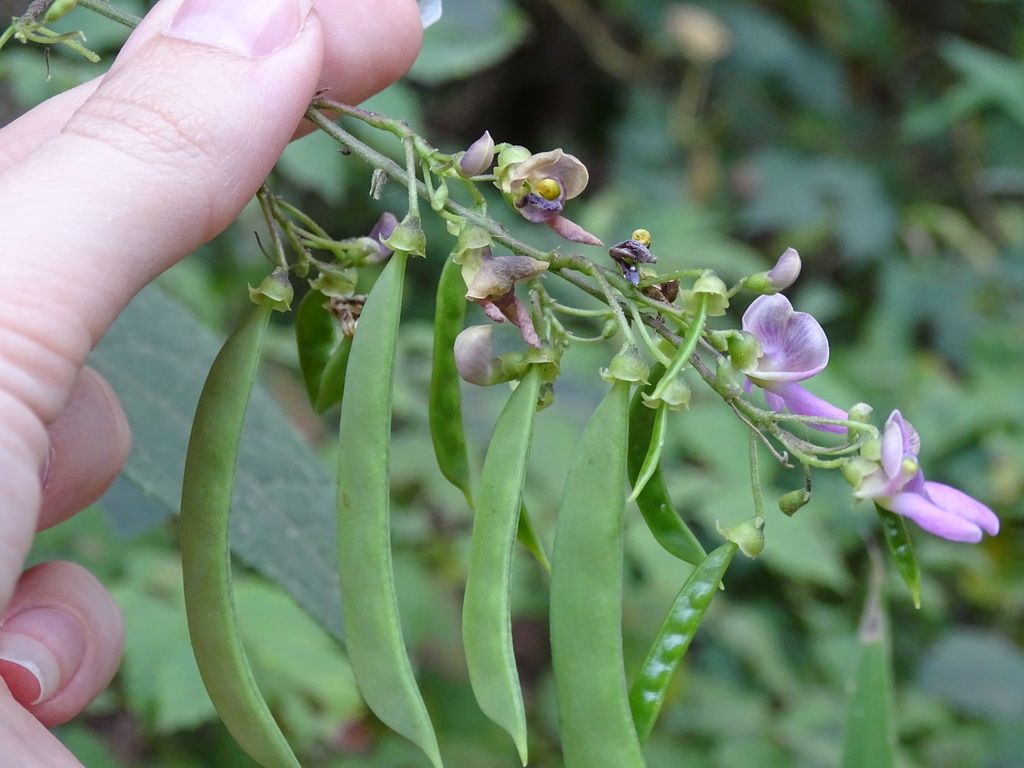
Thicket Bean
Phaseolus polystachios
Phaseolus polystachios, also known as the thicket bean or wild kidney bean, is a perennial, herbaceous vine that is native to North America. It is unique among the Phaseolus in that its native range extends across the eastern temperate United States to southeast Canada, while most Phaseolus are tropical or subtropical. It is the namesake for the Polystachios group clade, which is the most species-rich within Phaseolus (17 species). In spite of its common name, it is more closely related to the lima bean (Phaseolus lunatus), and it holds potential as a crop wild relative due to its resistance to white mold (Sclerotinia sclerotiorum).
From the article Phaseolus polystachios on Wikipedia (CC BY-SA), quoted section by section
What it does
Phaseolus polystachios inhabits well-drained soils and slopes, generally woodlands and thickets, and may form colonies. Their pods are eaten extensively by weevils.
== References ==
Wikipedia: “Ecology”
At the table
Phaseolus polystachios has been found in a few Native American archaeological sites in Oklahoma and Arkansas, with some evidence of artificial selection for indehiscent (non-shattering) pods. Its fruit and seeds can reportedly be eaten in much the same way as cultivated Phaseolus, although they are smaller.
Wikipedia: “Ethnobotany and uses”
In human culture
Phaseolus polystachios exhibits hypogeal germination and is photoperiod sensitive, requiring day lengths greater than 10 hours to vine and flower. It overwinters via a tuberous root system.
Wikipedia: “Life history”
Where it lives
Recorded sightings
—
geo-referenced records in GBIF, from museums, herbaria and field observers.
Drag the globe to turn it. Dots are where records exist, not a range map; darker means more records.
In the stacks
Searching the stacks…
Every page naming Phaseolus polystachios in the Biodiversity Heritage Library →
This page is assembled live from iNaturalist, GBIF, Wikipedia, the Source Library and the Internet Archive. It is not yet part of the hand-edited codex. iNaturalist taxon 138680.