On eBird ↗
Cape Verde Sparrow
Live sightings near you, the range map, bar charts of when it is seen, and Macaulay Library photos and recordings.
Cape Verde Sparrow
Passer iagoensis
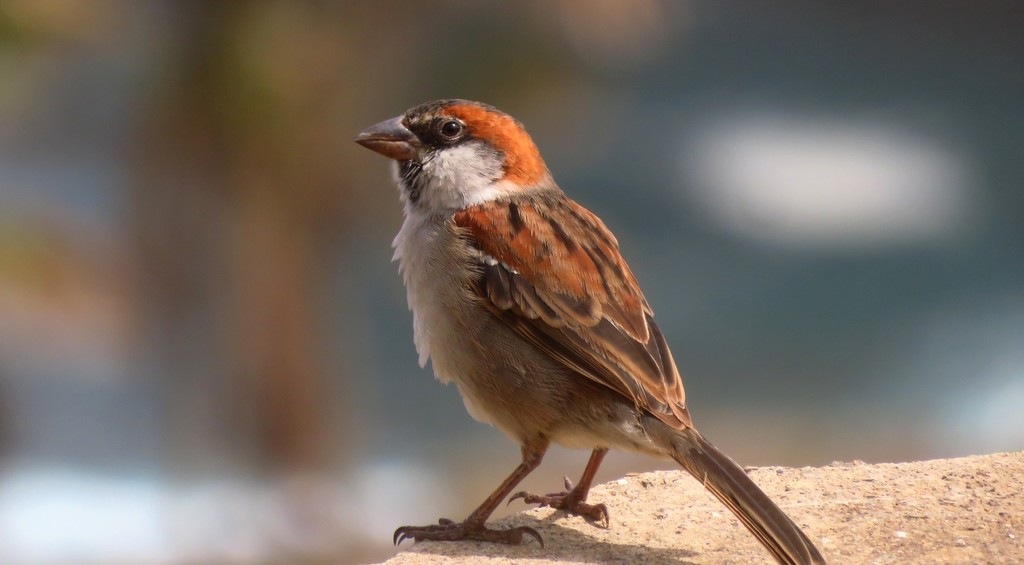
The Iago sparrow (Passer iagoensis), also known as the Cape Verde or rufous-backed sparrow, is a passerine bird of the sparrow family Passeridae. It is endemic to the Cape Verde archipelago, in the eastern Atlantic Ocean near western Africa. Females and young birds have brown plumage with black marks above, and a dull grey underside, and are distinguished from other species of sparrow by their large, distinct supercilium. Males have a brighter underside and bold black and chestnut stripes on their head. At 12.5–13 centimetres (4.9–5.1 in) long, it is a smaller sparrow. This bird's vocalisations are mostly variations on its chirp, which differ somewhat between males and females.
The Iago sparrow was once thought to be most closely related to the rufous sparrows, a group of species within the genus Passer which live in similar habitats on continental Africa. Though the Iago sparrow is closest to the rufous sparrows in appearance, it has a number of crucial differences in morphology and behavior, and is separated by thousands of kilometres. It may in fact be more closely related to the house sparrow and Spanish sparrow. In Cape Verde it occurs on all but one island, and on most of them it is quite common. The Iago sparrow occurs in most of the habitats that are available in its range, such as lava plains, rocky hills, and gorges; however, the house sparrow and Spanish sparrow are typically present instead in denser settlements and richer cultivated areas respectively.
From the article Iago sparrow on Wikipedia (CC BY-SA), quoted section by section
Description
The Iago sparrow is a small sparrow, 12.5–13 centimetres (4.9–5.1 in) long, with a wing length of 5.5–6.9 centimetres (2.2–2.7 in). Its plumage is similar to that of the house sparrow, and it similarly is sexually dimorphic. The male has a black or greyish-black crown and eyestripe, a grey nape and a small patch of white on the lower forehead. The sides of its head, especially above the eye, are a rich cinnamon colour. The scapulars are white and brown, while the rest of the upperparts are brown, streaked with black and beige. The cheeks and underparts are pale grey, and the throat and chin are marked with a small black bib. The female is grey-brown, with black-streaked wings and breast, and pale grey underparts. It is very similar to the female house sparrow but has a more apparent pale supercilium (stripe over the eye). The juvenile resembles the adult female, but young males are more chestnut from an early age, with a trace of a black bib on the chin. In 1898, ornithologist Boyd Alexander reported that adults begin moulting in early February, and some birds were still in moult by late May. The Iago sparrow's vocalisations include calls, varying between the sexes, elaborations of these called 'songs', and an alarm call. …
Range & habitat
The Iago sparrow is endemic to the archipelago of Cape Verde. It is common on most islands, excluding Fogo (from which it is absent) and Santa Luzia, Branco and Sal (on which it is scarce). The Iago sparrow is found commonly in a variety of habitats, including flat lava plains, coastal cliffs, gorges, and the edges of farmland, at altitudes of up to 1,200 metres (3,900 ft). It also occurs in settled areas and gardens, where it may overlap somewhat with the house sparrow, but usually not with the Spanish sparrow. The Spanish sparrow occurs in richer cultivated land with larger trees and villages, restricting the Iago sparrow to more arid cultivated land with smaller trees. In settlements where both the house sparrow and Iago sparrow occur, house sparrows tend to occupy the denser areas, while Iago sparrows are found primarily around trees and open spaces. In agricultural areas the Iago sparrow may do some damage to crops, mostly by eating buds and shoots. The Iago sparrow is highly common within its limited range, though its exact population is not known. Though the size of its range means it may be at risk to unpredicted changes in its environment, it is assessed as Least Concern by the IUCN Red List. In May 2013 four vagrant Iago sparrows were seen at Hansweert, in the Netherlands, having flown onto a ship as it passed by the island of Raso.
Wikipedia: “Distribution and habitat”
What it does
The Iago sparrow is gregarious while foraging and breeding. Outside of the breeding season, Iago sparrows are always in flocks, which may be of considerable size. It flocks with other birds, even warblers such as the blackcap and the Cape Verde warbler. The Iago sparrow is not very shy toward humans, allowing them to approach, even while it is at its nest. Birds on the isolated and uninhabited island of Raso will even perch on human visitors with little fear. Because of the scarcity of water to drink in its habitat, it has a strong attraction to sources of water, and large flocks may congregate when humans provide water it can drink. It often is seen dust bathing in small groups, a behavior necessary to keep clean with a paucity of water. The adult Iago sparrow feeds mainly on the seeds of grass and grain (the main cereal crop grown in Cape Verde is maize), but also on insects and plant shoots. They can do damage to crops by eating young leaves, and like house sparrows will eat the food scraps available near houses. Nestlings, by contrast to adults, are fed almost exclusively on insects, especially caterpillars, flies, and orthopterans. The Iago sparrow forages mostly on the ground, moving restlessly whilst clinging to the ground like a mouse.
Breeding. …
Wikipedia: “Behaviour”
Listen
Looking for field recordings…
Where it lives
Recorded sightings
—
geo-referenced records in GBIF, from museums, herbaria and field observers.
Drag the globe to turn it. Dots are where records exist, not a range map; darker means more records.
In the stacks
Searching the stacks…
Every page naming Passer iagoensis in the Biodiversity Heritage Library →
This page is assembled live from iNaturalist, GBIF, Wikipedia, the Source Library and the Internet Archive. It is not yet part of the hand-edited codex. iNaturalist taxon 13855.