On eBird ↗
Bar-winged Weaver
Live sightings near you, the range map, bar charts of when it is seen, and Macaulay Library photos and recordings.
Bar-winged Weaver
Ploceus angolensis
The bar-winged weaver (Ploceus angolensis) is a species of bird in the Ploceidae family. It is found in Angola, Democratic Republic of the Congo, and Zambia.
From the article Bar-winged weaver on Wikipedia (CC BY-SA), quoted section by section
Description
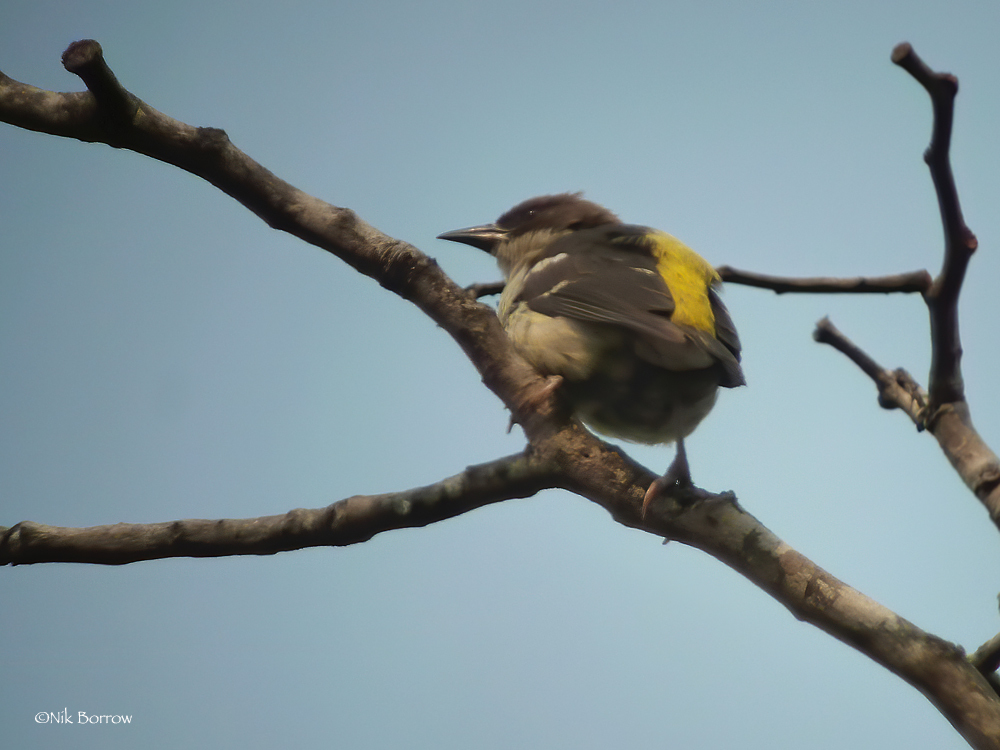
The weaver is 13cm in length, with dark coloring on the top of the bird's body and light on the bottom. It has dark blackish-brown feathers covering the top of the head and continuing down onto the wings. The wings also contain white tips at the end of each feather, with the female containing much more white. In the middle of the wings, a yellow strip runs down the back of the weaver. The tail resembles the same blackish-brown coloring that is on the head and wings. The chin and belly have a white and yellow wash of color and the females are seen with a whiter coloring. The bill is black, the legs are brown, and the eye iris of the weaver is red.
Range & habitat
Weavers live in mature evergreen (Cryptosepalum) forests and miombo (Brachystegia) woodland which is moist enough to grow Usnealichen on the trees.
Wikipedia: “Habitat”
What it does
Bar-winged weavers are insectivorous. Specifically, they eat mantids (Mantidae), beetles (Coleoptera), and chironomid larvae (Diptera). They forage for their food on trees covered with lichens and Usnea and move like nuthatches to find their food.
Wikipedia: “Diet”
Listen
Looking for field recordings…
Where it lives
Recorded sightings
—
geo-referenced records in GBIF, from museums, herbaria and field observers.
Drag the globe to turn it. Dots are where records exist, not a range map; darker means more records.
In the stacks
Searching the stacks…
Every page naming Ploceus angolensis in the Biodiversity Heritage Library →
This page is assembled live from iNaturalist, GBIF, Wikipedia, the Source Library and the Internet Archive. It is not yet part of the hand-edited codex. iNaturalist taxon 13814.