On eBird ↗
Black-breasted Weaver
Live sightings near you, the range map, bar charts of when it is seen, and Macaulay Library photos and recordings.
Black-breasted Weaver
Ploceus benghalensis
The black-breasted weaver (Ploceus benghalensis), also known as the Bengal weaver or black-throated weaver, is a weaver resident in the northern river plains of the Indian subcontinent. Like the other weavers, the males build an enclosed nest from reeds and mud, and visiting females select a mate at least partially based on the quality of the nest.
From the article Black-breasted weaver on Wikipedia (CC BY-SA), quoted section by section
Description
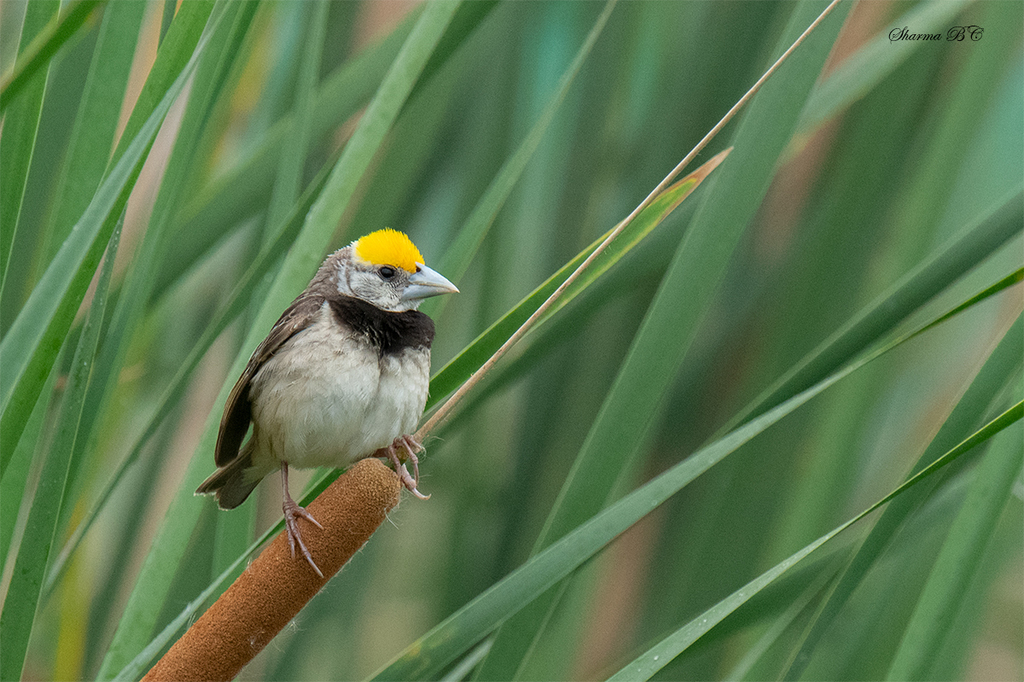
The black-breasted weaver is sparrow-sized with a total body length of about 15 cm. The male in breeding plumage has a brilliant golden-yellow crown and a variable amount of black on the head and breast; some males have an entirely black head (apart from the yellow crown) and breast, while others have a whitish throat or an entirely buffy-white face with a black band separating it from the fulvous-white underparts. In the non-breeding male and female, the crown is brown like the rest of the upperpart plumage, and the black pectoral band is less developed. It has a prominent supercilium, a spot behind ear, and narrow moustachial streaks, which are pale yellow. Flocks frequent cultivation and the reedy margins of tanks and jheels (shallow lakes), or extensive tall grass areas.
Range & habitat
Resident or local migrant, endemic to South Asia. Species is described as 'common' in at least parts of its range. It is found throughout northern part of Indian subcontinent, with small populations in the Peninsular region. Local names include Hindi: Sarbo baya, and Bengali: কালোবুক বাবুই (Kalo-buk babui), বাংলা বাবুই (Bangla babui), শর বাজা (Shor baJa) or কান্তাওয়ালা বায়া (Kantawala baya).
Wikipedia: “Distribution”
What it does
It is polygynous and colonial, and on the whole similar to that of the baya and streaked weavers.
Breeding. Breeding takes place between June and September. Nests are in scattered groups of 4 or 5; sometimes larger colonies. The male constructs the nest single-handedly, with a group of females visiting it during late construction stage, jumping on the helmets, tugging and testing, presumably for strength. If a female appears interested, the male bows low before her, presenting his golden crown to her. He flaps his wings deliberately and sings softly tsi-tsisik-tsisik-tsik-tsik, like the chirp of a cricket or the subdued squeaking of an unoiled bicycle wheel. Once the female agrees and permits copulation, he quickly completes the rest of the nest, and she lays her eggs inside. He immediately commences a second nest nearby to attract other females, and occasionally a third nest, or very rarely a fourth. Nests not accepted by females may be torn down by the builder himself. The nest is similar to that of the streaked weaver; somewhat smaller and normally with shorter entrance tubes. Built in reed-beds in marsh, often moonj or kans (Saccharum spontaneum), with some of the growing reeds incorporated into the dome as support. Entrance tube is somewhat shorter than Baya weavers (up to about 25 cm). …
Wikipedia: “Behaviour”
Listen
Looking for field recordings…
Where it lives
Recorded sightings
—
geo-referenced records in GBIF, from museums, herbaria and field observers.
Drag the globe to turn it. Dots are where records exist, not a range map; darker means more records.
In the stacks
Searching the stacks…
Every page naming Ploceus benghalensis in the Biodiversity Heritage Library →
This page is assembled live from iNaturalist, GBIF, Wikipedia, the Source Library and the Internet Archive. It is not yet part of the hand-edited codex. iNaturalist taxon 13795.