On eBird ↗
Paramo Pipit
Live sightings near you, the range map, bar charts of when it is seen, and Macaulay Library photos and recordings.
Páramo Pipit
Anthus bogotensis
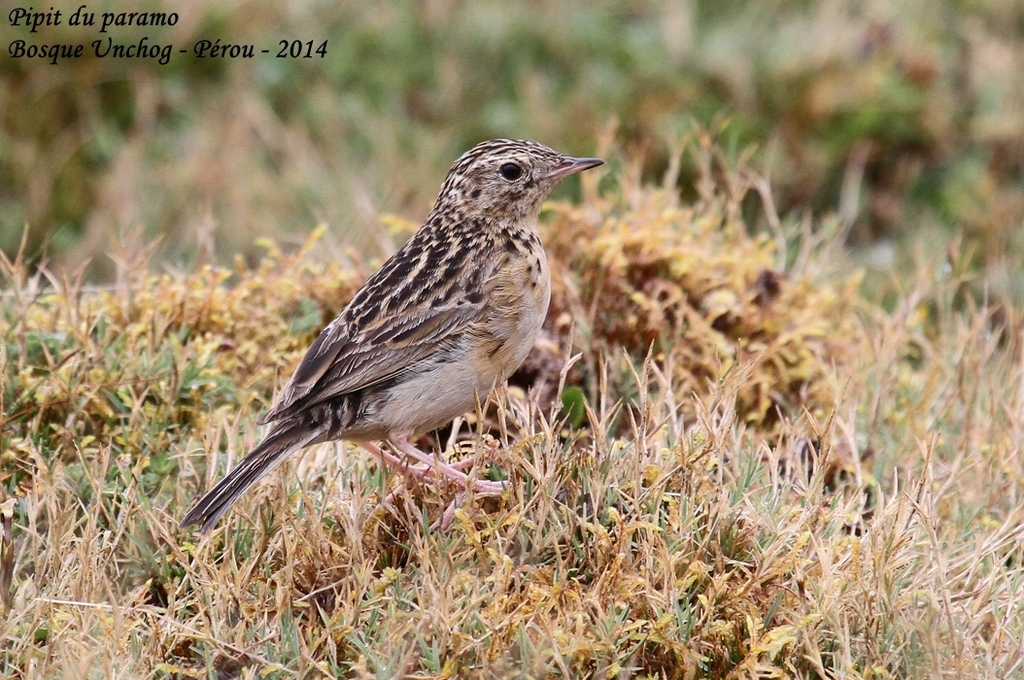
The paramo pipit (Anthus bogotensis) is a species of bird in the family Motacillidae. It is found in Argentina, Bolivia, Colombia, Ecuador, Peru, and Venezuela. Its natural habitats are subtropical or tropical high-altitude grassland and pastureland.
From the article Paramo pipit on Wikipedia (CC BY-SA), quoted section by section
Description
The paramo pipit is about 15 cm (5.9 in) long. The sexes have the same plumage. Adults of the nominate subspecies A. b. bogotensis have a dusky to cinnamon-brown head with a buffy supercilium and a thin white eye-ring. Their upperparts are dusky to cinnamon-brown with bold buff and blackish streaks. Their wing coverts are dusky with buffy tips that show as two thin wing bars. Their flight feathers are dusky with buffy brown edges. Their tail is mostly dusky. The outermost pair of feathers have a whitish outer web and a buffy inner web and the next pair inward (T5) have a whitish tip. Their throat is light buff and their underparts darker buff with sparse dark streaks on the breast and flanks. Subspecies A. b. meridae has wider wing bars than the nominate and buffy tips on T5. A. b. shiptoni has very faint wing bars and buffy white to white underparts that sometimes lack streaks on their sides. A. b. immaculatus is like shiptoni but with buffy white streaks on the crown and a buffy white supercilium. All subspecies have a brown iris, a dusky maxilla, a pale mandible, and pinkish legs and feet.
Range & habitat
The paramo pipit has a disjunct distribution. The subspecies are found thus:
A. b. meridae: Venezuelan Andes in northern Táchira, Mérida, and Trujillo A. b. bogotensis: from southern Táchira south intermittently through Colombia's Eastern and Central Andes, in the Andes through Ecuador, and on the Andes' western slope of northern Peru to Ancash Department A. b. immaculatus: east slope of the Andes from north-central Peru south to Bolivia's Cochabamba Department A. b. shiptoni: northwestern Argentina's Tucumán Province The paramo pipit is a bird of open treeless landscapes, especially its namesake páramo and puna grasslands. It favors flatter areas with a mix of short grasses, bunch grass, and bogs, and also occurs in nearby pastures and cultivated land. In elevation it ranges between 2,200 and 4,100 m (7,200 and 13,500 ft) in Venezuela, between 3,100 and 3,600 m (10,200 and 11,800 ft) in Colombia, mostly between 3,000 and 4,000 m (9,800 and 13,100 ft) in Ecuador, and between 2,950 and 4,400 m (9,700 and 14,400 ft) in Peru.
Wikipedia: “Distribution and habitat”
What it does
The paramo pipit feeds on insects and seeds. It forages singly, in pairs, and in small flocks, walking and running on the ground among grass, shrubs, and other low vegetation.
Wikipedia: “Feeding”
Listen
Looking for field recordings…
Where it lives
Recorded sightings
—
geo-referenced records in GBIF, from museums, herbaria and field observers.
Drag the globe to turn it. Dots are where records exist, not a range map; darker means more records.
In the stacks
Searching the stacks…
Every page naming Anthus bogotensis in the Biodiversity Heritage Library →
This page is assembled live from iNaturalist, GBIF, Wikipedia, the Source Library and the Internet Archive. It is not yet part of the hand-edited codex. iNaturalist taxon 13723.