- Plants
- ›Vascular Plants
- ›flowering plants
- ›Dicots
- ›Mints, Plantains, Olives, and Allies
- ›figwort family
- ›Eremophila
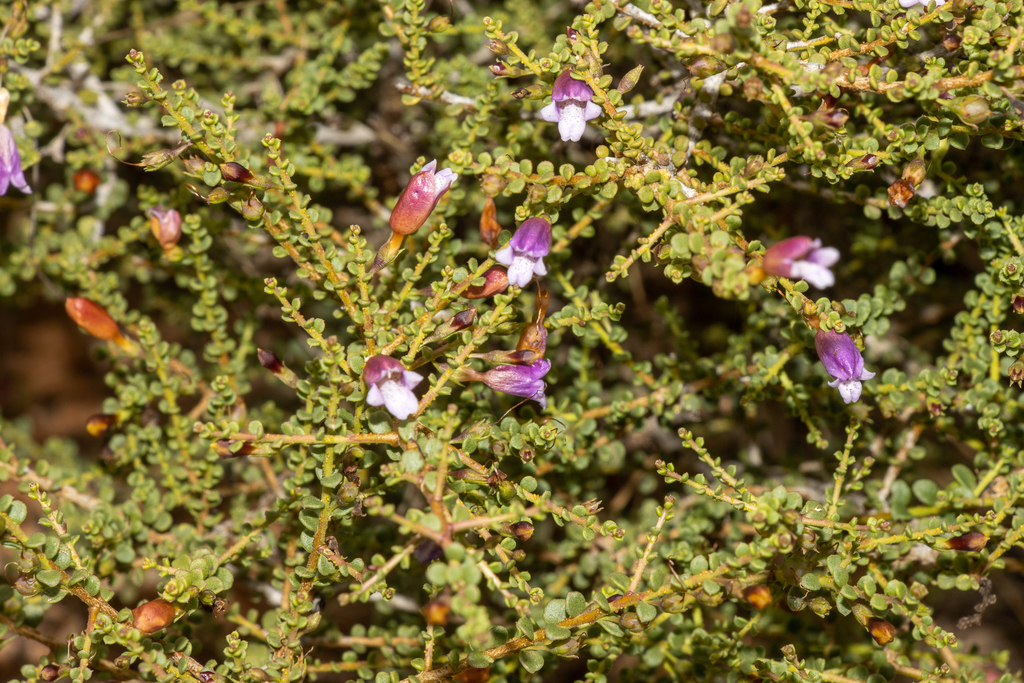
Eremophila parvifolia
Eremophila parvifolia is a flowering plant in the figwort family, Scrophulariaceae and is endemic to Australia. It is a shrub which has small, usually egg-shaped leaves and blackish flower buds which open to purple flowers which are white with purple spots inside. There are two subspecies, both of which are found in Western Australia and one which is also found in South Australia.
From the article Eremophila parvifolia on Wikipedia (CC BY-SA), quoted section by section
Description
Eremophila parvifolia is a spreading shrub which, depending on subspecies, is either a low shrub with spiny branch tips growing to a height of 50 to 70 cm (20 to 30 in) or a tall shrub, lacking spines and growing to 0.5 to 1.2 m (2 to 4 ft). Its young branches and leaves are slightly sticky due to the presence of resin. The leaves are arranged alternately along the branches and are thick, egg-shaped to almost round, mostly 1–5 mm (0.04–0.2 in) long, 0.7–1.5 mm (0.03–0.06 in) wide and are often tinged purple.
The flowers are borne singly in leaf axils on a straight, mostly glabrous stalk 1–2.2 mm (0.04–0.09 in) long. There are 5 overlapping, green or blackish-purple, egg-shaped, tapering sepals which are 1.5–3.3 mm (0.06–0.1 in) long. The petals are 6.5–10.5 mm (0.3–0.4 in) long and are joined at their lower end to form a tube. The flower buds are blackish brown but the open to purple on the outside and white with purple spots inside the tube. The petal tube is glabrous apart from the inside of the tube and the lower petal lobe which have long, soft hairs. The 4 stamens extend beyond the petal tube. Flowering time depends on subspecies. The fruits are woody, cone-shaped to almost spherical and 2.5–4 mm (0.1–0.2 in) long.
Range & habitat
Subspecies parvifolia occurs east from Balladonia in Western Australia to Fowlers Bay in South Australia. It grows in calcareous loam in woodland or shrubland. Subspecies auricampi is common from near Norseman and Kalgoorlie to Balladonia growing in sand, loam or clay on sandplains, hillsides and the edges of salt lakes.
Wikipedia: “Distribution and habitat”
How it is grown
This small shrub is suitable for planting between larger plants and is very reliable, hardy and long-lived in the garden, some examples having been in cultivation for over 25 years. It can be propagated from seed or cuttings or by grafting onto Myoporum rootstock and will grow in a range of soils, including clay. It prefers a sunny position but is very drought and frost tolerant.
== References ==
Wikipedia: “Use in horticulture”
Where it lives
Recorded sightings
—
geo-referenced records in GBIF, from museums, herbaria and field observers.
Drag the globe to turn it. Dots are where records exist, not a range map; darker means more records.
In the stacks
Searching the stacks…
Every page naming Eremophila parvifolia in the Biodiversity Heritage Library →
This page is assembled live from iNaturalist, GBIF, Wikipedia, the Source Library and the Internet Archive. It is not yet part of the hand-edited codex. iNaturalist taxon 1369450.