- Animals
- ›Chordates
- ›Vertebrates
- ›Mammals
- ›Therians
- ›Placental Mammals
- ›Primates, Rodents, and Allies
- ›Primates
- ›Monkeys, Apes, and Tarsiers
- ›Monkeys and Apes
- ›Apes and Old World Monkeys
- ›Old World Monkeys
- ›Colobines
- ›Langurs, Surilis, and Lutungs
- ›Semnopithecus
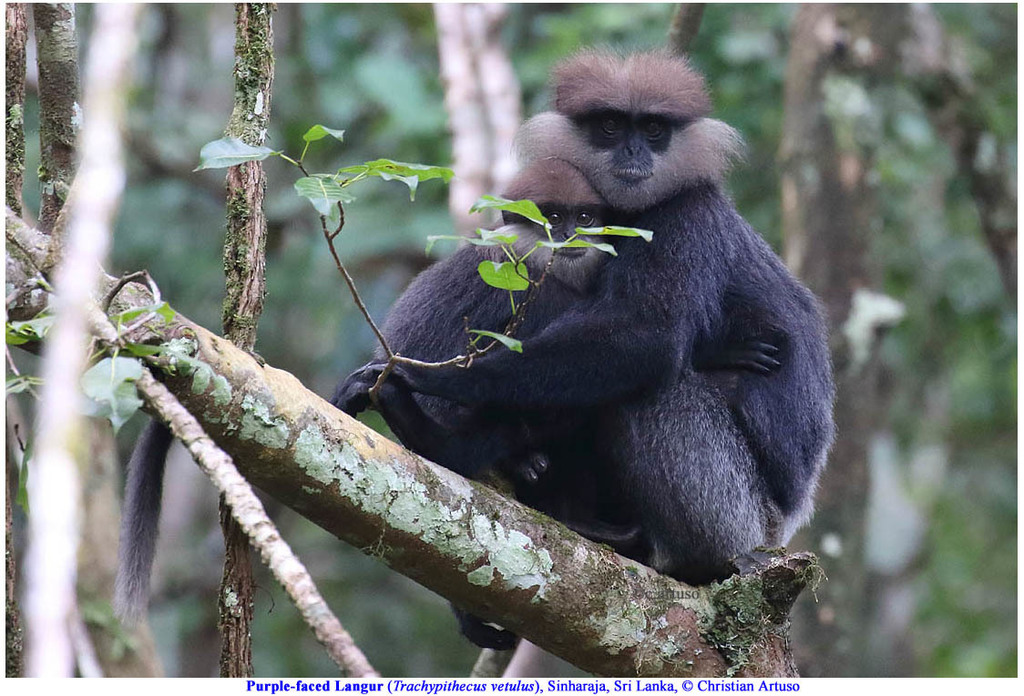
Purple-faced Langur
Semnopithecus vetulus
The purple-faced langur (Semnopithecus vetulus), also known as the purple-faced leaf monkey, is a species of Old World monkey that is endemic to Sri Lanka. The animal is a long-tailed arboreal species, identified by a mostly brown appearance, dark face (with paler lower face) and a very shy nature. The species was once highly prevalent, found in suburban Colombo and the "wet zone" villages (areas with high temperatures and high humidity throughout the year, whilst rain deluges occur during the monsoon seasons), but rapid urbanization has led to a significant decrease in the population level of the monkeys. It had traditionally been classified within the genus Trachypithecus but was moved to the genus Semnopithecus based on DNA evidence indicating that is it more closely related to the gray langurs.
In Sinhala, it is known as ශ්රී ලංකා කළු වඳුරා [kalu ʋaⁿd̪uraː] (Sri Lanka black monkey).
From the article Purple-faced langur on Wikipedia (CC BY-SA), quoted section by section
Description
In the purple-faced langur, males are usually larger than females. Males measure 50 to 67.1 cm (19.7 to 26.4 in) in head-body length with a tail of 67 to 85.1 cm (26.4 to 33.5 in). Females possess a head-body length 44.7 to 60 cm (17.6 to 23.6 in) and tail length of 58.9 to 82 cm (23.2 to 32.3 in). The pelage may generally vary from blackish to grayish. The species tends to have whitish to gray short 'trousers' rounded off by purplish-black faces with white sideburns. Part of the back is covered with whitish fur, and tail is also furred with black and white mixed colors. The feet and hands are also purplish-black in color. Size varies among the subspecies. Typically adults will weigh somewhere between 3.1 and 11.4 kg (6.8 and 25.1 lb), averaging about 7.08 kg (15.6 lb). The smallest subspecies (S. v. nestor) commonly weighs between 3.8 and 6 kg (8.4 and 13.2 lb). Average weight from other subspecies has been recorded up to 7.8 kg (17 lb) in females and 8.5 kg (19 lb) in males with some exceptionally big langurs weighing up to perhaps 18 kg (40 lb). Among the primates that live in Sri Lanka, it is somewhat smaller than the tufted gray langur despite leading males of the group of purple-faced langurs often being larger than the tufted gray langur that lived together in the habitats. In the subspecies known as the "bear monkey" (S. v. …
Range & habitat
The purple-faced langur is found in closed canopy forests in Sri Lanka's mountains and the southwestern part of the country, known as the "wet zone". Only 19% of Sri Lanka consists of forested areas. This habitat has decreased from 80% in 1980 to ~25% in 2001. Currently, this range has decreased to below 3%. The range consists of the most densely populated lowland rainforest areas of Sri Lanka. Deforestation has resulted in the langurs home ranges to be exposed to direct sunlight. Purple-faced langurs are most often found in small and widely scattered groups. Ninety percent of the langurs range, now consists of human populated areas. Populations are critically low within and between sites. Threats to this species include infringement on range by croplands, grazing, changing agriculture, road production, soil loss/erosion and deforestation, poisoning from prevention of crop raiding, and hunting for medicine and food. Its range has constricted greatly in the face of human encroachment, although it can still be seen in Sinharaja, Kitulgala, Kandalama, Mihintale, in the mountains at Horton Plains National Park or in the rainforest near the city of Galle.
Wikipedia: “Habitat and status”
What it does
The purple-faced langur is mostly folivorous, but will also feed on fruits, flowers, and seeds. While they normally avoid human habitations, fruit such as jak (Artocarpus heterophyllus), rambutan (Nephelium lappaceum), banana (Musa balbisiana), and mango (Mangifera indica) may contribute up to 50% to their diet in cultivated areas. In the wild, food such as the fruits of Dimocarpus longan and Drypetes sepiaria are taken. Purple-faced langur digestion is adapted to derive the majority of required nutrients and energy from complex carbohydrates found in leaves, with the help of specialized stomach bacteria. Where the species' diet is currently heavily dependent cultivated fruits, the ability to derive sufficient nutrition may become impaired. Seasonal availability of fruit may serve to increase this effect. Semnopithecus vetulus feed on a less diverse diet than S. priam, with a greater proportion of leaves. Food plants that have been identified include Holoptelea integrifolia, Hydnocarpus venenata, Macaranga peltata, Manilkara hexandra, Mikania scandens, Mischodon zeylanica, Pterospermum suberifolium, Tetrameles nudiflora, Vitex altissima, and Wrightia angustifolia. The purple-faced langur was found to be dominated by tufted gray langurs in mixed feeding groups.
Wikipedia: “Diet”
Listen
Looking for field recordings…
Where it lives
Recorded sightings
—
geo-referenced records in GBIF, from museums, herbaria and field observers.
Drag the globe to turn it. Dots are where records exist, not a range map; darker means more records.
In the stacks
Searching the stacks…
Every page naming Semnopithecus vetulus in the Biodiversity Heritage Library →
This page is assembled live from iNaturalist, GBIF, Wikipedia, the Source Library and the Internet Archive. It is not yet part of the hand-edited codex. iNaturalist taxon 1369308.