- Animals
- ›Chordates
- ›Vertebrates
- ›Mammals
- ›Therians
- ›Placental Mammals
- ›Primates, Rodents, and Allies
- ›Primates
- ›Monkeys, Apes, and Tarsiers
- ›Monkeys and Apes
- ›New World Monkeys
- ›Spider, Howler, and Woolly Monkeys
- ›Spider and Woolly Monkeys
- ›Lagothrix
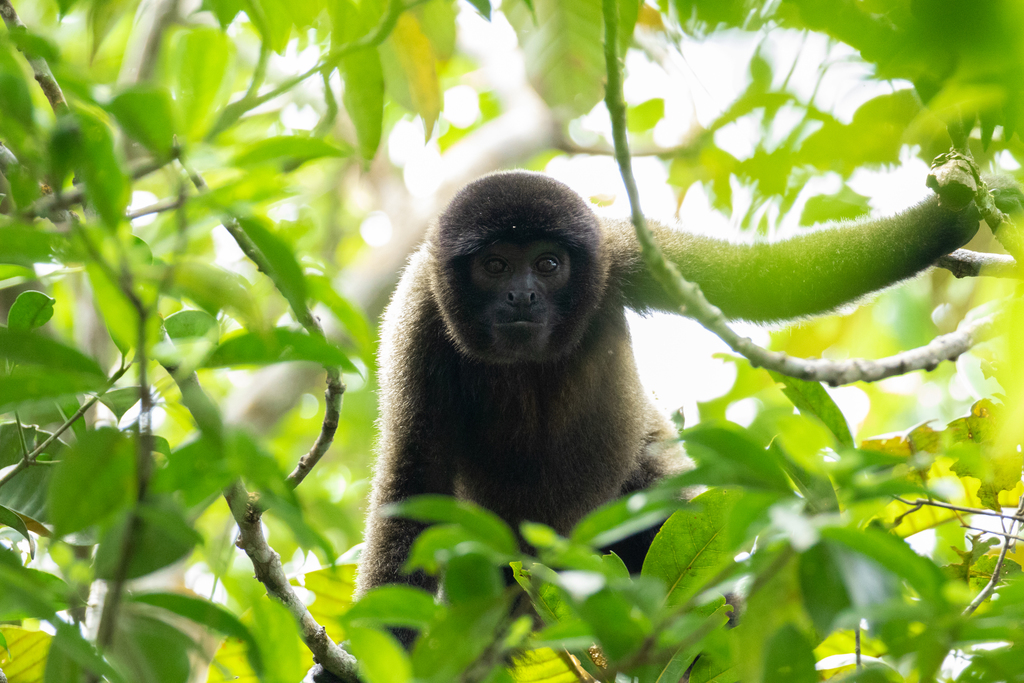
Common Woolly Monkey
Lagothrix lagothricha
The common woolly monkey, brown woolly monkey, or Humboldt's woolly monkey (Lagothrix lagothricha) is a woolly monkey from Colombia, Ecuador, Peru, Bolivia, Brazil, and Venezuela. It lives in groups of two to 70 individuals, usually splitting the group into smaller subgroups when active.
From the article Common woolly monkey on Wikipedia (CC BY-SA), quoted section by section
Description
Common woolly monkeys are large compared to most other tree-dwelling primates, with a head-body length of 40 to 60 centimetres (1.3 to 2.0 ft), a tail length of 55 to 75 centimetres (22 to 30 in), and a weight of 5.5 to 10.8 kilograms (12 to 24 lb). Contrary to their name, they may also be a shade of grey or black as well as brown, and are darker on the head and underparts. The face is naked of any fur and is typically black. Most male woolly monkeys are larger than the females, also having larger canines. Common woolly monkeys are also diurnal.
Range & habitat
The common woolly monkey is present in the upper Amazon basin in South America, ranging from the Rio Tapajos in Brazil, to eastern Peru, Ecuador and Colombia, with scattered populations north to Venezuela. They also used to be found in Bolivia, however it is likely they have been extirpated by hunters.
Wikipedia: “Distribution and habitat”
What it does
Common woolly monkeys are omnivorous, but mainly frugivorous. Their diet consists primarily of fruits containing 1 or 2 large seeds and fruits that are lower in fat and higher in sugar and water. Although they prefer certain fruits such as fruits from the Fabaceae (Legume), Moraceae (fig), Convolvulaceae, and Sapotaceae families, which represent roughly 50% of consumption time, fruit abundance and production influence their diet more than preference. As such, during periods of scarcity, fruit consumption tends to decrease and leaf and insect consumption increases. Females with dependents tend to eat more leaves, most likely because the leaves contain more protein, which helps the female produce more milk, whereas juvenile woolly monkeys have been observed to eat more arthropods than other members of the group.
Wikipedia: “Diet”
Listen
Looking for field recordings…
Where it lives
Recorded sightings
—
geo-referenced records in GBIF, from museums, herbaria and field observers.
Drag the globe to turn it. Dots are where records exist, not a range map; darker means more records.
In the stacks
Searching the stacks…
Every page naming Lagothrix lagothricha in the Biodiversity Heritage Library →
This page is assembled live from iNaturalist, GBIF, Wikipedia, the Source Library and the Internet Archive. It is not yet part of the hand-edited codex. iNaturalist taxon 1369209.