- Plants
- ›Vascular Plants
- ›flowering plants
- ›Dicots
- ›Sunflowers, Bellflowers, Fanflowers, and Allies
- ›Sunflowers, Daisies, Asters, and Allies
- ›Thistles and Allies
- ›Cardueae
- ›Thistles and Burdocks
- ›Cirsium
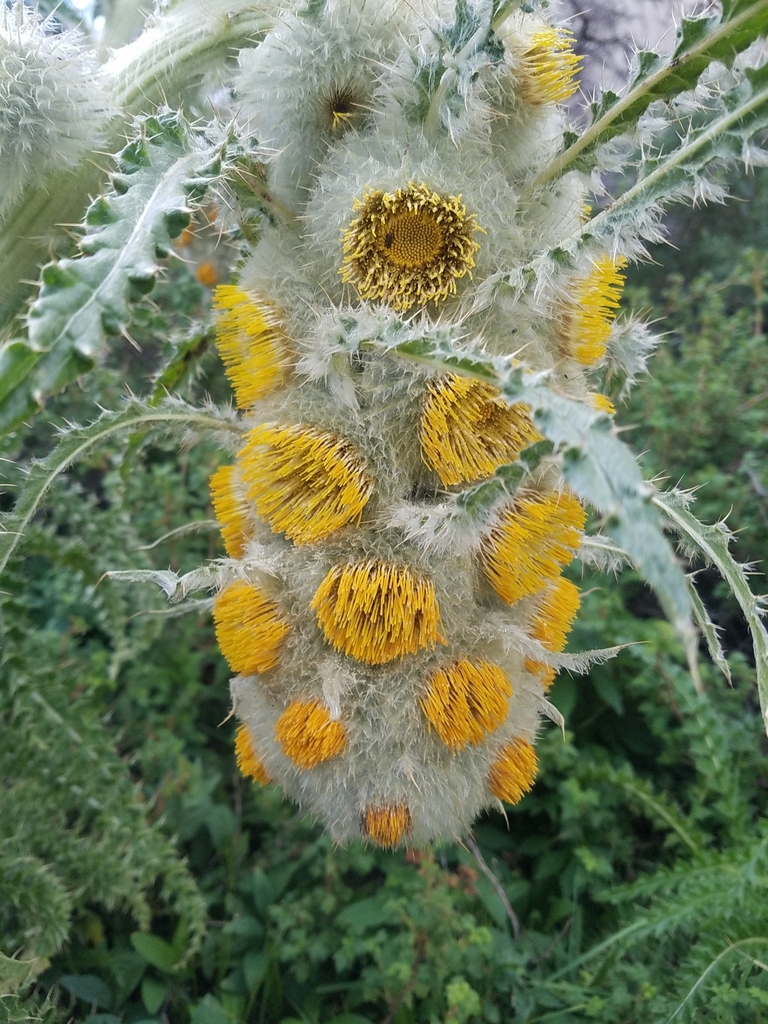
funky thistle
Cirsium funkiae
Cirsium funkiae, the funky thistle or Funk's thistle, is a species of thistle found in the United States. It was first described by American botanist Jennifer Ackerfield in 2022.
The funky thistle's common name refers to the plant's "funky" appearance, with a nodding woolly flower head, and additionally honors Ackerfield's mentor Vicki Funk, who was also described as funky. The funky thistle can be differentiated from the similar looking mountain thistle Cirsium scopulorum by the coloration of the style branches and corolla, and the nodding flowerhead that the funky thistle exhibits.
From the article Cirsium funkiae on Wikipedia (CC BY-SA), quoted section by section
Description
The funky thistle is a hairy perennial herb that grows up to 3 feet (0.91 m) in height. The plant has yellow branches with pale yellow flowers that turn brown with age that grow in fuzzy clusters. The leaves are oblong or narrowly elliptic and undulate. The leaves are pinnately divided and are 8–25 centimetres (3.1–9.8 in) in length and 1.5–3.5 centimetres (0.59–1.38 in) in width. The leaves range from smooth to hairy in texture. The seeds are dark brown or grayish brown in color, and are 4–6 millimetres (0.16–0.24 in) in length. It flowers from mid-July until late-August, the plant begins to fruit from mid-August to early September. Jennifer Ackerfield, who described it, said it was the "funkiest of all new thistles".
Ackerfield described the coloration of the style branches, corolla, and the head position (whether erect or nodding), as the best characteristics toward identifying the alpine thistles in the Southern Rocky Mountains. The style branches are yellow in color. The corolla is pale yellow in color, turning brown as it ages. The anther tube is white in color, alternatively pale yellow with brown stripes. The flower head grows in a nodding, terminal cluster. …
Range & habitat
The type specimen was collected at the base of Mount Sherman in Pike National Forest. The funky thistle is found on the mountaintops on the Sangre de Cristo Range, Mosquito Range, and Tenmile Range in central and southern Colorado. Its range extends as far north as Breckenridge, Colorado, and as far south as Santa Fe, New Mexico, where it exists as an isolated population.
Habitat. The plant grows in higher elevations above the tree line. among spruce and fir forests and alpine tundra, although it is mainly grows in alpine meadows, boulder fields, or rocky scree slopes. At lower elevations it grows in association with Bistorta bistortoides, Picea engelmannii, Potentilla pulcherrima, and Sibbaldia procumbens. In rocky slopes and meadows it grows in association with: Cirsium griseum, Carex scopulorum, Castilleja miniata, Castilleja occidentalis, Claytonia megarhiza, Geum rossii, Senecio atratus, Senecio fremontii, Polemonium confertum, and Trifolium dasyphyllum. In its highest locations on scree slopes, it is often the only species of plant found, or can be found associated with Senecio soldanella. One specimen was growing in a rocky tundra environment alongside Cerastium beeringianum, Heuchera parviflora, Pentaphylloides floribunda, and Trifolium dasyphyllum.
Wikipedia: “Range”
In human culture
The specific epithet honors Vicki Funk, who died in 2019 just before the study was completed, and was Jennifer Ackerfield's mentor. The name was chosen because of her work in the field of Compositae research at the Smithsonian Institution and to highlight her position of leadership in the study. Funk was known for having a funky personality, and Ackerfield remarked that Funk would have a special tune that she would sing when she was pricked by a thistle she was collecting, "Ooh Eeh Ooh Ah Aah Ting Tang Walla Walla Bing Bang" (Ross Bagdasarian's "Witch Doctor"), and that she wanted to honor the "funkiest of all thistles". Ackerfield described the plant's dense mass of noddy wooly heads as "funky indeed".
== References ==
Wikipedia: “Etymology”
Where it lives
Recorded sightings
—
geo-referenced records in GBIF, from museums, herbaria and field observers.
Drag the globe to turn it. Dots are where records exist, not a range map; darker means more records.
In the stacks
Searching the stacks…
Every page naming Cirsium funkiae in the Biodiversity Heritage Library →
This page is assembled live from iNaturalist, GBIF, Wikipedia, the Source Library and the Internet Archive. It is not yet part of the hand-edited codex. iNaturalist taxon 1367578.