- Plants
- ›Vascular Plants
- ›flowering plants
- ›Dicots
- ›Sunflowers, Bellflowers, Fanflowers, and Allies
- ›Sunflowers, Daisies, Asters, and Allies
- ›Asteroideae
- ›bonesets, blazingstars, and allies
- ›Eupatoriinae
- ›Eupatorium
- ›Eupatorium hyssopifolium
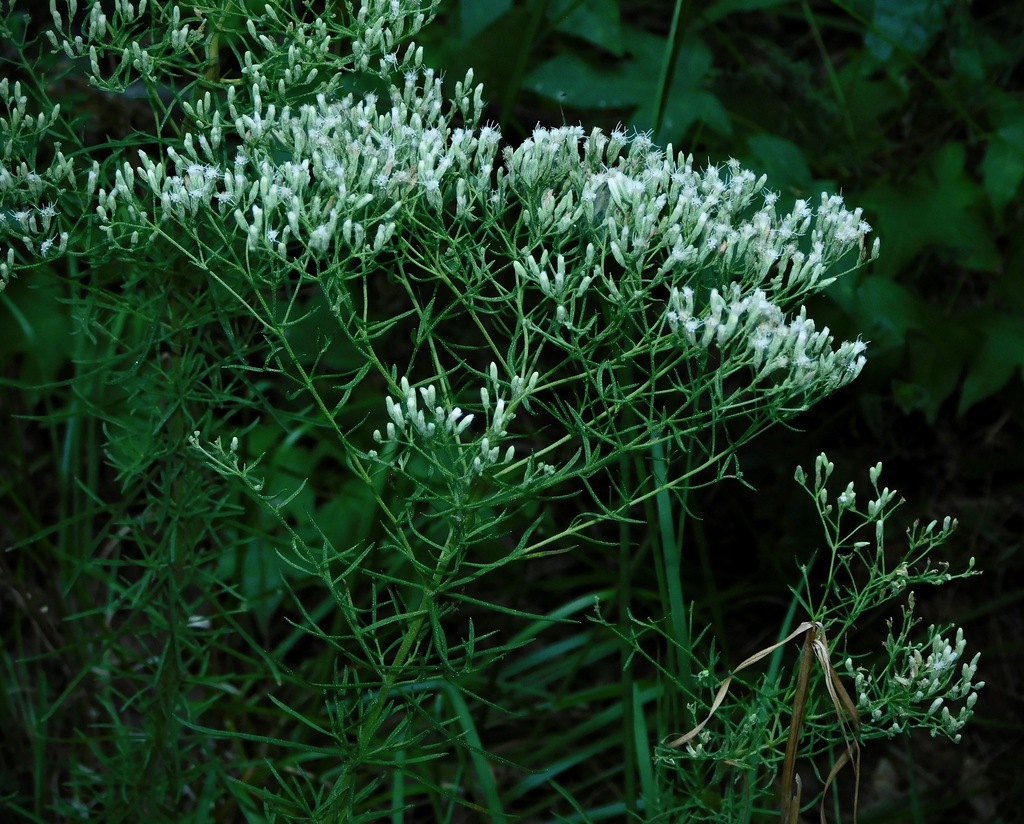
hyssopleaf thoroughwort
Eupatorium hyssopifolium
Eupatorium hyssopifolium, also known as hyssopleaf thoroughwort, is a fall-blooming herbaceous plant native to North America. Like other members of the genus Eupatorium it has inflorescences containing a large number of very small flower heads, each with 5 white disc florets but no ray florets. At 0.5 to one meter (20-40 inches) tall, it is towards the shorter end of the range of heights found in Eupatorium species.
Plants which are classified as E. hyssopifolium can be either diploid or polyploid, and some of them seem to have been the result of past hybridizations with Eupatorium serotinum. Hybrids with E. album and E. linearifolium also seem to exist. The hybrid E. torreyanum is similar to E. hyssopifolium but is a hybrid of E. serotinum and Eupatorium mohrii.
From the article Eupatorium hyssopifolium on Wikipedia (CC BY-SA), quoted section by section
Range & habitat
Eupatorium hyssopifolium is found in much of the eastern and south-central United States, from Massachusetts west to Wisconsin, and as far south as Texas and Florida. Listed as endangered in the state of Ohio. It grows in moist soils and can be found in woodlands and oak savannas, pastures, fields, roadsides, and disturbed areas, over both acidic and calcareous substrates.
Wikipedia: “Distribution and habitat”
What it does
Eupatorium hyssopifolium increases in abundance with fire disturbance, and is most commonly found in habitats with high fire return intervals. Eupatorium hyssopifolium is insect pollinated and is recorded to have been visited in northern Florida by Augochlorella aurata.
Wikipedia: “Ecology”
At the table
Eupatorium hyssopifolium can be used medicinally (applied externally for insect and reptile bites). It can also be planted near crops to attract beneficial insects.
Wikipedia: “Uses”
Where it lives
Recorded sightings
—
geo-referenced records in GBIF, from museums, herbaria and field observers.
Drag the globe to turn it. Dots are where records exist, not a range map; darker means more records.
In the stacks
Searching the stacks…
Every page naming Eupatorium hyssopifolium in the Biodiversity Heritage Library →
This page is assembled live from iNaturalist, GBIF, Wikipedia, the Source Library and the Internet Archive. It is not yet part of the hand-edited codex. iNaturalist taxon 136397.