- Plants
- ›Vascular Plants
- ›flowering plants
- ›monocots
- ›Agaves, Orchids, Irises, and Allies
- ›agave and allies
- ›Century plant subfamily
- ›Hooveria
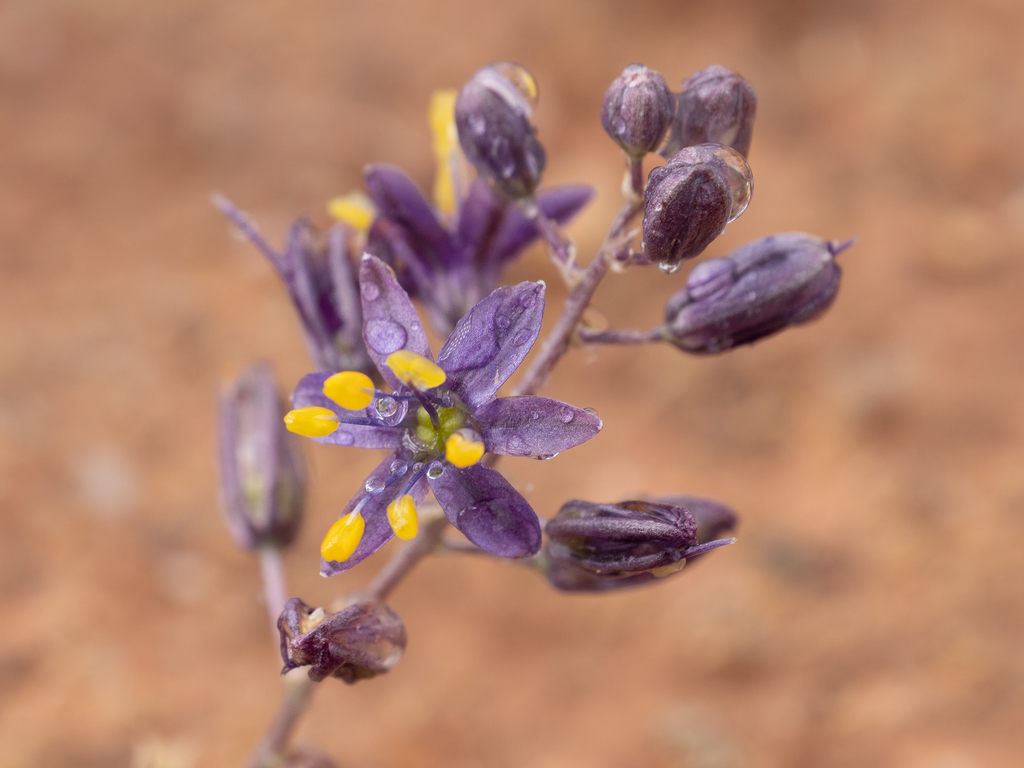
Purple amole
Hooveria purpurea
Hooveria purpurea is a species of flowering plant related to the agaves known by the common name purple amole. This species of soap plant is endemic to California, where it grows in the Santa Lucia Range, in the Central Coast region. There are two varieties of this plant, and both are believed to be quite rare. It is a federally listed threatened species.
From the article Hooveria purpurea on Wikipedia (CC BY-SA), quoted section by section
Description
Hooveria purpurea is a perennial plant growing from a bulb about 3 centimeters in diameter. The narrow, wavy leaves grow at the base of the stem. The leaves are bright green and have thick midribs. There are usually one to eight leaves, but plants with up to fourteen have been noted. The stem bears flowers at widely spaced nodes. Each flower has curled tepals each less than a centimeter long in shades of blue or purple. The flowers have long stamens with yellow anthers around a protruding style. The two varieties of the species can be told apart by their sizes; var. purpurea (the variety usually called purple amole) grows up to 40 centimeters tall and var. reducta (Camatta Canyon amole) reaches only 20 centimeters. About 90% of the plants are of var. purpurea. The blooming period of the Hooveria purpurea is from May to June.
Range & habitat
This is a plant of the Mediterranean climate with hot, rainless summers and wet winters. The Hooveria purpurea grows in woodland areas of Southern Monterey and San Luis Obispo California coastline. It grows on highly weathered, rocky, reddish clay soils in foothill woodland areas near the south-central San Luis Obispo County. Hooviera purpurea var. reducta, is endemic to the Santa Lucia Range of Monterey and San Luis Obispo Counties. It is known from only two locations, the Army installation Fort Hunter Liggett and the National Guard post Camp Roberts. There are a total of four populations, probably totalling under 10,000 total individuals. The habitat is grassland with patches of oak woodland. The Camatta Canyon amole, var. reducta, is known only from the La Panza Range in the center of San Luis Obispo County, about 61 kilometers away from the nearest population of purple amole. There is a single population with a variable number of individuals. The population sizes are difficult to estimate because the plants bloom infrequently and go dormant for several seasons at a time. Both varieties of this plant grow in soil lined with cryptogamic crusts. Purple amole is often associated with undisturbed or recovering soil crusts dominated by cyanobacteria. The soils beneath are clay topped with loam and a gravelly top layer. …
Wikipedia: “Ecology and distribution”
In human culture
The name Hooveria is named after California botanist Robert Francis Hoover, who contributed greatly to the discovery of many California flora. Hoover was the author of The Vascular Plants of San Luis Obispo County, California, and founder of the herbarium at California Polytechnic State University.
Wikipedia: “Etymology”
Where it lives
Recorded sightings
—
geo-referenced records in GBIF, from museums, herbaria and field observers.
Drag the globe to turn it. Dots are where records exist, not a range map; darker means more records.
In the stacks
Searching the stacks…
Every page naming Hooveria purpurea in the Biodiversity Heritage Library →
This page is assembled live from iNaturalist, GBIF, Wikipedia, the Source Library and the Internet Archive. It is not yet part of the hand-edited codex. iNaturalist taxon 1362971.