- Plants
- ›Vascular Plants
- ›flowering plants
- ›Dicots
- ›nightshades, bindweeds, gooseweeds, and allies
- ›bindweed family
- ›Bindweeds, Morning-glories and Allies
- ›Ipomoeeae
- ›Ipomoea
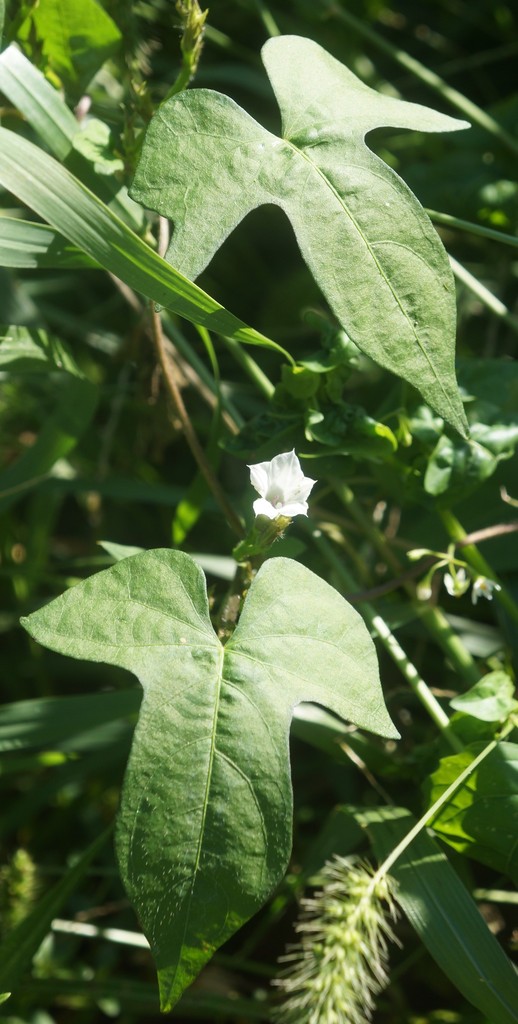
White Morning-glory
Ipomoea lacunosa
Ipomoea lacunosa, the whitestar, white morning-glory or pitted morning-glory, is a species that belongs to the genus Ipomoea. In this genus most members are commonly referred to as "morning glories". The name for the genus, Ipomoea, has roots in the Greek words ips and homoios, which translates to worm-like. This is a reference to the plant's vine-like growth. Lacunosa comes from a Latin word meaning air spaces, correlating with the venation of the leaves. Ipomoea lacunosa is native to the United States and grows annually. The flowers of this species are usually white and smaller than most other morning glories.
From the article Ipomoea lacunosa on Wikipedia (CC BY-SA), quoted section by section
Description
The stem of I. lacunosa is a slightly hairy (white hairs), twisting, climbing and twining vine with a small taproot. It can reach 2 meters in length. I. lacunose depends on its vining habit for dispersal. The roots are fibrous and have a small taproot. In a mature plant, the leaves take on a cordate shape, with a pointed tip, although sometimes it may have 3 deep lobes. The leaves of a less mature plant are usually ovate. They are arranged alternately on the stem of the plant. The slender petioles are usually at least 3 centimeters long and have a slight adaxial groove. The leaves themselves can be up to 8 cm wide and 9.4 cm long. The margin of the leaf is typically purple and smooth. The upperside of the leaf may have a small amount of white hairs.
Wikipedia: “Morphology”
Range & habitat
Since Ipomoea lacunosa is native to the United States, the plant can be found in multiple areas throughout the country. Ipomoea lacunosa occurs in almost every state on the east coast, as well as some states in the Midwest, and California. The states that the whitestar potato can be found in are as follows: Alabama, Arkansas, California, Washington D.C., Delaware, Florida, Georgia, Iowa, Illinois, Indiana, Kansas, Kentucky, Louisiana, Massachusetts, Maryland, Montana, Mississippi, North Carolina, New Jersey, New York, Ohio, Oklahoma, Pennsylvania, South Carolina, Tennessee, Texas, Virginia, and West Virginia. This species was also introduced to Canada and lives successfully in the province of Ontario. Although this plant grows rapidly, its tendency to be invasive is rather small in comparison to other members of the genus.
Wikipedia: “Distribution”
What it does
Ipomoea lacunosa occurs in a variety of habitat types, including disturbed areas, It grows on prairie, riverbanks, lakeshores, and roadsides, and in cultivated and abandoned fields and meadows. Insects associated with the plant include bees such as bumblebees, Melitoma taurea, Peponapis pruinosa, and Cemolobus ipomoea. The larvae of the plume moth Emmelina monodactyla feeds on the foliage, and it is host to several tortoise beetles.
Wikipedia: “Habitat and ecology”
At the table
Ipomoea lacunosa is one of the species of Ipomoea that is used on a small scale by humans. The whitestar potato that it produces is traditionally consumed by a number of Native American tribes like the Chiricahua Apaches. Other animals usually avoid eating this plant due to the high alkaloid content which makes it unpalatable. In some cases the amount of alkaloid in the plant can make it toxic. However certain caterpillars are capable of digesting the plant.
== References ==
Wikipedia: “Food usage”
Where it lives
Recorded sightings
—
geo-referenced records in GBIF, from museums, herbaria and field observers.
Drag the globe to turn it. Dots are where records exist, not a range map; darker means more records.
In the stacks
Searching the stacks…
Every page naming Ipomoea lacunosa in the Biodiversity Heritage Library →
This page is assembled live from iNaturalist, GBIF, Wikipedia, the Source Library and the Internet Archive. It is not yet part of the hand-edited codex. iNaturalist taxon 135262.