On eBird ↗
Brown Thornbill
Live sightings near you, the range map, bar charts of when it is seen, and Macaulay Library photos and recordings.
Brown Thornbill
Acanthiza pusilla
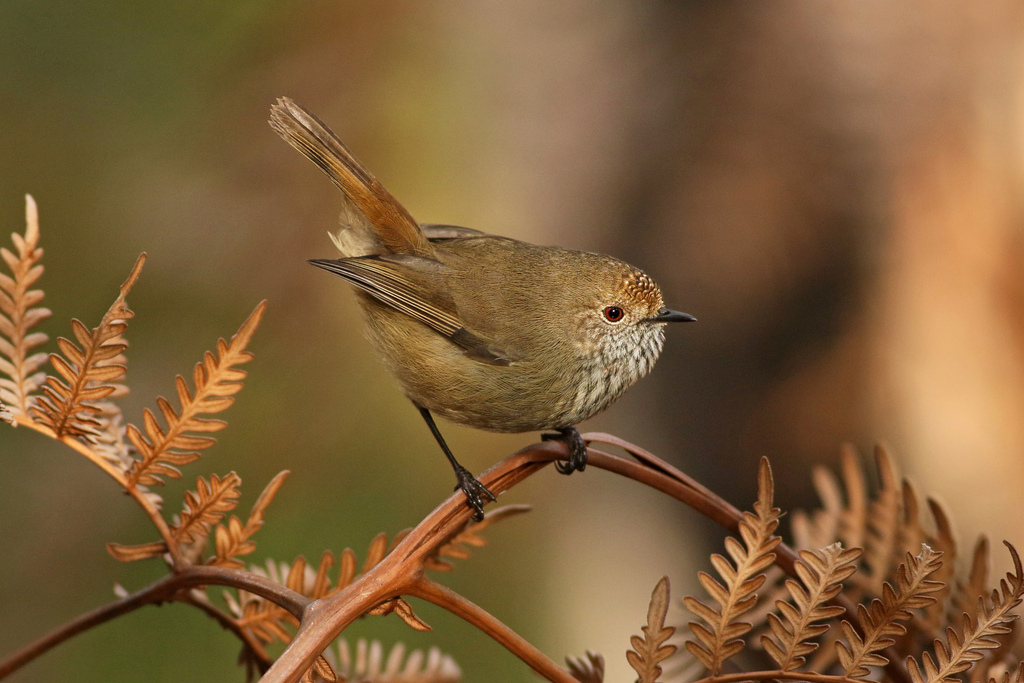
The brown thornbill (Acanthiza pusilla) is a passerine bird usually found in eastern and south-eastern Australia, including Tasmania. It can grow up to 10 centimetres (3.9 in) long, and feeds on insects. It is brown, gray, and white. The species has five subspecies.
From the article Brown thornbill on Wikipedia (CC BY-SA), quoted section by section
Description
The brown thornbill is warm brown to olive-brown above, with flanks of olive-buff to yellowish white. It has buff scallops on the forehead and large dark red eyes. There are blackish streaks on a grey throat and breast, a tawny rump and tail base, and a black subterminal band with paler tips on the tail. The brown thornbill ranges in size from 9 to 10 cm (3.5 to 3.9 in), making it relatively small. It typically weighs 7 g (0.25 oz).
Range & habitat
The brown thornbill can be found in the eastern and southeastern parts of Australia, including Tasmania. It is usually found within 300 kilometres (190 mi) of the coast. It shares a substantial part of its range with the inland thornbill on the western slopes of the Great Dividing Range and the Mt Lofty Ranges. It is also common in the Blue Mountains. The subspecies A. p. pusilla and A. p. diemenensis have been observed near the Australian Capital Territory and on Tasmania, respectively. Brown thornbills live at elevations up to 1,200 m (3,900 ft). They are found in dry forests with dense undergrowth, rainforests, shrublands, coastal dune thickets, and in rushes and bracken along rivers and creeks. They are sedentary and common, except in the drier parts of their range.
Wikipedia: “Distribution and habitat”
What it does
The brown thornbill is mainly an insectivore, including spiders, beetles, lerp insects, ants and grasshoppers in its diet. However, it may sometimes eat seeds, fruit, or nectar. It feeds restlessly close to the ground, in lower trees and shrubs of the understory. It often feeds in groups with other thornbills, except during the breeding season. It also forms mixed-species feeding flocks with the yellow-rumped thornbill (Acanthiza chrysorrhoa), the white-browed scrubwren (Sericornis frontalis), the speckled warbler (Pyrrholaemus sagittatus), and the eastern yellow robin (Eopsaltria australis).
Wikipedia: “Feeding”
Listen
Looking for field recordings…
Where it lives
Recorded sightings
—
geo-referenced records in GBIF, from museums, herbaria and field observers.
Drag the globe to turn it. Dots are where records exist, not a range map; darker means more records.
In the stacks
Searching the stacks…
Every page naming Acanthiza pusilla in the Biodiversity Heritage Library →
This page is assembled live from iNaturalist, GBIF, Wikipedia, the Source Library and the Internet Archive. It is not yet part of the hand-edited codex. iNaturalist taxon 13468.