On eBird ↗
Tasmanian Thornbill
Live sightings near you, the range map, bar charts of when it is seen, and Macaulay Library photos and recordings.
Tasmanian Thornbill
Acanthiza ewingii
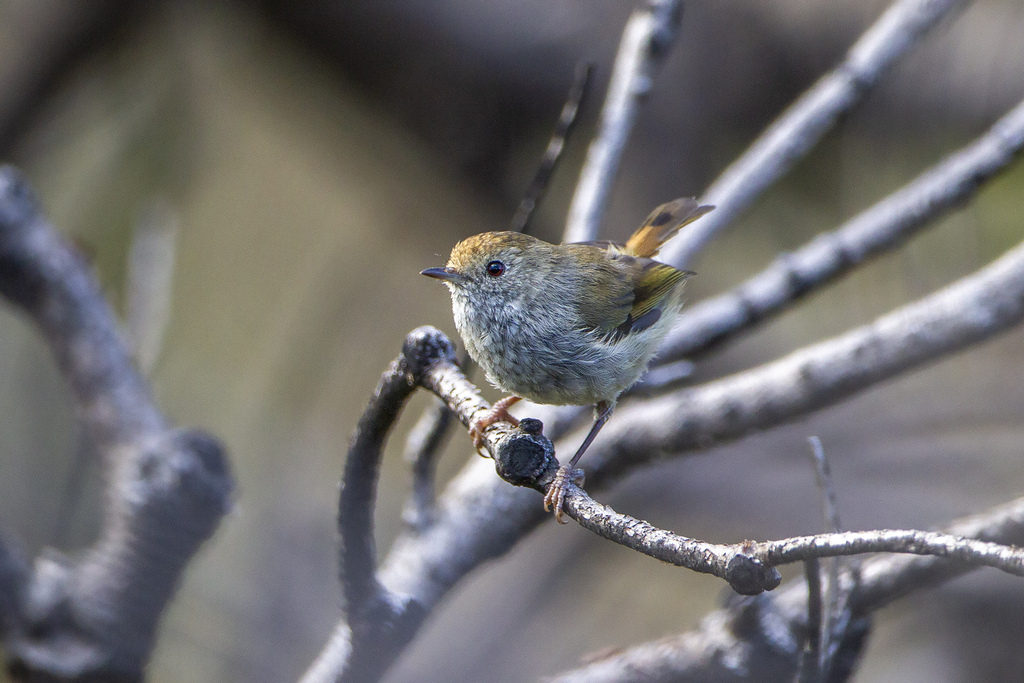
The Tasmanian Thornbill (Acanthiza ewingii) is a small bushland member of the Acanthizidae (Australian warbler) family, endemic to Tasmania and the Bass Strait Islands. It is a common bird in these regions and is often found occupying the colder, wetter portions of them. The brown thornbill (Acanthiza pusilla) will typically occupy the correspondingly drier portions of habitat.
From the article Tasmanian thornbill on Wikipedia (CC BY-SA), quoted section by section
Description
The Tasmanian Thornbill is olive-brown above, darkening toward the back and tail, and can exhibit a patch of reddish-brown colouration on the forehead. The wings are dark grey with olive-brown edge lining. Grey on light grey scalloping is present from the chin to breast, with similar scalloping occurring on the sides of the head. The bill, feet, and legs are all dark grey and the eyes are distinctly large and dark, with red irises. It's long, thin, thorn-shaped beak is a distinguishing characteristic of the Acanthiza (thornbill) family. Visibly fluffy, white under-tail coverts are a distinguishing feature of the species. The Tasmanian Thornbill averages in size at around 10 cm and shows no significant coloration or size differentiation between sexes.
Differentiating from Brown Thornbill. The Tasmanian and Brown Thornbills both occupy similar habitat, and are strikingly similar in appearance and behaviour, hence they are often easily confused. There are five principal, physical, differences to distinguish between the two species:
The under-tail coverts of the Tasmanian Thornbill are clear white, while those of the brown thornbill are a duller greyish brown, hence the adage that the Tasmanian Thornbill "wears white underpants". The edges of the primary feathers in the wing of the Tasmanian Thornbill contrast the wings at the edges much more than those of the brown thornbill. Th …
Range & habitat
The Tasmanian thornbill is endemic to Tasmania and the Bass Strait Islands and is a common resident of rainforests, wet forests, and scrublands. It shares much of its range with the brown thornbill, but tends to occupy the wetter areas of the habitat, often choosing to live in dense scrub around wet gullies rather than the drier, more open slopes. Temperate rainforest has been established to be the preferred habitat of the Tasmanian Thornbill, but its range of suitable habitats also include Mediterranean-style shrubby vegetation, bogs, marshes, fens, swamps, peatlands, and shrub-dominated wetlands. The subspecies A. e. rufifrons (King Island Tasmanian Thornbill) occupies similar habitat but on King Island and is endemic there.
Wikipedia: “Habitat and distribution”
What it does
The Tasmanian thornbill is primarily insectivorous, but will sometimes include seeds and fruits into its diet. It is typically arboreal, and will forage at all levels of the forest including the ground, leaves, and the bark of trunks, branches, and twigs.
Wikipedia: “Feeding”
Listen
Looking for field recordings…
Where it lives
Recorded sightings
—
geo-referenced records in GBIF, from museums, herbaria and field observers.
Drag the globe to turn it. Dots are where records exist, not a range map; darker means more records.
In the stacks
Searching the stacks…
Every page naming Acanthiza ewingii in the Biodiversity Heritage Library →
This page is assembled live from iNaturalist, GBIF, Wikipedia, the Source Library and the Internet Archive. It is not yet part of the hand-edited codex. iNaturalist taxon 13465.