On eBird ↗
Metallic-winged Sunbird
Live sightings near you, the range map, bar charts of when it is seen, and Macaulay Library photos and recordings.
Metallic-winged Sunbird
Aethopyga pulcherrima
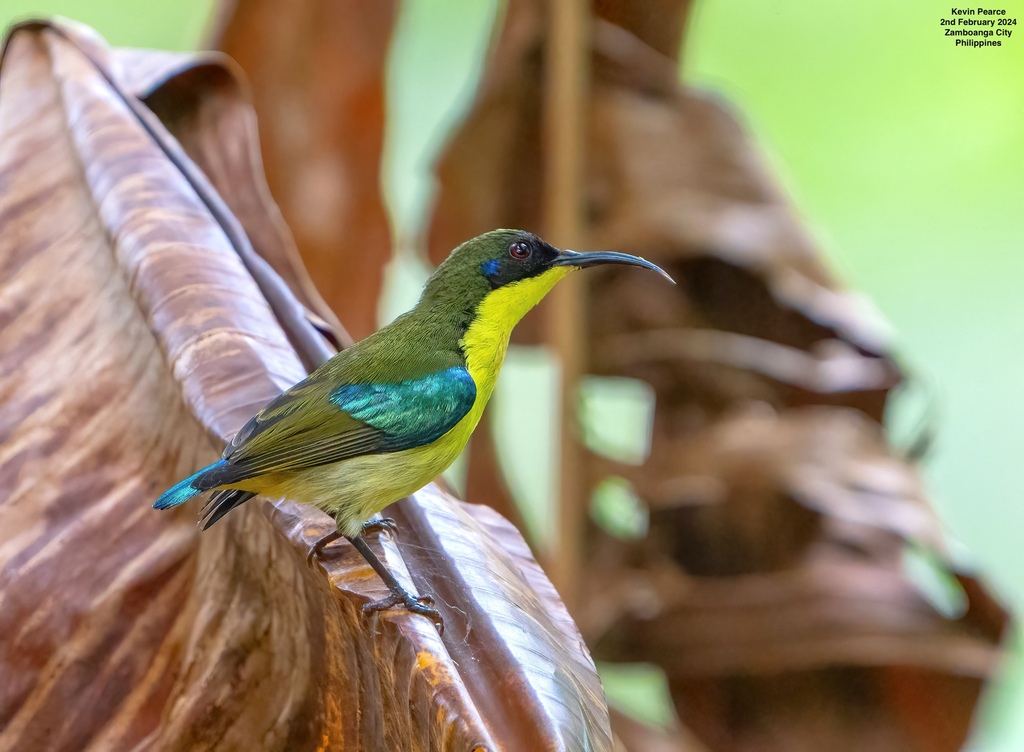
The metallic-winged sunbird (Aethopyga pulcherrima) is a species of bird in the family Nectariniidae. It is endemic to the Philippines.
Its natural habitats are tropical moist lowland forests and tropical moist montane forests. This species was formerly three species named the Luzon sunbird, Mindanao sunbird and Bohol sunbird but has since been lumped into a single species.
From the article Metallic-winged sunbird on Wikipedia (CC BY-SA), quoted section by section
Description
The metallic-winged sunbird was formally described in 1876 by the English ornithologist Richard Bowdler Sharpe based on specimens collected on the island of Basilan by members of an expedition to the Philippines led by the American ornithologist Joseph Beal Steere. Sharpe coined the binomial name Aethopyga pulcherrima, where the specific epithet is from Latin pulcherrimus meaning "very beautiful". Three subspecies are recognised:
A. p. pulcherrima Sharpe, 1876 – Eastern Visayas and Mindanao group (central, south Philippines, formerly called the Mindanao sunbird); irridiscent blue only on shoulder A. p. jefferyi (Ogilvie-Grant, 1894) – montane Luzon (north Philippines, formerly considered as a separate species, the Luzon sunbird); irridiscent blue encompasses the entire wing and rump A. p. decorosa (McGregor, 1907) – Bohol (central south Philippines, formerly considered as a separate species, the Bohol sunbird); irridiscent blue encompasses the entire wing and rump but much paler than the Luzon sunbird
Wikipedia: “Description and taxonomy”
Range & habitat
Its natural habitat is tropical moist lowland forests and tropical moist montane forests up to 2,000 meters above sea level although the altitudes differ per subspecies. The Bohol and Mindanao sunbirds were more often seen in lowlands while the Luzon sunbird is only recorded above 900 meters above sea level. It is assessed as a Least-concern species by the International Union for Conservation of Nature as it is fairly common in its range and tolerant of disturbed habitat.
== References ==
Wikipedia: “Habitat and conservation status”
What it does
Seen alone or are part of mixed flocks. This species is often observed foranging on flowers but it is believed that this species also feeds on insects. A single nest recorded contained 3 eggs which were described as dull pink with gray mottling.
Wikipedia: “Ecology and behavior”
Listen
Looking for field recordings…
Where it lives
Recorded sightings
—
geo-referenced records in GBIF, from museums, herbaria and field observers.
Drag the globe to turn it. Dots are where records exist, not a range map; darker means more records.
In the stacks
Searching the stacks…
Every page naming Aethopyga pulcherrima in the Biodiversity Heritage Library →
This page is assembled live from iNaturalist, GBIF, Wikipedia, the Source Library and the Internet Archive. It is not yet part of the hand-edited codex. iNaturalist taxon 13426.