- Plants
- ›Vascular Plants
- ›flowering plants
- ›Dicots
- ›Legumes, Milkworts, and Allies
- ›Legumes
- ›Peacock Flower Subfamily
- ›Cassieae
- ›Cassiinae
- ›Senna
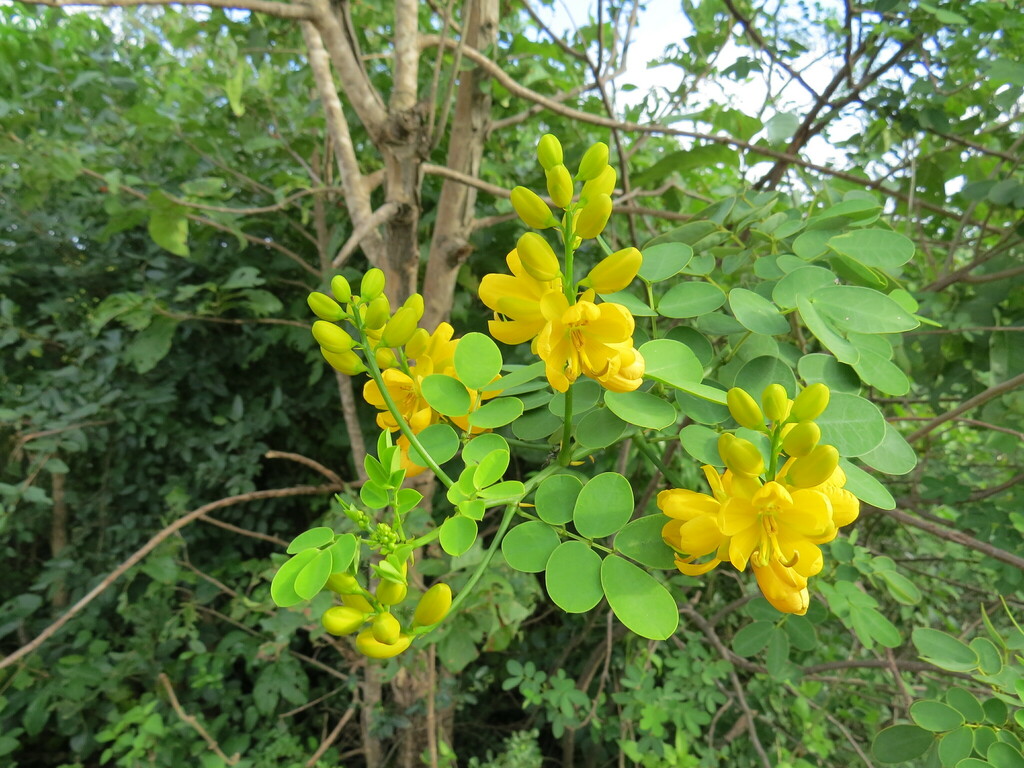
Money Bush
Senna bicapsularis
Senna bicapsularis is a species of the legume genus Senna, native to northern South America, from Panama south to Venezuela and Colombia, and also the West Indies. Common names include rambling senna (formerly "cassia"), winter cassia, Christmas bush, money bush, and yellow candlewood. In Florida, Senna pendula is usually cultivated as, and misapplied to, S. bicapsularis.
From the article Senna bicapsularis on Wikipedia (CC BY-SA), quoted section by section
Description
It is a semi-evergreen shrub growing to 3.5 m tall with a low spreading crown that reproduces by seed. It can grow from 2 – 12 metres tall and it branches from near the base. The leaves are 2.5–9 cm long, pinnate, with six to eight leaflets; the leaflets are 1.6–4.5 cm long and 1.1–2.3 cm broad. The yellow flowers are produced in masses with a few together on short racemes and 12–16 mm long. The plant flowers from autumn to winter, attracting bees and butterflies. Senna bicapsularis is distinguished from Senna pendula by having 3 pairs of leaflets on each leaf and elongated pedicels (flower stalks), while S. pendula has 4-7 pairs of leaflets on each leaf and a gland between each pair of leaflets, with shorter flower stalks. S. bicapsularis flowers from late fall to winter depending on climate, whilst S. pendula can flower from as early as late summer. Senna pendula can grow very easily from seed, while Senna bicapsularis has a tough seed coat that needs mechanical scarification to sprout with success.
At the table
In the 20th century, the plant may have been used as a traditional medicine to counteract the effects of arthropod stings, and in Mexico, a decoction was intended as a remedy for whooping cough. The seedpod flavour resembles tamarind.
Wikipedia: “Uses”
Where it lives
Recorded sightings
—
geo-referenced records in GBIF, from museums, herbaria and field observers.
Drag the globe to turn it. Dots are where records exist, not a range map; darker means more records.
In the stacks
Searching the stacks…
Every page naming Senna bicapsularis in the Biodiversity Heritage Library →
This page is assembled live from iNaturalist, GBIF, Wikipedia, the Source Library and the Internet Archive. It is not yet part of the hand-edited codex. iNaturalist taxon 134205.