- Plants
- ›Vascular Plants
- ›flowering plants
- ›Dicots
- ›Mints, Plantains, Olives, and Allies
- ›figwort family
- ›Buddlejeae
- ›Buddleja
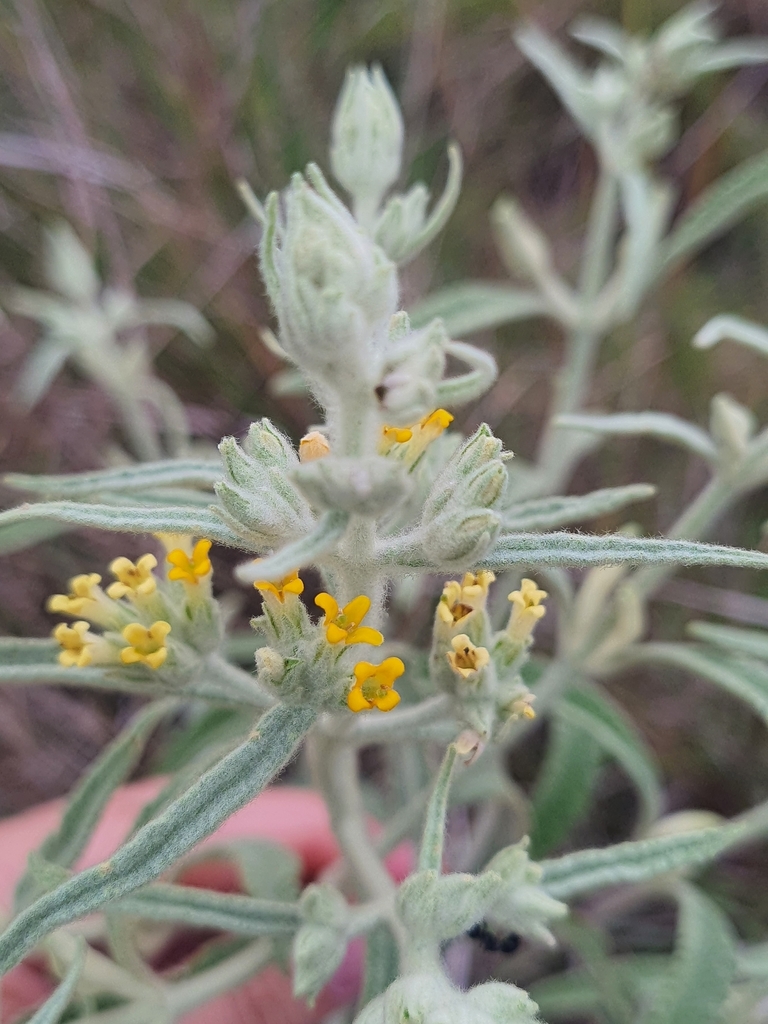
Buddleja grandiflora
Buddleja grandiflora is endemic to the marshy fields and river margins of southern Brazil, and adjacent areas of Argentina and Uruguay. The species was first described and named by Chamisso & von Schlechtendal in 1827.
From the article Buddleja grandiflora on Wikipedia (CC BY-SA), quoted section by section
Description
Buddleja grandiflora is a shrub 1 – 2 m high, and unlike most South American members of the genus, is hermaphroditic, not dioecious. The young branches are subquadrangular, and covered with a white tomentum, bearing leaves subsessile or with a petiole < 1 cm, narrowly lanceolate, 5 – 10 cm long by 1 – 2.5 cm wide, membranaceous, tomentose or glabrescent above, and lanose below. The yellow inflorescence is 5 – 15 cm long, comprising two orders of branches. The sessile perfect flowers are borne in pairs of cymes, each with 1 – 6 flowers. The tubular corolla is 10 – 12 mm long. Unusually, the spongy seeds have buoyancy cells at their bases enabling them to float and withstand flooding. The species is closely related to B. cestriflora, B. stachyoides, B. tubiflora, and B. hatschbachii.
Where it lives
Recorded sightings
—
geo-referenced records in GBIF, from museums, herbaria and field observers.
Drag the globe to turn it. Dots are where records exist, not a range map; darker means more records.
In the stacks
Searching the stacks…
Every page naming Buddleja grandiflora in the Biodiversity Heritage Library →
This page is assembled live from iNaturalist, GBIF, Wikipedia, the Source Library and the Internet Archive. It is not yet part of the hand-edited codex. iNaturalist taxon 1337752.