- Animals
- ›Arthropods
- ›Hexapods
- ›Insects
- ›Winged and Once-winged Insects
- ›Antlions, Lacewings, and Allies
- ›Lacewings and Allies
- ›Mantispoidea
- ›Mantidflies
- ›Mantispinae
- ›Climaciella
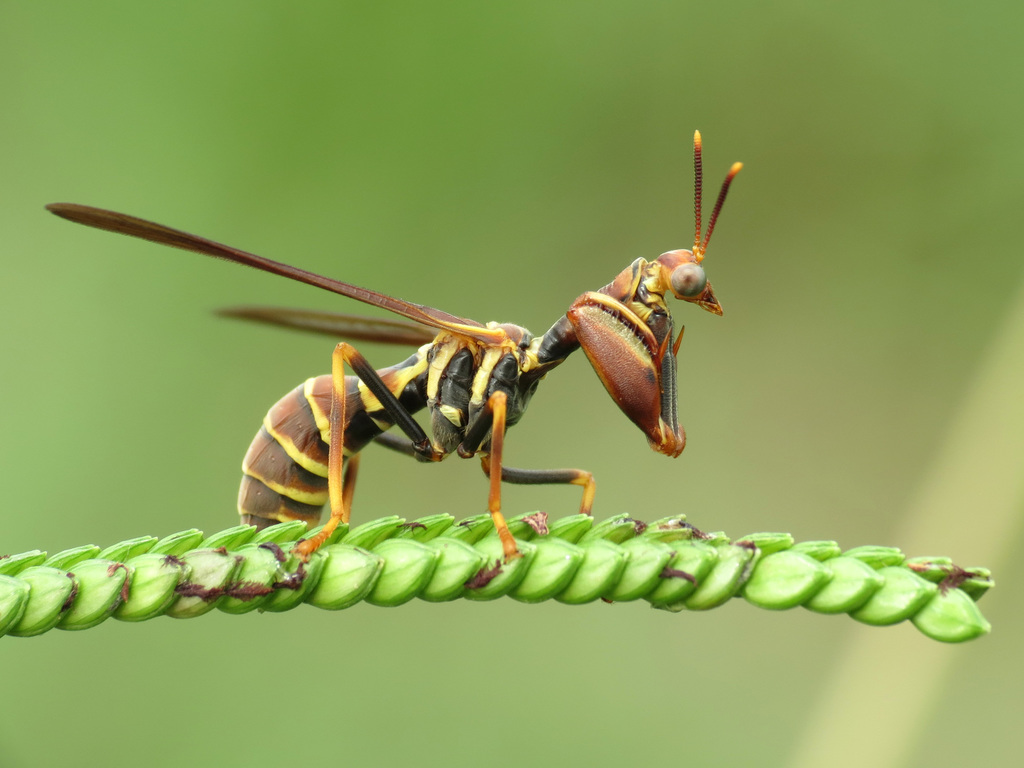
Brown Wasp Mantidfly
Climaciella brunnea
Climaciella brunnea, known sometimes by the common names wasp mantidfly, western mantidfly, and brown mantidfly, is a predatory neuropteran insect in the family Mantispidae.
From the article Climaciella brunnea on Wikipedia (CC BY-SA), quoted section by section
Description
C. brunnea has a triangular head with large, compound eyes and a broad frons. It has straight antennae. Its raptorial forelegs are similar in shape and function to that of Mantodea; this adaptation has evolved independently in the two groups and is an example of convergent evolution. The wings of C. brunnea are distinctive in that they are often characterized by having thick brown edges and transparent inner edges. The species has a body length of 2 to 3 cm. Its markings mimic those of wasp species within the Polistes genus. C. brunnea exhibits a large amount of color polymorphism as many groups will mimic the colorations of specific wasps found within their respective region.
Range & habitat
Climaciella brunnea is found in Canada, the United States, and as far south as Nicaragua. While finding a single C. brunnea alone is difficult, the species is most commonly seen in aggregations. Attracted to a male pheromone, groups of C. brunnea will accumulate in areas to breed and feed. Adults can be found sitting on vegetation or flowers in forest clearings. Individuals are often found on flower heads waiting for prey or feeding on nectar. Thus, it has some effect on pollination and is known as a casual pollinator.
Wikipedia: “Distribution”
What it does
First instar larvae of this species are campodeiform and will use phoretic behavior in an attempt to find an adult spider. C. brunnea specializes on lycosid spiders. The larvae have a unique adaptation known as a caudal sucker that they use to attach themselves to the substrate of their habitat. Once attached, they will lift themselves and begin to wave their body back and forth for a short period of time. Afterwards, if they have not grabbed onto a passing spider they will briefly rest before resuming their phoretic behavior. Once on the adult spider, a C. brunnea larva will remain atop the carapace of the spider until either the spider copulates or begins to lay eggs. If the larva grabbed onto a male spider, they will quickly transfer to a female spider when the male mates. If the larva is attached to a female spider initially, it will remain on her until she lays eggs. Until then, the larva will subsist off the spider's hemolymph. Once the spider is ready to lay eggs, the C. brunnea larva will quickly move into the sticky fluid the spider is using to construct the egg sac and thus the larva becomes trapped within the sac. Inside, the larva will use its specially adapted sucking tube (made from its maxilla and mandibles) to feed off the spider eggs within the sac.
Wikipedia: “Life cycle”
Listen
Looking for field recordings…
Where it lives
Recorded sightings
—
geo-referenced records in GBIF, from museums, herbaria and field observers.
Drag the globe to turn it. Dots are where records exist, not a range map; darker means more records.
In the stacks
Searching the stacks…
Every page naming Climaciella brunnea in the Biodiversity Heritage Library →
This page is assembled live from iNaturalist, GBIF, Wikipedia, the Source Library and the Internet Archive. It is not yet part of the hand-edited codex. iNaturalist taxon 133448.