- Plants
- ›Vascular Plants
- ›flowering plants
- ›Dicots
- ›Mints, Plantains, Olives, and Allies
- ›Plantain Family
- ›Toadflaxes and Allies
- ›Asarina
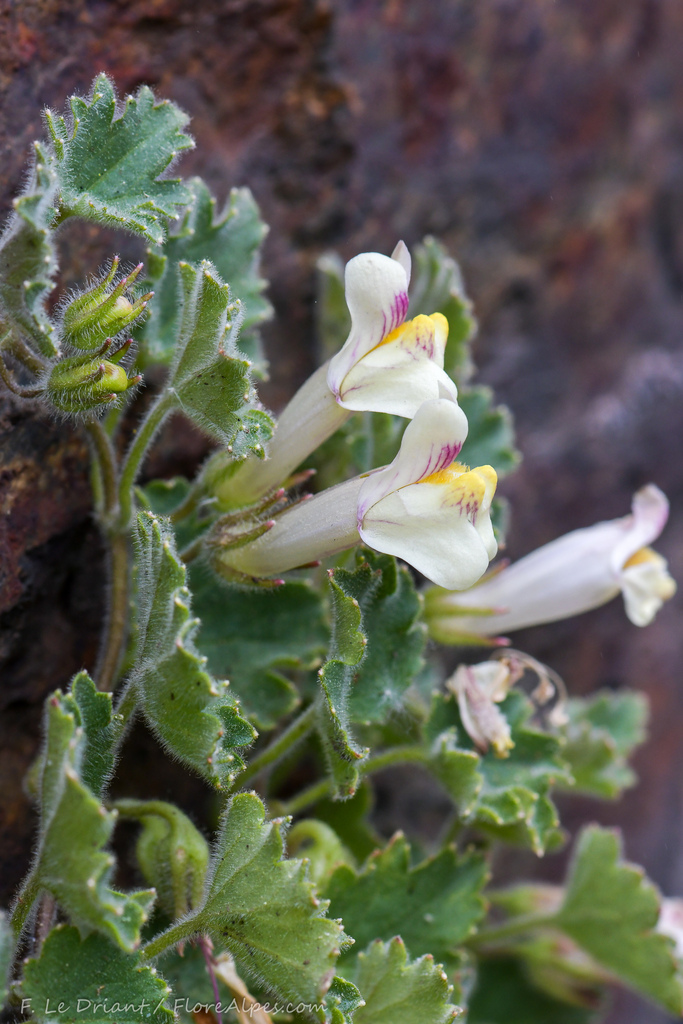
Trailing Snapdragon
Asarina procumbens
Asarina is a flowering plant genus of only one species, Asarina procumbens Mill. the trailing snapdragon, which is native to France and Spain and introduced in Germany, Switzerland, Austria, Hungary and the United Kingdom. Originally placed in the Scrophulariaceae (figwort family), the genus has more recently been moved to the Plantaginaceae (plantain family). Species from North America formerly placed in the genus Asarina are now placed in Holmgrenanthe, Lophospermum, Mabrya and Maurandya, as well as Neogaerrhinum. Asarina is now regarded as exclusively an Old World genus.
From the article Asarina on Wikipedia (CC BY-SA), quoted section by section
Description
The single remaining species of the now monotypic genus, A. procumbens is a foetid, strongly pubescent, viscid subshrub of trailing/mat-forming habit reaching a height of only 10-20cm. The somewhat woody main stems give rise to lax creeping/cascading stems bearing opposite, long-petioled, hairy, lobed, reniform-to-cordate leaves with crenate and often red-tinged margins. Flowers solitary or in short racemes of only two or three, fragrant, bumblebee-pollinated, borne in the leaf axils. Corolla cream-coloured, somewhat resembling that of Antirrhinum, the tube bearing faint violet striations, the upper part divided into two keel-like lips, the lower bearing paired inflated lobes, concealing the corolla tube, with a three-lobed margin; pistil violet, persistent, stamens four. Base of corolla bearing (starting behind inflated lobes and extending into corolla throat) a dense mat or beard of deep yellow trichomes. Calyx tubular, five-toothed, densely hairy. Peduncle narrow where joined to stem, thickening greatly to junction with fruiting calyx, reflexed so as to lie parallel to capsule. Fruit a dry capsule, glabrous, subglobose, shorter than the calyx and dehiscing at the apex by two openings separating three valves, the central valve bearing the persistent withered pistil. Seeds small, brownish-buff, roughly conical, testa finely incised with deep sinuous furrows. …
Range & habitat
A. procumbens is a semi-evergreen alpine chasmophyte, favouring partial shade, its preferred habitat being crevices in silica-rich, non-sedimentary rocks. This type of habitat - "Mediterranean siliceous inland cliff" - is designated by endangered habitat code H3.1d by the European Red List of Habitats. The term siliceous cliffs (in this context) refers to those which are composed chiefly of quartz-rich rocks (making them of an acidic character) of either igneous type, such as granite, diorite and andesite, or metamorphic type, such as gneiss, slate, schist and quartzite. Low-altitude cliffs of this type - as favoured by A. procumbens - are more affected by human disturbances than high mountain cliffs, as the latter often occur within nature reserves and other protected areas. Cliffs at low altitudes, by contrast, are susceptible to a wide variety of threats including the shoring-up of cliffs over roads and railway lines, sport and leisure activities -particularly rock-climbing - and, at lower elevations, mining, quarrying and invasive/alien plants. In the French part of its range A. procumbens is seldom to be found growing at altitudes below 400m, with an upper limit of some 1800m.
Wikipedia: “Endangered habitat”
How it is grown
A. procumbens grows best in somewhat dry partial shade. Soil: well-drained, sandy/gravelly, humus-rich, moderately moist: dislikes excessive winter wetness. Blooms most profusely in climates in which summers are not excessively hot. Pollinated by bumblebees. Plant is evergreen in mild climates, although may be killed outright by heavy frost, in which case may be propagated afresh: self-seeds readily. Uses: trailing alpine or ground cover. Thrives and increases rapidly as a container plant. Not usually invasive in gardens, though one report of aggressive growth from southeastern U.S.A. Pruning: not usually needed, though may be cut back in autumn if foliage is spent or untidy. Hardiness zone: U.K. H3. USDA zones 8,9 & 10.
Wikipedia: “Cultivation”
Where it lives
Recorded sightings
—
geo-referenced records in GBIF, from museums, herbaria and field observers.
Drag the globe to turn it. Dots are where records exist, not a range map; darker means more records.
In the stacks
Searching the stacks…
Every page naming Asarina procumbens in the Biodiversity Heritage Library →
This page is assembled live from iNaturalist, GBIF, Wikipedia, the Source Library and the Internet Archive. It is not yet part of the hand-edited codex. iNaturalist taxon 133227.