- Plants
- ›Vascular Plants
- ›flowering plants
- ›Dicots
- ›Buttercups, Poppies, and Allies
- ›Poppy Family
- ›Poppy Subfamily
- ›Chelidonieae
- ›Bocconia
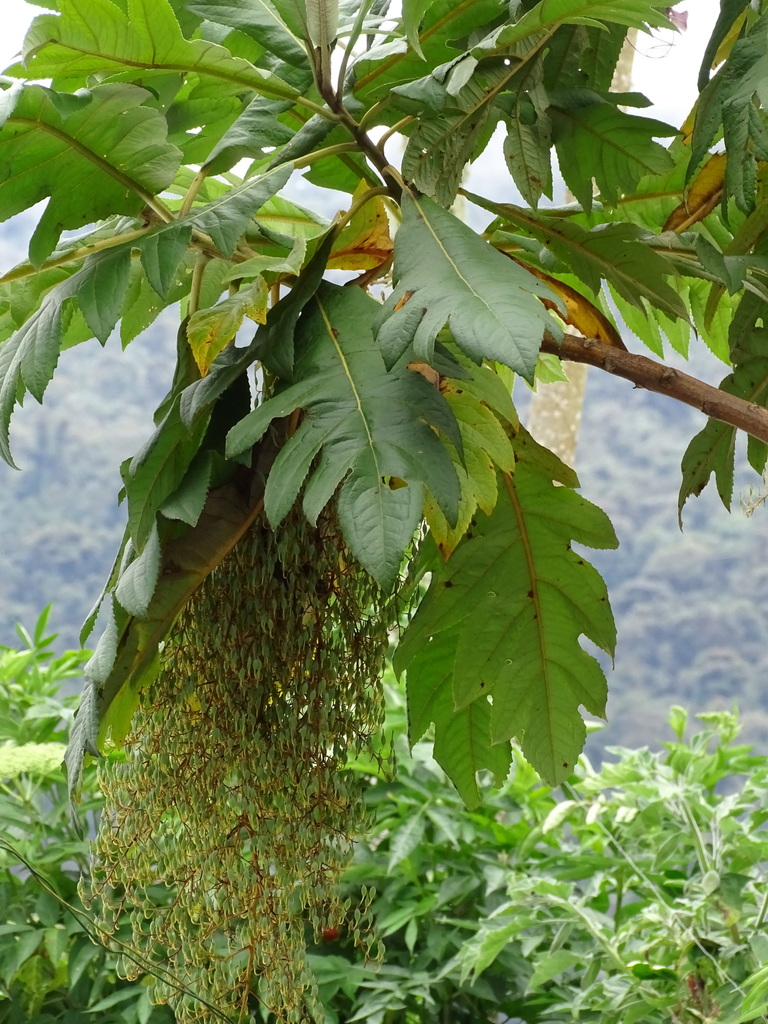
Parrotweed
Bocconia frutescens
Bocconia frutescens is a species of flowering plant in the poppy family known by many common names, including plume poppy, tree poppy, tree celandine, parrotweed, sea oxeye daisy, and John Crow bush in English, gordolobo, llorasangre, tabaquillo, palo amarillo, palo de toro and pan cimarrón in Spanish, bois codine in French and bwa kodenn in Haitian Kreyòl. It is native to the Americas, including Mexico, parts of Central and South America, and the West Indies. It is perhaps better known in Hawaii, where it is an introduced species and an aggressive invasive weed with rapid negative effects on local ecosystems. In other parts of the United States it is used as an ornamental plant for its "tropical"-looking foliage.
From the article Bocconia frutescens on Wikipedia (CC BY-SA), quoted section by section
Description
This relative of the poppy is a shrub growing up to 6 metres tall. It yields a bitter yellow or orange latex sap. The leaves are up to 45 cm long by 20 wide and the blades are divided into deep lobes. There are many leaves toward the ends of the branches. The inflorescence is a branching panicle up to 60 centimeters long. The purple-green flower lacks petals but has sepals each up to a centimetre long. The anthers dangle from the flower center by their filaments. The fruit is a capsule about 1.2 cm long containing yellowish pulp and a single black seed half-sheathed in a bright red aril.
What it does
This plant is capable of thriving in many types of habitat. In its native range it grows in dry, moist, and wet forests on many soil types. It is known from cloud forests and several types of disturbed and degraded habitat. It is not, however, tolerant of dense shade. The seeds of the plant are generally dispersed by birds, which are attracted to the pulpy fruits. In Hawaii, the Japanese white-eye (Zosterops japonicus) is a common visitor to the plant. In its native range it is also an important plant for various birds.
Wikipedia: “Ecology”
Where it lives
Recorded sightings
—
geo-referenced records in GBIF, from museums, herbaria and field observers.
Drag the globe to turn it. Dots are where records exist, not a range map; darker means more records.
In the stacks
Searching the stacks…
Every page naming Bocconia frutescens in the Biodiversity Heritage Library →
This page is assembled live from iNaturalist, GBIF, Wikipedia, the Source Library and the Internet Archive. It is not yet part of the hand-edited codex. iNaturalist taxon 133166.