- Animals
- ›Arthropods
- ›Hexapods
- ›Insects
- ›Winged and Once-winged Insects
- ›Butterflies and Moths
- ›Butterflies
- ›Metalmark Butterflies
- ›Old World Metalmarks
- ›Nemeobiini
- ›Nemeobiina
- ›Hamearis
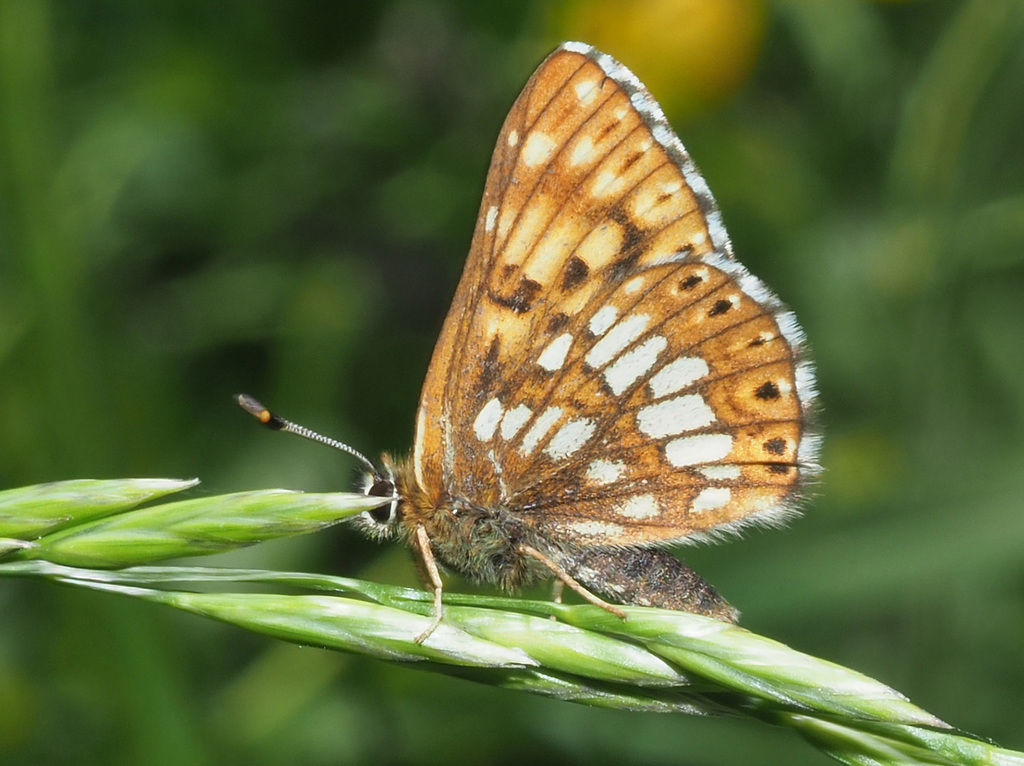
Duke of Burgundy
Hamearis lucina
Hamearis lucina, the Duke of Burgundy, the only member of the genus Hamearis, is a European butterfly in the family Riodinidae. For many years, it was known as the "Duke of Burgundy fritillary", because the adult's chequered pattern is strongly reminiscent of "true" fritillaries of the family Nymphalidae.
From the article Hamearis lucina on Wikipedia (CC BY-SA), quoted section by section
Description
The male has a wingspan of 29–31 millimetres (1.1–1.2 in), and the female 31–34 mm (1.2–1.3 in). The upperside of the wings are marked in a checquered pattern strongly reminiscent of a fritillary butterfly (family Nymphalidae); however, the Duke of Burgundy may be separated by its wing shape. Hamearis lucina also has a distinctive underwing pattern.
Range & habitat
The species' range is restricted to the Western Palaearctic, from Spain, the UK and Sweden to the Balkans. It is the sole representative of its (sub)family in Europe.
Wikipedia: “Range”
Listen
Looking for field recordings…
Where it lives
Recorded sightings
—
geo-referenced records in GBIF, from museums, herbaria and field observers.
Drag the globe to turn it. Dots are where records exist, not a range map; darker means more records.
In the stacks
Searching the stacks…
Every page naming Hamearis lucina in the Biodiversity Heritage Library →
This page is assembled live from iNaturalist, GBIF, Wikipedia, the Source Library and the Internet Archive. It is not yet part of the hand-edited codex. iNaturalist taxon 133154.