On eBird ↗
Fiscal Flycatcher
Live sightings near you, the range map, bar charts of when it is seen, and Macaulay Library photos and recordings.
Fiscal Flycatcher
Sigelus silens
The fiscal flycatcher (Sigelus silens) is a small passerine bird in the Old World flycatcher family. It is the only species placed in the genus Sigelus. It is a resident breeder in Botswana, South Africa, Lesotho, Mozambique and Swaziland, and a vagrant to Namibia.
This species is found in subtropical open woodland, dry savanna, shrubland and suburban gardens.
From the article Fiscal flycatcher on Wikipedia (CC BY-SA), quoted section by section
Description
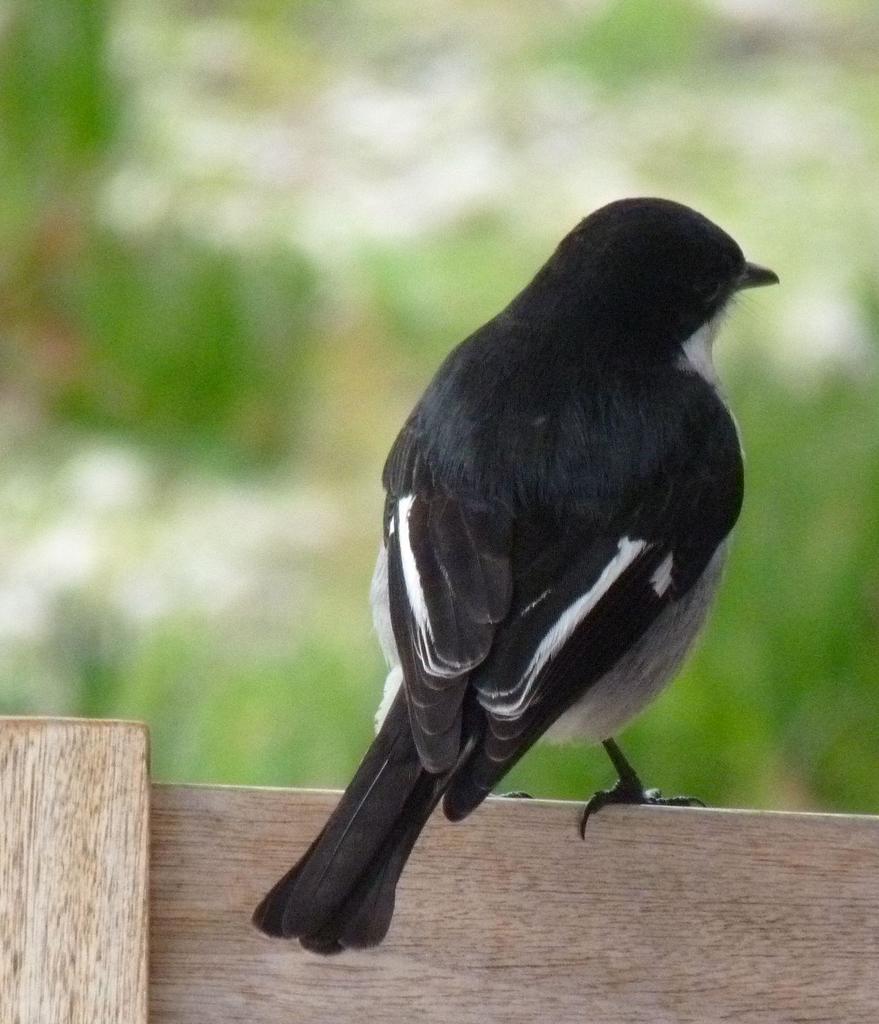
This black and white bird gets its name from its resemblance to the northern and southern fiscal shrikes (previously considered one species, common fiscal), shrikes that in turn get the name from their black and white suit-and-tie appearance reminiscent of the taxman ('fiscal'). The male may be confused with the fiscal shrikes, but the shrikes have heavy, hooked bills, white patches on the shoulder rather than the lower wing, and no white on their longer tails. The resemblance is assumed to be an example of Batesian mimicry. The fiscal flycatcher is 17–20 cm in length. The adult male is black above and white below with white wing patches and white sides to the tail. The female is brown above, somewhat like an immature fiscal shrike, not black. The juvenile is like the female but duller and with brown spots and scalloping above and below. The song is a weak chittering, and the alarm call is tssisk. The fiscal flycatcher is larger than the male collared flycatcher, which has a white collar and lacks white wing panels.
What it does
The fiscal flycatcher builds an open-cup nest from thin stems and other plant material, and lined with plant down. It is placed in a dense bush or thicket in a tree. In these respects it resembles the fiscal shrike. The fiscal flycatcher feeds on insects, often taken in flight, but also on non-flying prey such as caterpillars. It may prey on the spiny caterpillars or "woolly worms" of tiger moths, after first scrubbing them on the ground or on bark, thereby denuding them of the worst of their spines. It also feeds on various species of small wild berries, such as Halleria and Chrysanthemoides, and from nectar-rich flowers such as some Aloe. In suburban gardens it commonly feeds opportunistically on domestic scraps.
Wikipedia: “Behaviour”
Listen
Looking for field recordings…
Where it lives
Recorded sightings
—
geo-referenced records in GBIF, from museums, herbaria and field observers.
Drag the globe to turn it. Dots are where records exist, not a range map; darker means more records.
In the stacks
Searching the stacks…
Every page naming Sigelus silens in the Biodiversity Heritage Library →
This page is assembled live from iNaturalist, GBIF, Wikipedia, the Source Library and the Internet Archive. It is not yet part of the hand-edited codex. iNaturalist taxon 13251.