- Plants
- ›Vascular Plants
- ›flowering plants
- ›Dicots
- ›Mallows, Rock Roses, and Allies
- ›Mallow and Hibiscus Family
- ›Malvoideae
- ›Malveae
- ›Sida
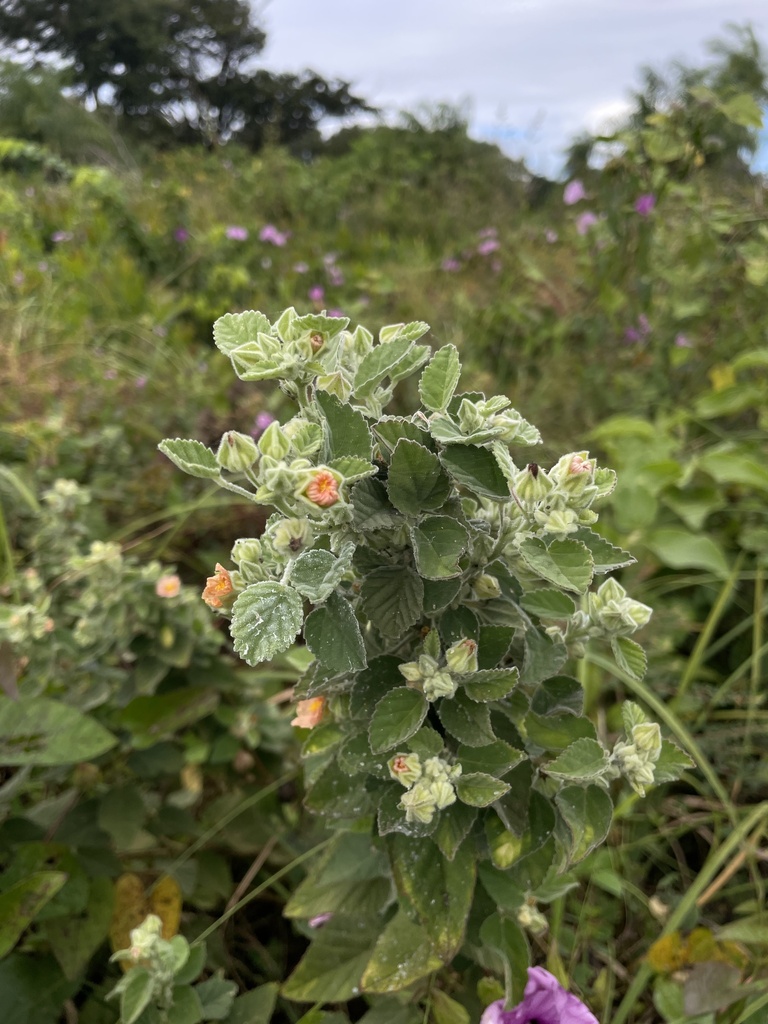
flannel weed
Sida cordifolia
Sida cordifolia ('ilima, flannel weed, bala, country mallow or heart-leaf sida) is a perennial subshrub of the mallow family Malvaceae native to India. It has naturalized throughout the world, and is considered an invasive weed in Africa, Australia, the southern United States, Hawaiian Islands, New Guinea, and French Polynesia. The specific name, cordifolia, refers to the heart-shaped leaf.
From the article Sida cordifolia on Wikipedia (CC BY-SA), quoted section by section
Description
Sida cordifolia is an erect perennial that reaches 50 to 200 cm (20 to 79 in) tall, with the entire plant covered with soft white felt-like hair that is responsible for one of its common names, "flannel weed". The stems are yellow-green, hairy, long, and slender. The yellow-green leaves are oblong-ovate, covered with hairs, and 3.5 to 7.5 cm (1.4 to 3.0 in) long by 2.5 to 6 cm (0.98 to 2.36 in) wide. The flowers are dark yellow, sometimes with a darker orange center, with a hairy 5-lobed calyx and 5-lobed corolla. As a weed, it invades cultivated and overgrazed fields, competing with more desired species and contaminating hay.
In medicine
Sida cordifolia is used in Ayurvedic medicine (Sanskrit:-BALA). Known as "malva branca", it is a plant used in Brazilian folk medicine for the treatment of inflammation of the oral mucosa, blennorrhea, asthmatic bronchitis and nasal congestion, stomatitis, of asthma and nasal congestion and in many parts of Africa for various ailments, particularly for respiratory problems. It has been investigated as an anti-inflammatory, for preventing cell proliferation, and for encouraging liver re-growth. Because of its ephedrine content, it possesses psychostimulant properties, affecting the central nervous system and also the heart.
Wikipedia: “Medicinal use”
Where it lives
Recorded sightings
—
geo-referenced records in GBIF, from museums, herbaria and field observers.
Drag the globe to turn it. Dots are where records exist, not a range map; darker means more records.
In the stacks
Searching the stacks…
Every page naming Sida cordifolia in the Biodiversity Heritage Library →
This page is assembled live from iNaturalist, GBIF, Wikipedia, the Source Library and the Internet Archive. It is not yet part of the hand-edited codex. iNaturalist taxon 132448.