- Animals
- ›Arthropods
- ›Hexapods
- ›Insects
- ›Winged and Once-winged Insects
- ›Grasshoppers, Crickets, and Katydids
- ›Grasshoppers, Locusts, and Allies
- ›Grasshoppers
- ›Short-horned Grasshoppers and Locusts
- ›Short-horned Grasshoppers
- ›Slant-faced Grasshoppers
- ›Stenobothrini
- ›Omocestus
- ›Omocestus
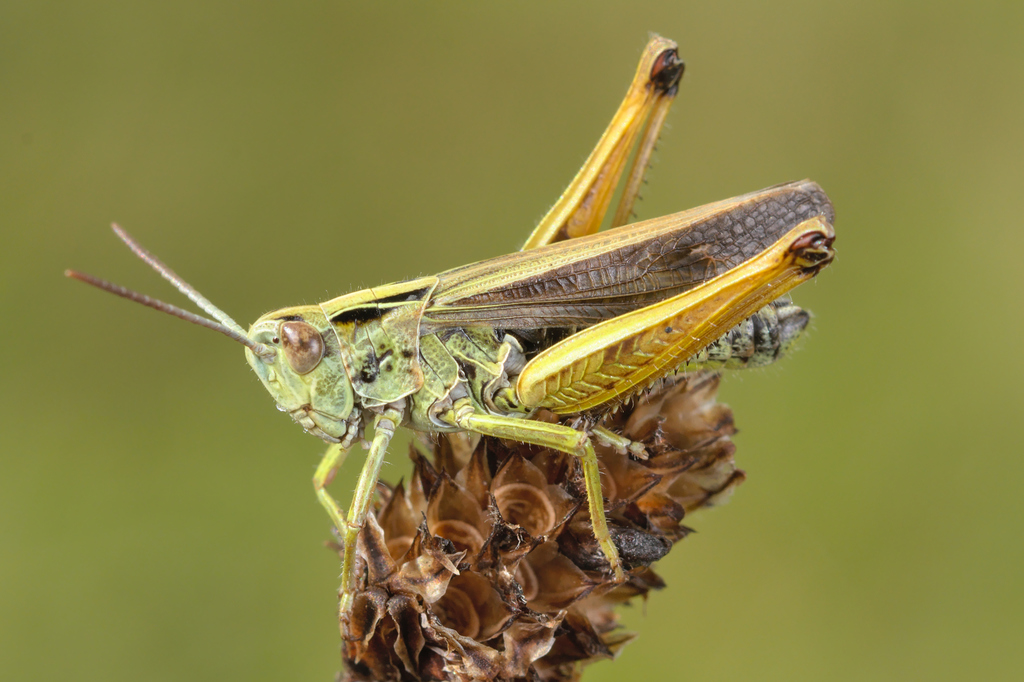
Common Green Grasshopper
Omocestus viridulus
Omocestus viridulus, known in the British Isles as the common green grasshopper, is a Palearctic species of grasshopper in the subfamily Gomphocerinae.
From the article Omocestus viridulus on Wikipedia (CC BY-SA), quoted section by section
Description
Omocestus viridulus are usually green all over, but some may have brown coloration on the sides. In Scandinavia, they are usually green or light brown. The males do not have any red coloring on the abdomen and possess a noticeably long ovipositor, characteristics that help distinguish it from the similar species O. rufipes and O. haemorrhoidalis. The eyes of this species may be brown or yellow. The typical body length is 17–20 millimetres (0.67–0.79 in). They possess a strongly darkened region of the hind wing.
Wikipedia: “Morphology”
Range & habitat
Omocestus viridulus typically lives in moderately wet regions around Europe except north of the Arctic Circle, and it is distributed widely over Britain. Its range extends east as far as Siberia and Mongolia. Their preferred habitat consists of areas with longer grass.
Wikipedia: “Distribution and habitat”
What it does
This species prefers to feed on the more common, abundant grass species and this may promote greater diversity of vegetation. O. viridulus feeds on grass from the genera Dactylis, Agrostis, Anthoxanthum, Lolium and Holcus. The life cycle begins with the females laying their clutch of eggs in the top layer of soil or near the root of the grass stalks. The young are called nymphs and emerge the next April. These nymphs resemble miniature versions of the adults with immature wings. After about a month of moulting their exoskeleton several times, they mature into adults with working wings. There is one generation of O. viridulus a year, and they are usually seen between the months of April and October.
Wikipedia: “Diet and life cycle”
Listen
Looking for field recordings…
Where it lives
Recorded sightings
—
geo-referenced records in GBIF, from museums, herbaria and field observers.
Drag the globe to turn it. Dots are where records exist, not a range map; darker means more records.
In the stacks
Searching the stacks…
Every page naming Omocestus viridulus in the Biodiversity Heritage Library →
This page is assembled live from iNaturalist, GBIF, Wikipedia, the Source Library and the Internet Archive. It is not yet part of the hand-edited codex. iNaturalist taxon 132419.