- Animals
- ›Arthropods
- ›Hexapods
- ›Insects
- ›Winged and Once-winged Insects
- ›Beetles
- ›Water, Rove, Scarab, Long-horned, Leaf, and Snout Beetles
- ›Staphyliniform Beetles
- ›Rove, Ant-like stone, and Carrion Beetles
- ›Rove Beetles
- ›Burying and Carrion Beetles
- ›Nicrophorini
- ›Nicrophorus
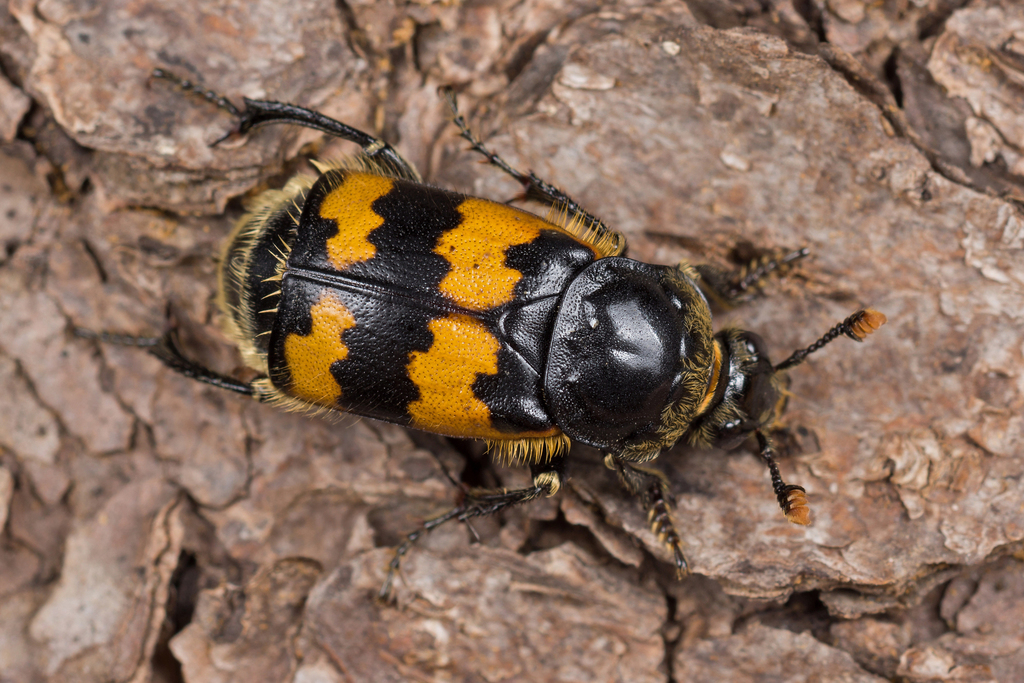
Vespillo Burying Beetle
Nicrophorus vespillo
Nicrophorus vespillo is a burying beetle described by Carl Linnaeus in his landmark 1758 10th edition of Systema Naturae. It has a paleartic distribution and is commonly found across Europe and Asia, extending from Western Europe to Mongolia.
From the article Nicrophorus vespillo on Wikipedia (CC BY-SA), quoted section by section
Description
These are large beetles, from 12 to 25 mm in length and fly strongly. The beetles have two striking orange-yellow bands on the wing-cases. They are distinguished from others in the genus by the long golden hairs on the body and wing-cases as well as the orange club-shaped ends of the antennae and the shape of the hind legs.
What it does
They live on and lay eggs near carrion. The beetles reproduce from May to September, with both parents participating in preparations and care of the offspring. The parents will excavate beneath suitable small animal corpses, also covering it with the soil, so that it becomes buried and ready for the female to lay eggs. They may move the body to a more suitable location prior to burial. Burial can take place within a day for a small animal like a mouse. After burial they remove hair or feathers and shape the carcass into a ball within a small underground space. Eggs are laid in the soil around the chamber. Once the young beetles hatch as larvae, both parents will feed and protect for them. This care continues for at least 10 days and is up to 30 days earlier in the season when temperatures are cooler and the young develop more slowly. The young will consume the corpse directly and also eat pre-digested food regurgitated by their parents. The final stage in their development is to pupate in the soil and then emerge as adult beetles. Pupae formed towards the end of the breeding season may spend the winter in hibernation and emerge as juvenile beetles the following spring.
== References ==
Wikipedia: “Reproduction”
Listen
Looking for field recordings…
Where it lives
Recorded sightings
—
geo-referenced records in GBIF, from museums, herbaria and field observers.
Drag the globe to turn it. Dots are where records exist, not a range map; darker means more records.
In the stacks
Searching the stacks…
Every page naming Nicrophorus vespillo in the Biodiversity Heritage Library →
This page is assembled live from iNaturalist, GBIF, Wikipedia, the Source Library and the Internet Archive. It is not yet part of the hand-edited codex. iNaturalist taxon 131878.