On eBird ↗
Black Solitaire
Live sightings near you, the range map, bar charts of when it is seen, and Macaulay Library photos and recordings.
Black Solitaire
Entomodestes coracinus
The black solitaire (Entomodestes coracinus) is a species of bird in the family Turdidae. It is found in Colombia and Ecuador. Its natural habitats are subtropical or tropical moist lowland forests and subtropical or tropical moist montane forests.
From the article Black solitaire on Wikipedia (CC BY-SA), quoted section by section
Description
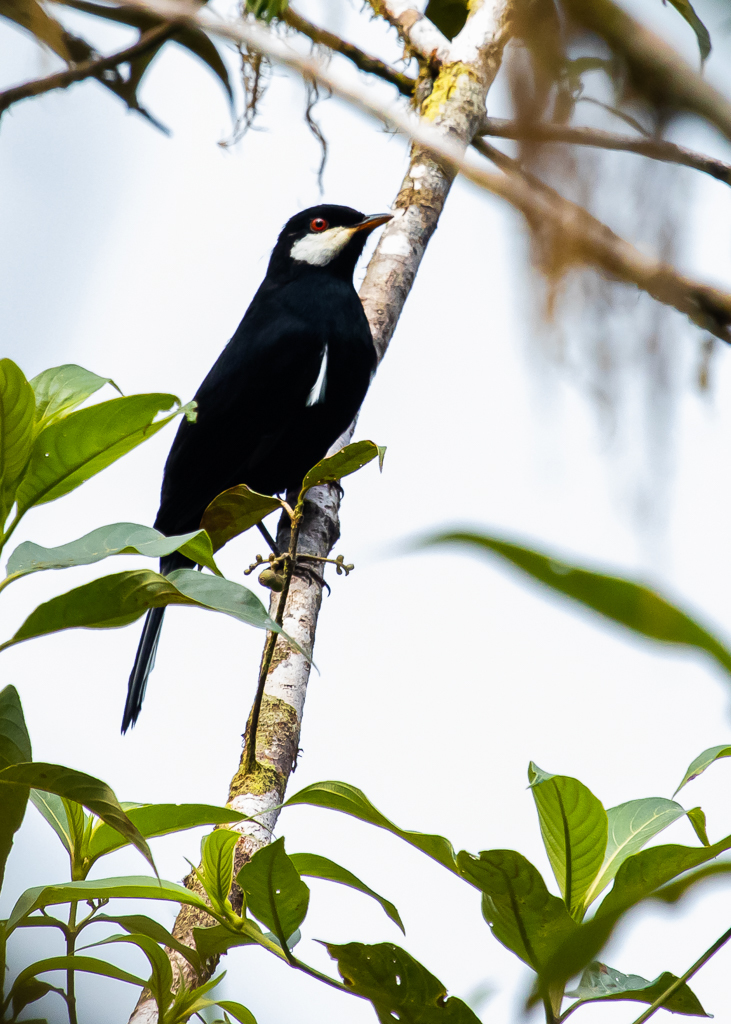
The black solitaire is about 23 cm (9.1 in) long; one individual weighed 56 g (2.0 oz). The sexes have the same plumage. Adults are almost entirely glossy black. They have silvery white "cheeks" from the base of the bill to the ear coverts, white underwing coverts, and white lower halves of their outer tail feathers. They have a red iris, a black maxilla, a yellowish orange mandible, and dark grayish brown legs and feet. Juveniles are mostly dull brown with less white than adults.
Range & habitat
The black solitaire is a bird of the Chocó region from Chocó Department in west-central Colombia south to Pichincha Province in northwestern Ecuador. It is found intermittently within that overall range. It inhabits the interior and edges of wet forest in the tropical and lower subtropical zones and occasionally is found in secondary forest. It especially favors forest that is dense with mosses. In elevation it is found between 400 and 2,300 m (1,300 and 7,500 ft) in Colombia and between 1,100 and 1,600 m (3,600 and 5,200 ft) in Ecuador.
Wikipedia: “Distribution and habitat”
What it does
The black solitaire feeds on fruit, taking it at all levels of the forest. It primarily forages singly or in pairs but will share fruiting trees with small numbers of its and other species.
Wikipedia: “Feeding”
Listen
Looking for field recordings…
Where it lives
Recorded sightings
—
geo-referenced records in GBIF, from museums, herbaria and field observers.
Drag the globe to turn it. Dots are where records exist, not a range map; darker means more records.
In the stacks
Searching the stacks…
Every page naming Entomodestes coracinus in the Biodiversity Heritage Library →
This page is assembled live from iNaturalist, GBIF, Wikipedia, the Source Library and the Internet Archive. It is not yet part of the hand-edited codex. iNaturalist taxon 13176.