- Plants
- ›Vascular Plants
- ›flowering plants
- ›Dicots
- ›Nances, Willows, and Allies
- ›Spurge Family
- ›Euphorbioideae
- ›Euphorbieae
- ›Euphorbiinae
- ›Euphorbia
- ›Chamaesyce
- ›Anisophyllum
- ›Euphorbia hyssopifolia
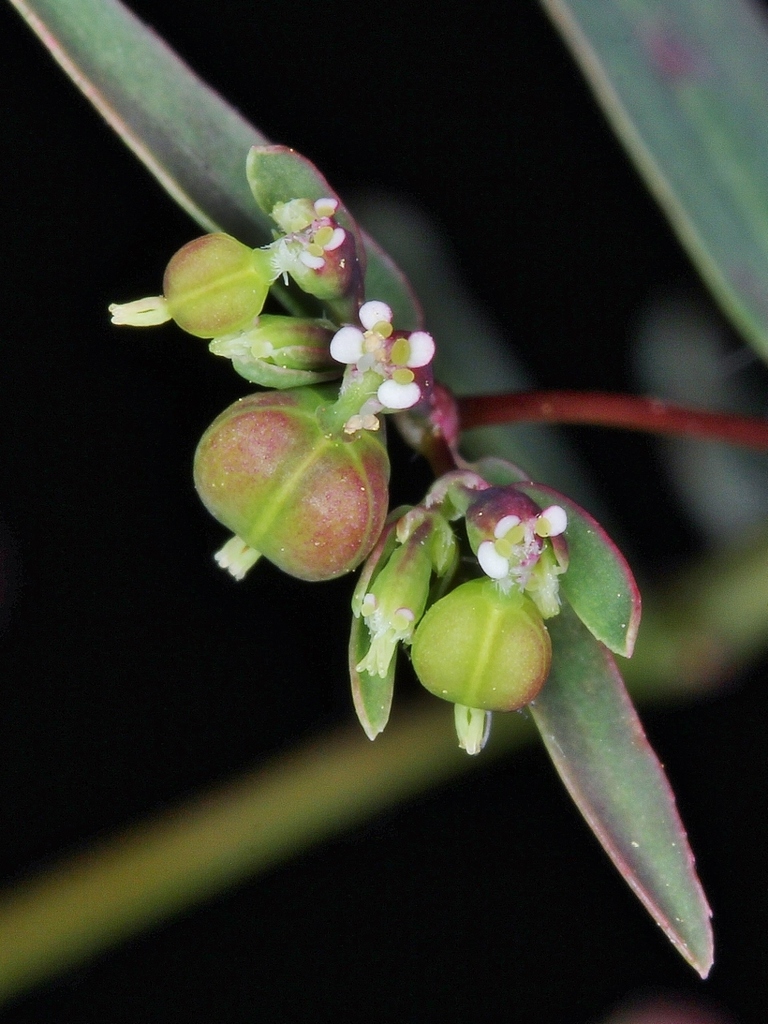
hyssop spurge
Euphorbia hyssopifolia
Euphorbia hyssopifolia, known by the common name of hyssopleaf sandmat in English and hierba de pollo ("chicken grass") in Spanish, is a member of the spurge family, Euphorbiaceae. It is an annual herb, native to Central and South America and the Southeastern United States. It has also been introduced to west Tropical Africa, India, and Australia.
From the article Euphorbia hyssopifolia on Wikipedia (CC BY-SA), quoted section by section
Description
Arching annual to 80 cm with leaf-bases oblique. Flowers and fruits in small loose clusters. Because it is rather confusable with the usually slightly hairier E. nutans, fruit capsules should always be opened for seeds. The seeds are cross-ridged and rather square-edged in comparison to the more irregular rounder-edged seeds of E. nutans. Seeds: "brown to grayish white, ovoid, slightly 4-angled in cross section, abaxial faces convex, adaxial faces slightly concave to slightly convex, 1–1.4 × 0.7–1.1 mm, with 2–3 prominent transverse ridges that do not interrupt adaxial keel, or coarsely and inconspicuously pitted-reticulate." FNA (see also FNA nutans)
Where it lives
Recorded sightings
—
geo-referenced records in GBIF, from museums, herbaria and field observers.
Drag the globe to turn it. Dots are where records exist, not a range map; darker means more records.
In the stacks
Searching the stacks…
Every page naming Euphorbia hyssopifolia in the Biodiversity Heritage Library →
This page is assembled live from iNaturalist, GBIF, Wikipedia, the Source Library and the Internet Archive. It is not yet part of the hand-edited codex. iNaturalist taxon 131561.