- Plants
- ›Vascular Plants
- ›flowering plants
- ›monocots
- ›Agaves, Orchids, Irises, and Allies
- ›Orchids
- ›Orchidoid Orchids
- ›Orchideae
- ›Orchidinae
- ›Platanthera
- ›Limnorchis
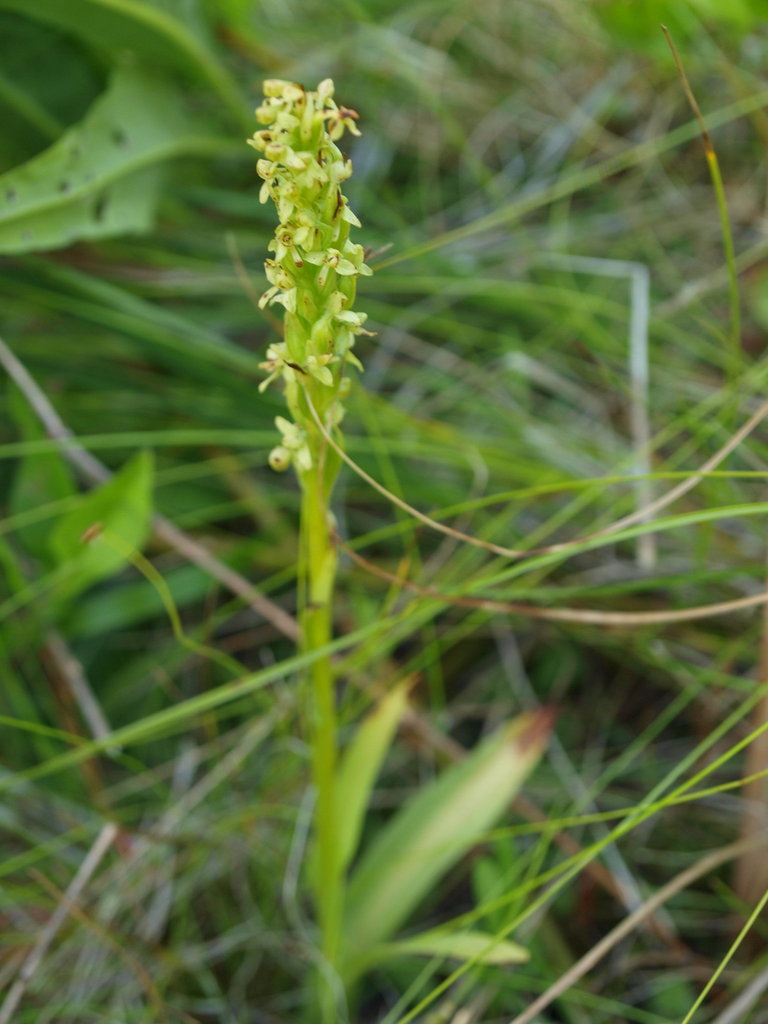
north wind bog orchid
Platanthera aquilonis
Platanthera aquilonis, the northern green orchid or north wind bog orchid, is a species of self-fertilizing orchid native to the United States and Canada with a widespread distribution across the two countries.
From the article Platanthera aquilonis on Wikipedia (CC BY-SA), quoted section by section
Description
Platanthera aquilonis is a small plant 5–60 cm in height. Flowers emerge in May and are present until August. These flowers are not showy and are generally a yellowish green color. The leaves are alternating and replaced by lenceloate bracts higher up on the stem. This orchid can be most easily identified by its forward rotated pollinia spilling over into the stigma and its rhombic to rhombic lanceolate lip. It is very similar looking to Platanthera huronensis but can be separated by the fact that Platanthera huronensis is whitish green whereas Platanthera aquilonis is just green or yellowish green in color. Platanthera aquilonis is usually scentless except in the far northwest of its range.
Range & habitat
Platanthera aquilonis occurs throughout much of Canada and the northern United States. But the southern extent of this species range follows the Rocky Mountains all the way into Northern New Mexico. This species can be found in a very large range of habitats including meadows, marshes, fens, the tundra, along stream banks and roadsides, as well as in wet deciduous forests. This plant can be commonly found at elevations between 0–2500 meters but has been found at elevations up to 3400 meters.
Wikipedia: “Distribution and habitat”
What it does
Platanthera aquilionis is facultatively self fertilizing. The pollinia rotate forward above the stigma and then either are transferred directly or fall onto the stigma. It has also more recently been described that water droplets may play a large role in this process collecting pollen in the droplet and then falling and depositing the pollen onto the stigma below.
Wikipedia: “Pollination”
Where it lives
Recorded sightings
—
geo-referenced records in GBIF, from museums, herbaria and field observers.
Drag the globe to turn it. Dots are where records exist, not a range map; darker means more records.
In the stacks
Searching the stacks…
Every page naming Platanthera aquilonis in the Biodiversity Heritage Library →
This page is assembled live from iNaturalist, GBIF, Wikipedia, the Source Library and the Internet Archive. It is not yet part of the hand-edited codex. iNaturalist taxon 131230.