- Animals
- ›Chordates
- ›Vertebrates
- ›Birds
- ›Perching Birds
- ›Old World Flycatchers, Robins, and Chats
- ›Enicurus
On eBird ↗
Chestnut-naped Forktail
Live sightings near you, the range map, bar charts of when it is seen, and Macaulay Library photos and recordings.
Chestnut-naped Forktail
Enicurus ruficapillus
The chestnut-naped forktail (Enicurus ruficapillus) is a species of bird in the flycatcher and chat family Muscicapidae. The species is monotypic, having no subspecies. It is found in Sundaland, in southern Burma and Thailand to Peninsular Malaysia, as well as Sumatra and Borneo. The species is not migratory.
From the article Chestnut-naped forktail on Wikipedia (CC BY-SA), quoted section by section
Description
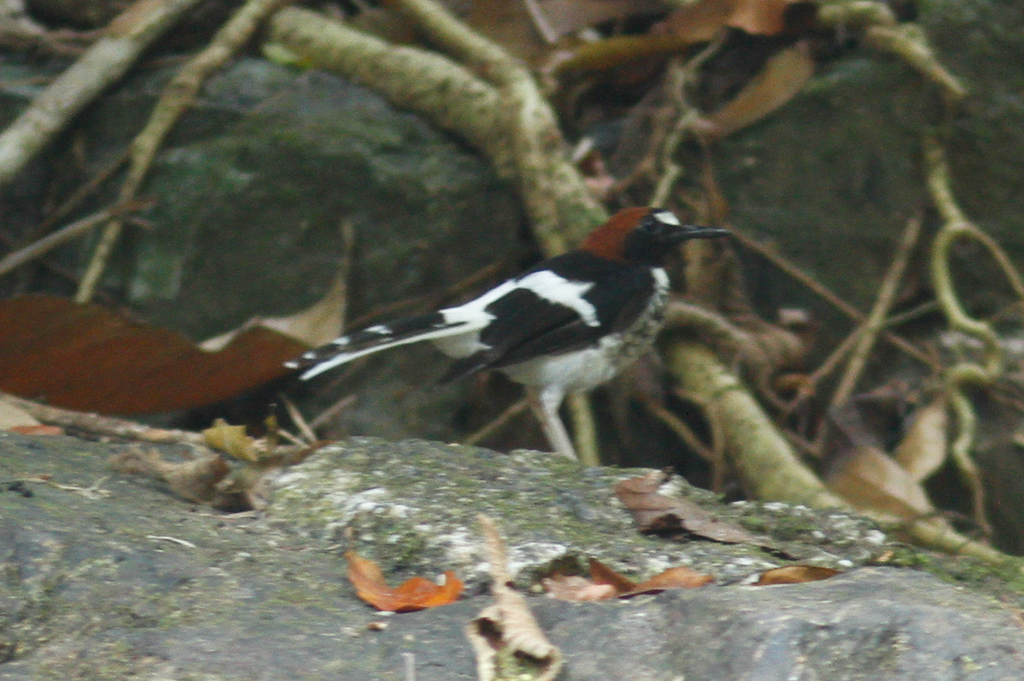
The chestnut-naped forktail is 18 to 20 cm (7.1–7.9 in) long and weighs 27 g (0.95 oz). The head of the male is chestnut-coloured, with a white forehead and black mask in front of the eye. The wings are black with a white wing-bar. The breast is white with black barring, fading towards the white belly. The rump is white and the tail is black with white stripes and a white tip. The female is the same as the male except the back and mantle is chestnut. The chestnut-naped forktail calls in flight, either a single or three whistles.
Range & habitat
The species is found along clear rivers and streams in lowland and hill rainforest. It can also be found in secondary scrub, dry ridges, and along logging roads. It is found from sea-level to 1,300 m (4,300 ft), except in southern Thailand, where it only reaches 900 m (3,000 ft).
Wikipedia: “Habitat and distribution”
What it does
Chestnut-naped forktails forage near water, eating a range of insects including earwigs, beetles, ants and caterpillars. They have also been recorded eating snakes. The nest is a cup of plant fibres, lined with leaf skeletons and decorated on the outside with moss. The nest is fixed with mud to a boulder or bank. The clutch size is 2 eggs, which are white or pale pink and marked with reddish-brown speckles and purple undermarkings. This species is a host to brush cuckoos.
Wikipedia: “Behaviour”
Listen
Looking for field recordings…
Where it lives
Recorded sightings
—
geo-referenced records in GBIF, from museums, herbaria and field observers.
Drag the globe to turn it. Dots are where records exist, not a range map; darker means more records.
In the stacks
Searching the stacks…
Every page naming Enicurus ruficapillus in the Biodiversity Heritage Library →
This page is assembled live from iNaturalist, GBIF, Wikipedia, the Source Library and the Internet Archive. It is not yet part of the hand-edited codex. iNaturalist taxon 13090.