- Plants
- ›Vascular Plants
- ›flowering plants
- ›Dicots
- ›Gentians, Dogbanes, Madders, and Allies
- ›Dogbane Family
- ›milkweeds
- ›Marsdenieae
- ›Hoya
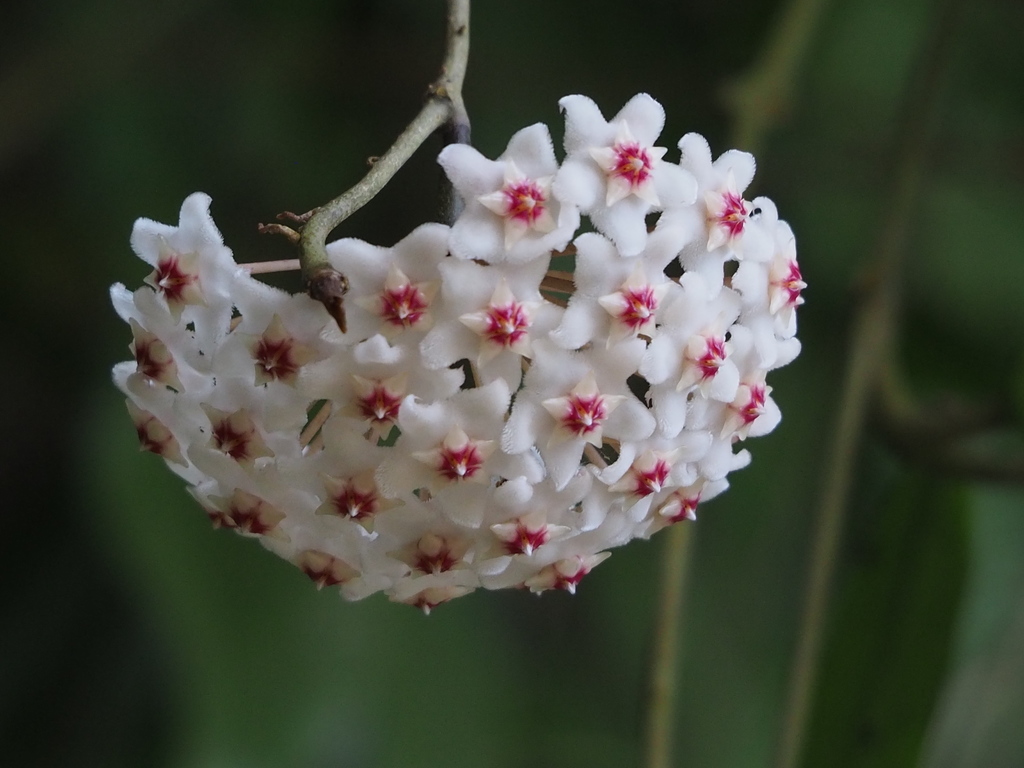
wax plant
Hoya carnosa
Hoya carnosa, the porcelain flower or wax plant, is a species of flowering plant in the family Apocynaceae, native to East Asia. It is a common house plant grown for its attractive waxy foliage, and sweetly scented flowers. It is grown well in pots and hanging baskets.
Hoya carnosa has been in cultivation for more than 200 years and has given rise to many cultivars that vary in foliage form or flower color. In cultivation in the UK it has gained the Royal Horticultural Society's Award of Garden Merit.
From the article Hoya carnosa on Wikipedia (CC BY-SA), quoted section by section
Description
Hoya carnosa makes faintly succulent shoots with smooth, pale gray, and bare surfaces that twine and climb. The perennial leaves are wide oval to longitudinal oval or heart-shaped. They are slightly succulent, fleshy with a waxy glossy surface, 3–5 centimetres (1.2–2.0 in) wide and 3.5–13 centimetres (1.4–5.1 in) long, with a petiole of about 1–1.5 centimetres (0.39–0.59 in). The spindle-shaped fruits measure 6 to 10 × 0.5 to 1.5 cm.
Flowers. The inflorescence is made up of numerous flowers, hanging or more upright, which are grouped in an umbel. The flowers are typically light pink, but may vary from near-white to dark pink; they are star-shaped, and are borne in clusters. The thick flower corollas look as if made from porcelaine or from wax, leading to the plant's common names. The surface of the flowers is covered in tiny hairs giving them a fuzzy sheen. They are heavily scented and may produce excess nectar that drips from the flowers. A single flower (corolla) has a diameter of 1.5 to 2 cm. Like most species of Hoya, H. carnosa flowers grow from specialised perennial peduncles; sometimes these structures are referred to as spurs. These appear from the axils of the leaves and stem; flowers may not be produced when the spurs first appear, but in time buds emerge from their tips. …
Range & habitat
Hoya carnosa is native to southern China (including Hainan), Taiwan, Laos and Japan (including the Ryukyu Islands).
Wikipedia: “Distribution and habitat”
How it is grown
Hoya carnosa prefers indirect bright light, but will tolerate much less. Though it will tolerate low temperatures (but not freezing), the optimal temperature is 60–85 °F (16–29 °C). It can be propagated by air layering or by stem cuttings. It benefits from an open potting medium that allows some air to get to the roots. Typical mixes include large-grade drainage material such as perlite, pumice, or ceramic balls. The plants should be fed regularly with a fertilizer suitable for epiphytic plants. There is a persistent piece of belief that hoyas prefer to be pot-bound (kept in a small pot). It is said that this will hasten flowering. Studies at the University of Georgia, published in 2009, have shown H. carnosa to be an excellent remover of pollutants in the indoor environment.
‘Compacta’. The cultivar Hoya carnosa ‘Compacta’, was first discovered as a branch mutation sport at Hummel’s Exotic Gardens of Inglewood, California, and is characterized by its folded, curled leaves and tight internodal spacing, growing in the form of a rope. It was later popularized in 1967 under the trademark “Hindu Rope” by B. L. Cobia Nursery Inc. of Winter Garden, Florida.
Wikipedia: “Cultivation”
Where it lives
Recorded sightings
—
geo-referenced records in GBIF, from museums, herbaria and field observers.
Drag the globe to turn it. Dots are where records exist, not a range map; darker means more records.
In the stacks
Searching the stacks…
Every page naming Hoya carnosa in the Biodiversity Heritage Library →
This page is assembled live from iNaturalist, GBIF, Wikipedia, the Source Library and the Internet Archive. It is not yet part of the hand-edited codex. iNaturalist taxon 129523.