- Plants
- ›Vascular Plants
- ›flowering plants
- ›monocots
- ›Agaves, Orchids, Irises, and Allies
- ›amaryllis, onions, and allies
- ›onion subfamily
- ›Allieae
- ›Allium
- ›Allium
- ›Codonoprasum
- ›Codonoprasum
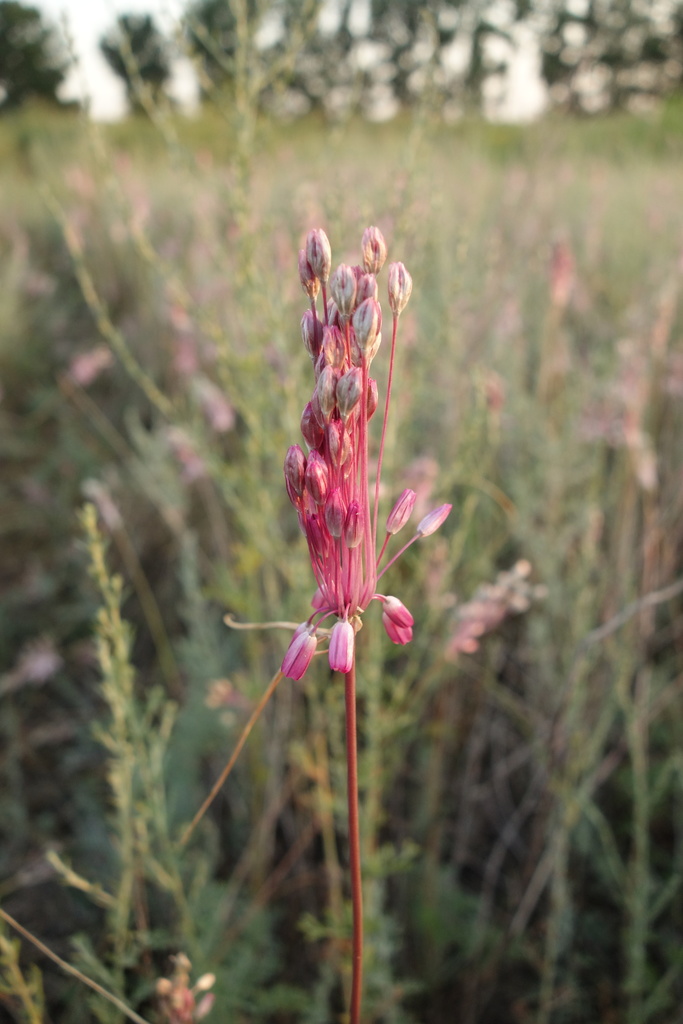
Allium praescissum
Allium paniculatum, common name pale garlic, is a species of monocot in the family Amaryllidaceae. It is widely cultivated and is now naturalized in several places outside its native range.
From the article Allium paniculatum on Wikipedia (CC BY-SA), quoted section by section
Description
Allium paniculatum produces several egg-shaped bulbs, each up to 1.5 cm across. It has no rhizomes. Leaves are tubular and hollow, up to 35 cm long. Scape is round in cross-section, solid, up to 75 cm tall. Inflorescence is (despite the name of the species referring to a panicle) an umbel with as many as 100 flowers. Flowers are bell-shaped, about 6 mm across; tepals white to lilac; pollen and anthers yellow.
Range & habitat
Allium paniculatum has been reported from every European country bordering on the Black and Mediterranean Seas, including the islands of Corsica, Sardinia, Sicily and Crete. It is also considered native in Portugal, the Czech Republic, Hungary, western Siberia, Kazakhstan, Armenia, Georgia, Azerbaijan, Iran, Iraq, Lebanon, Syria, Israel, and Palestine. It has become naturalized in California, New York State, Azores, Madeira, Canary Islands, and South Australia. Recent phylogenetic studies demonstrate that the species' true distribution is in the countries around the Black and Caspian seas, including Bulgaria, Ukraine and Crimea, European Russia, the Caucasus, Iraq, Iran, Kazakhstan, and western Siberia. In European Russia, Ukraine, and Crimea it is typically found in dry grasslands (steppes), including on ancient burial mounds, where it grows association with other steppe plants. The species has been collected in the vicinity of San Francisco Bay in California, as well as isolated locales in Essex County in northeastern New York State. This is of concern because the species has the potential to become a noxious weed. It tends to grow in disturbed sites such as roadsides, cultivated fields, etc.
== References ==
Wikipedia: “Distribution and habitat”
Where it lives
Recorded sightings
—
geo-referenced records in GBIF, from museums, herbaria and field observers.
Drag the globe to turn it. Dots are where records exist, not a range map; darker means more records.
In the stacks
Searching the stacks…
Every page naming Allium praescissum in the Biodiversity Heritage Library →
This page is assembled live from iNaturalist, GBIF, Wikipedia, the Source Library and the Internet Archive. It is not yet part of the hand-edited codex. iNaturalist taxon 1292027.