- Plants
- ›Vascular Plants
- ›flowering plants
- ›Dicots
- ›honeysuckles, moschatels, and allies
- ›honeysuckle family
- ›Scabious subfamily
- ›Knautia
- ›Trichera
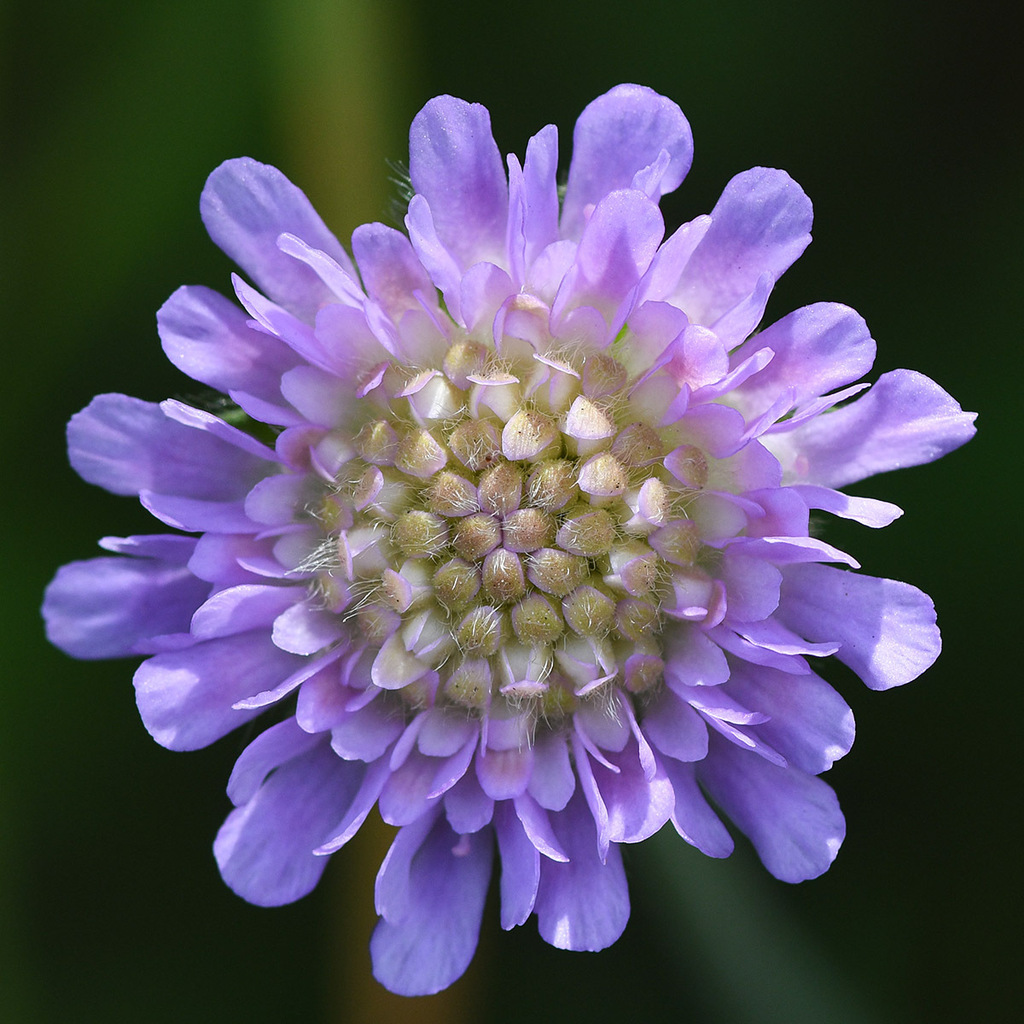
Field Scabious
Knautia arvensis
Knautia arvensis, commonly known as field scabious, is a herbaceous perennial species of flowering plant in the honeysuckle family Caprifoliaceae.
From the article Knautia arvensis on Wikipedia (CC BY-SA), quoted section by section
Description
It is a perennial plant that grows between 25 and 100 cm (9.8 and 39.4 in). It prefers grassy places and dry soils, avoiding heavy soils, and flowers between May and August. The flowers are borne on inflorescences in the form of heads; each head contains many small florets. The head is flatter than in similar species, such as devil's bit scabious (Succisa pratensis) and small scabious (Scabiosa columbaria). There are 4 stamens in each floret, and 1 notched long stigma. The fruit is nut like, cylindrical and hairy, 5–6 mm (0.20–0.24 in) in size. It has a tap root. The stem has long stiff hairs angled downwards. The leaves form a basal rosette, are paired on the stem, the lowest typically 300 mm (12 in) long, spear shaped, whereas the upper are smaller. There are no stipules.
Range & habitat
Commonly found on roadsides and field margins, and in meadows, it is particularly abundant where there is chalk bedrock.
Wikipedia: “Habitat”
What it does
It is occasionally used by the marsh fritillary as a foodplant instead of its usual foodplant of devils bit scabious (Succisa pratensis). It is also the foodplant of the narrow-bordered bee hawk-moth (Hemaris tityus).
Wikipedia: “Ecology”
Where it lives
Recorded sightings
—
geo-referenced records in GBIF, from museums, herbaria and field observers.
Drag the globe to turn it. Dots are where records exist, not a range map; darker means more records.
In the stacks
Searching the stacks…
Every page naming Knautia arvensis in the Biodiversity Heritage Library →
This page is assembled live from iNaturalist, GBIF, Wikipedia, the Source Library and the Internet Archive. It is not yet part of the hand-edited codex. iNaturalist taxon 129115.