- Plants
- ›Vascular Plants
- ›flowering plants
- ›monocots
- ›grasses, sedges, cattails, and allies
- ›grasses
- ›Pooideae
- ›Wheats, ryes, barleys and relatives
- ›barleys, ryes, and relatives
- ›Hordeum
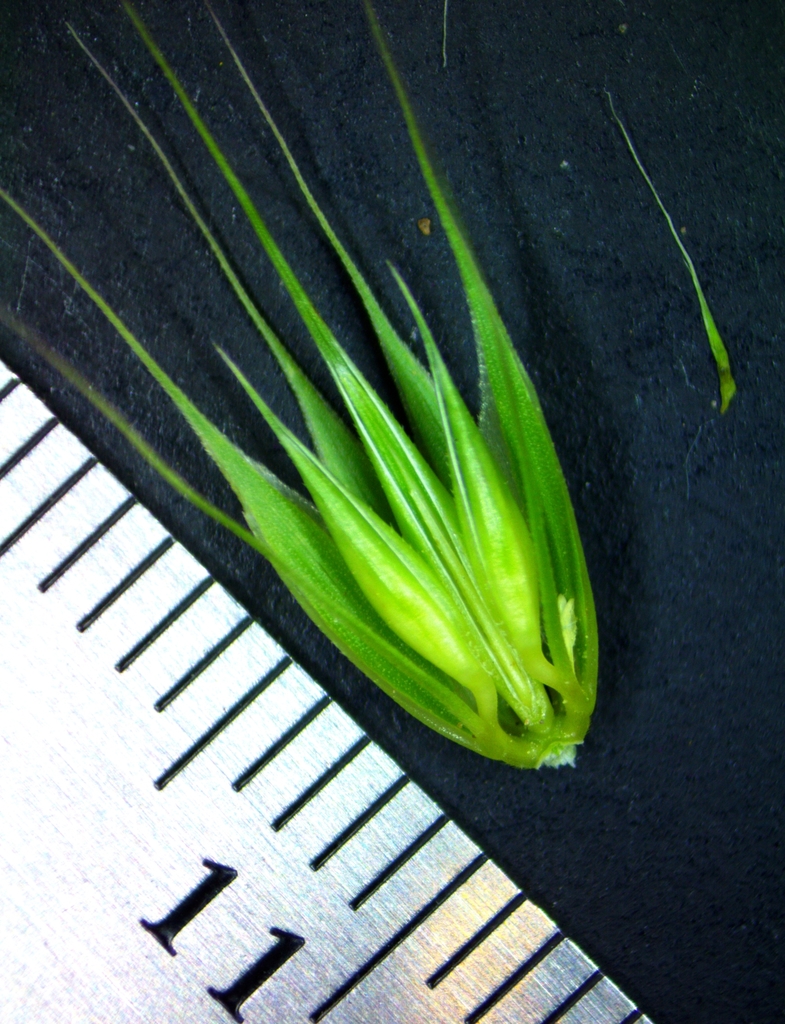
little barley
Hordeum pusillum
Hordeum pusillum, also known as little barley, is an annual grass native to most of the United States and southwestern Canada. It arrived via multiple long-distance dispersals of a southern South American species of Hordeum about one million years ago. Its closest relatives are therefore not the other North American taxa like meadow barley (Hordeum brachyantherum) or foxtail barley (Hordeum jubatum), but rather Hordeum species of the Pampas of central Argentina and Uruguay. It is less closely related to the Old World domesticated barley, from which it diverged about 12 million years ago. It is diploid.
From the article Hordeum pusillum on Wikipedia (CC BY-SA), quoted section by section
Description
First described in 1818 by Thomas Nuttall, Hordeum pusillum, also known as little barley, is an annual flowering plant native to the majority of North America, mainly the United States and southwestern Canada. It is a member of the subfamily Pooideae in the grass family Poaceae. The plant itself is approximately 14–40 cm (5.5–15.7 in) tall and is self-fertilizing. Leaves and spikelets are alternate. The flat, pubescent leaves can range anywhere from 2.4–12.7 cm (0.94–5.00 in) in length and 2.0–4.5 mm (0.079–0.177 in) wide. The sheath of little barley can be either glabrous or pubescent and wraps loosely around the stem. The inflorescence ranges between 4–8 cm (1.6–3.1 in) long. Of the three alternating floral spikelets, only one is fertile. The plant's growth period is during the winter months, producing mature grains by April. The roots are fibrous, and the mark of a mature spikelet is when they turn a tan to brown color. The stem changes from a bluish-green color to brown as the plant matures. Its habitat is in sunny locations on dry gravely soils, rock outcrops, roadsides, railroads, waste places, in grasslands, and on marsh edges.
What it does
Pollination occurs during the winter through the summer. The center spikelet is fertile whilst the lateral spikelets are male and infertile.
Wikipedia: “Pollination”
At the table
The small grains are edible, and this plant was part of the Eastern Agricultural Complex of cultivated plants used in the Pre-Columbian era by Native Americans. Before being displaced by agriculture based on maize, little barley may have been domesticated.
Wikipedia: “Uses”
In human culture
Hordeum comes from the Latin word horreō, horrēre "to bristle " and pusillum is the "nominative neuter singular of pusillus"- "very little, very small, tiny."
Wikipedia: “Etymology”
Where it lives
Recorded sightings
—
geo-referenced records in GBIF, from museums, herbaria and field observers.
Drag the globe to turn it. Dots are where records exist, not a range map; darker means more records.
In the stacks
Searching the stacks…
Every page naming Hordeum pusillum in the Biodiversity Heritage Library →
This page is assembled live from iNaturalist, GBIF, Wikipedia, the Source Library and the Internet Archive. It is not yet part of the hand-edited codex. iNaturalist taxon 129018.