- Animals
- ›Chordates
- ›Vertebrates
- ›Birds
- ›Perching Birds
- ›Ovenbirds and Woodcreepers
- ›Typical Ovenbirds
- ›Dendroma
On eBird ↗
Buff-fronted Foliage-gleaner
Live sightings near you, the range map, bar charts of when it is seen, and Macaulay Library photos and recordings.
Buff-fronted Foliage-gleaner
Dendroma rufa
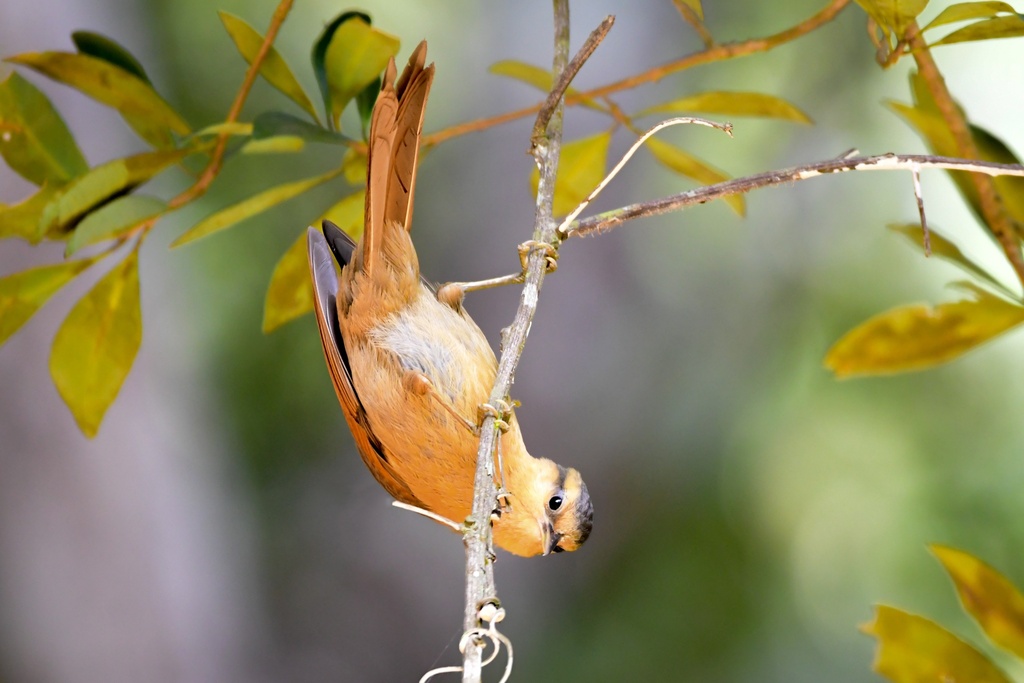
The buff-fronted foliage-gleaner (Dendroma rufa) is a species of bird in the Furnariinae subfamily of the ovenbird family Furnariidae. It is found in Argentina, Bolivia, Colombia, Costa Rica, Ecuador, Panama, Peru, and Venezuela.
From the article Buff-fronted foliage-gleaner on Wikipedia (CC BY-SA), quoted section by section
Description
The buff-fronted foliage-gleaner is 18 to 19 cm (7.1 to 7.5 in) long and weighs 25 to 36 g (0.88 to 1.3 oz). It is a largish furnariid. The sexes have the same plumage. Adults of the nominate subspecies D. r. rufa have an ochraceous forehead ("front") that continues into a wide supercilium, a dark brownish gray line behind the eye, dark brownish gray lores, and ochraceous ear coverts and malars. Their crown behind the forehead is dull brownish gray with almost invisible paler streaks. Their upper back is dull brownish gray becoming ochraceous brown on the lower back. Their rump and uppertail coverts are a slightly paler ochraceous brown. Their wings are mostly bright rufous with darker primary coverts. Their dull rufous-brown tail has pointed feather tips. Their throat and breast are glowing ochraceous that fades to the duller ochraceous of their belly, flanks, and undertail coverts. Their iris is grayish brown to dark brown to chestnut, their maxilla blackish to dark grayish, their mandible silvery gray to olive, and their legs and feet olive to grayish green. Juveniles have a narrower forehead band than adults, with a paler crown and darker and more rufescent underparts. Subspecies D. r. chapadensis has a deeper ochraceous forehead than the nominate, and a paler gray crown with a few ochraceous spots and richer colors on the back. D. r. …
Range & habitat
The buff-fronted foliage-gleaner has a highly disjunct distribution, with at least seven general areas represented and smaller areas within some of them. The subspecies are found thus:
D. r. panerythra: spottily in the highlands of Costa Rica and Panama and also in the Central and Eastern Andes and separate Serranía de San Lucas of Colombia D. r. riveti: Colombia's Western Andes and south through most of western Ecuador D. r. columbiana: northern Venezuela's Sierra de San Luis and Coastal Range D. r. cuchiverus: southern Venezuela's Cerro Calentura and Cerro El Negro D. r. boliviana: east slope of the Andes from Napo Province in Ecuador south through eastern Peru into central Bolivia D. r. chapadensis: mostly in Brazil's Mato Grosso and Goiás states, and recorded in Tocantins D. r. rufa: eastern and southeastern Brazil from Bahia south to Rio Grande do Sul and west and south through Mato Grosso do Sul and eastern Paraguay into northeastern Argentina The buff-fronted foliage-gleaner populations in Central America, northern South America, and the Andes inhabit humid foothill and montane forest. In Central America the species occurs at elevations between 800 and 2,500 m (2,600 and 8,200 ft) and in northern and western South America between 600 and 2,000 m (2,000 and 6,600 ft). …
Wikipedia: “Distribution and habitat”
What it does
The buff-fronted foliage-gleaner feeds on a wide variety of adult and larval arthropods. It typically forages singly or in pairs, and usually in mixed-species feeding flocks. It mostly forages in the forest's subcanopy and canopy though it will do so lower. It works along horizontal branches and acrobatically gleans its prey, primarily from live leaves and also dead leaves, bark, moss, and debris, sometimes hanging nearly upside down to reach their undersides.
Wikipedia: “Feeding”
Listen
Looking for field recordings…
Where it lives
Recorded sightings
—
geo-referenced records in GBIF, from museums, herbaria and field observers.
Drag the globe to turn it. Dots are where records exist, not a range map; darker means more records.
In the stacks
Searching the stacks…
Every page naming Dendroma rufa in the Biodiversity Heritage Library →
This page is assembled live from iNaturalist, GBIF, Wikipedia, the Source Library and the Internet Archive. It is not yet part of the hand-edited codex. iNaturalist taxon 1289538.